
Friends Don’t Lie: Mining Personality Traits from the Fabric of Social Structure
Friends don't lie: inferring personality traits from social network structure
The paper introduces a method for predicting Big-Five personality traits by analyzing the structural properties of social networks derived from smartphone data (Call logs and Bluetooth proximity). Using Random Forest classifiers, it demonstrates that network-level features—specifically those related to ego-networks—can accurately categorize traits like Extraversion and Openness, outperforming traditional survey-based metrics.
TL;DR
Can your smartphone’s Bluetooth logs tell researchers more about your personality than a standardized test? This study suggests the answer is a resounding "Yes." By shifting the focus from how much we use our phones to how our social networks are structured (who knows whom in our circle), researchers achieved up to 80% accuracy in predicting traits like Extraversion. The core takeaway: our social topology is a mathematical mirror of our psychological disposition.
Problem & Motivation: Beyond Self-Reports
For decades, social psychology has relied on the "Big Five" model (Agreeableness, Conscientiousness, Extraversion, Neuroticism, and Openness). Traditionally, these are measured via surveys—long-form questionnaires that assume users have perfect self-awareness and honesty.
The authors of this paper identify a critical gap in early "Mobile Sensing" research. Most early attempts to use phone data for personality detection looked at Actor-Based Features—purely quantitative metrics like the number of calls made or total minutes spent talking. The authors argue that this is too shallow. Instead, they propose looking at Network-Based Features, specifically "ego-networks" (the web of relationships surrounding a single person), to see if the shape of our social life reveals our inner traits.
Methodology: The Geometry of Friendship
The researchers monitored 53 subjects over eight weeks, collecting call logs, Bluetooth proximity data (sensing who was physically near whom), and traditional surveys.
They didn't just count friends; they analyzed the topology of these connections using four main categories of features:
- Centrality: Are you a "hub" (Degree) or a "bridge" (Betweenness) between disconnected groups?
- Efficiency: How fast does information spread through your immediate circle?
- Transitivity: If you have two friends, do they also know each other? This measures "clustering."
- Triadic Census: Counting the specific combinations of strong, weak, and non-existent ties among sets of three people.

The brilliance of this approach is its use of Bluetooth Proximity Networks. Unlike call logs, which only show active communication, Bluetooth shows physical social gatherings, capturing a more raw and honest picture of social behavior.
Experiments & Results: Bluetooth is King
The study used Random Forest classifiers to predict whether a user scored "High" or "Low" on each Big Five trait. The results were striking:
- The Superiority of Physical Proximity: Bluetooth networks (BT) significantly outperformed Call networks and even the self-reported Survey networks.
- Extraversion: Achieved a peak accuracy of 79.74% using transitivity markers in the Bluetooth network. Extraverts tend to have "closed" triads—they introduce their friends to each other.
- Openness and Agreeableness: These traits were best recognized via network structure, with Openness showing a strong relationship with how "connected" one's egonet is.
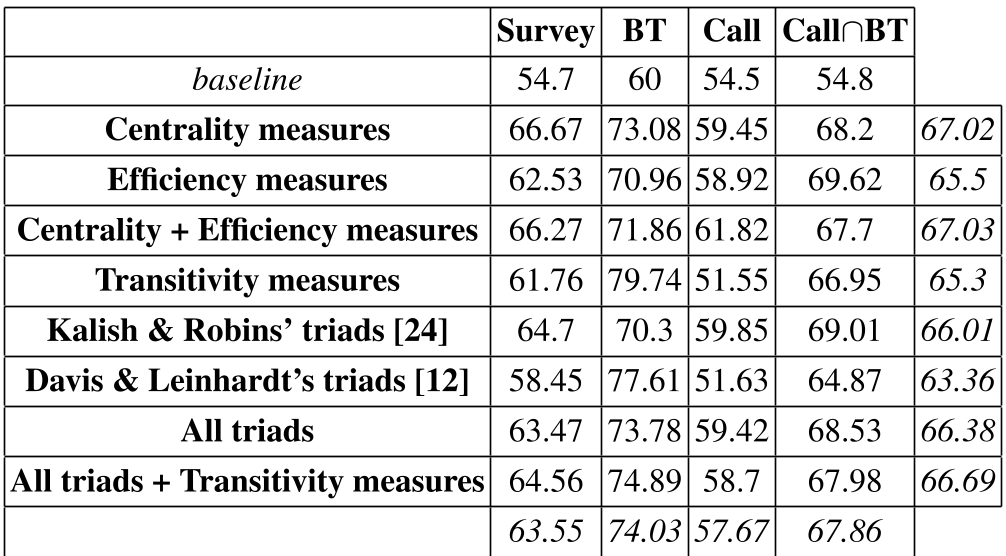
One of the most profound findings was the Ablation-style comparison between actor-based features and network-based features. As shown in the comparison tables, simply knowing the structure of your network (who your friends' friends are) provides a much higher signal for personality classification than knowing how many calls you make.
Critical Insight: Why Does It Work?
Why does network structure beat simple usage stats? The authors suggest that personality traits are "enduring dispositions" that actively shape our environment.
- Extraverts act as social "glues," creating dense, highly transitive clusters (cliques).
- Individuals high in Neuroticism might show different patterns in call networks vs. proximity networks, reflecting anxieties that manifest as "centrality" in digital communication but perhaps "isolation" in physical spaces.
Conclusion & Future Outlook
The study concludes that "Friends don't lie," but more accurately, the structure formed by those friendships doesn't lie. This has massive implications for:
- Persuasive Technology: Apps that adapt their tone based on your inferred personality.
- UI/UX Customization: Interfaces that change layout according to whether a user is "Open" or "Conscientious."
While the sample size (53 subjects) is a limitation common to 2012-era ubiquitous computing studies, the blueprint provided here—using graph theory to decode human psychology—remains a cornerstone for modern social computing.
Final Takeaway
If you want to know who someone is, don't ask them, and don't count their texts. Look at the map of their relationships. The topology of our social lives is the most honest CV we never wrote.