
Can Friends Be Trusted? The High Cost of Transitive Trust on Social Media
Can Friends Be Trusted? Exploring Privacy in Online Social Networks
This paper presents a behavioral case study on Facebook privacy, quantifying how users divulge sensitive personal data to adversarial profiles. It characterizes social structures into passive and active friendship graphs and concludes that "friend-of-a-friend" connections significantly increase the likelihood of trust privacy breaches.
In the digital age, a "friend" is often just a click away. But is that click a bridge to a relationship or a door for an adversary? This seminal study by Frank Nagle and Lisa Singh explores the fragile boundary between social connectivity and personal security within online social networks (OSNs).
TL;DR
This research investigates how much personal information Facebook users share with strangers. By deploying automated "adversary" profiles, the researchers found that while users are generally cautious with total strangers (19% acceptance), they are nearly three times more likely (55%) to accept a friend request if they share a mutual connection. This "transitive trust" allows attackers to harvest sensitive data like birthdates and phone numbers with alarming ease.
The Problem: The "Open by Default" Trap
The core issue identified by the authors is the architectural "Inductive Bias" of social platforms. Most OSNs are designed for discovery, meaning they are often "open by default."
The authors define two types of connections:
- Passive Friendship Links: Edges formed simply by belonging to the same network (e.g., a university or workplace).
- Active Friendship Links: Explicitly confirmed connections where users believe they are sharing data with trusted individuals.
The danger lies in the Trust Privacy Breach: when an adversary infiltrates an active graph by exploiting the social validation of a mutual friend.
Methodology: Engineering the Adversary
To test this, the researchers created four personas:
- Izzie: High school female.
- Kate: College female.
- Jane: Working professional.
- Abe Simpson: A known cartoon character.
They utilized a Python-based automated module to send requests and scrape profile data, moving through the social graph in two distinct phases.
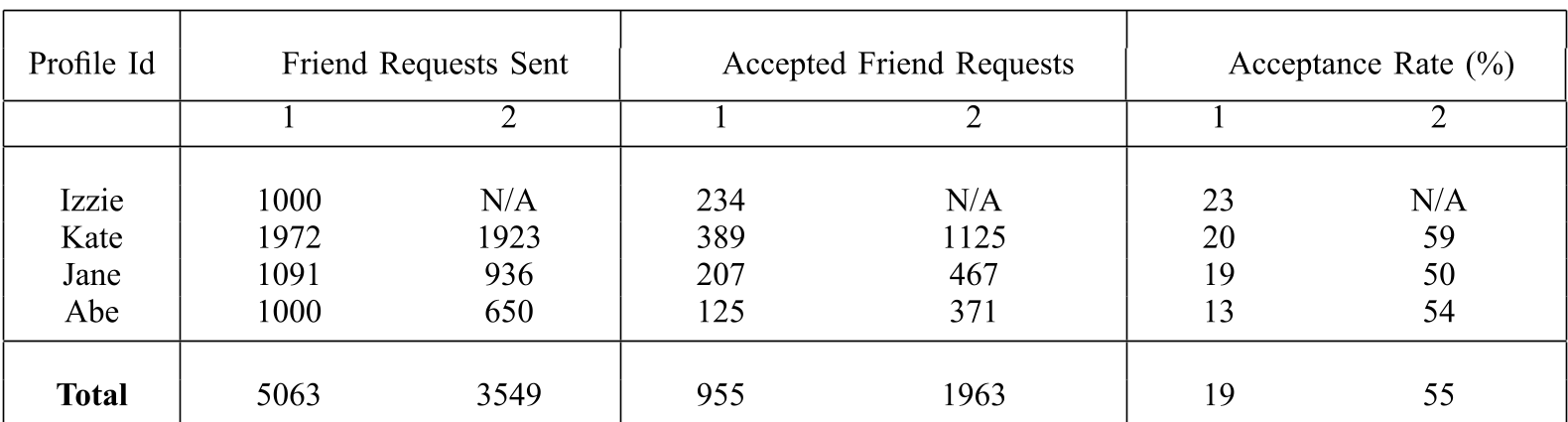 Table 1: The jump in acceptance rates from Iteration 1 (Strangers) to Iteration 2 (Mutual Friends) is stark across all profiles.
Key Insights from the Data
The results reveal a massive disparity in how we perceive risk:
- The Power of One Mutual Friend: Having even a single mutual friend caused the acceptance rate for the fake "Abe Simpson" profile to jump from 13% to 54%. This suggests that users stop vetting the authenticity of a profile once it is "vouched for" by the network.
- Data Goldmine: Once the request was accepted, the "privacy curtain" fell entirely. 94% of users shared their birthday, and 90% shared their email.
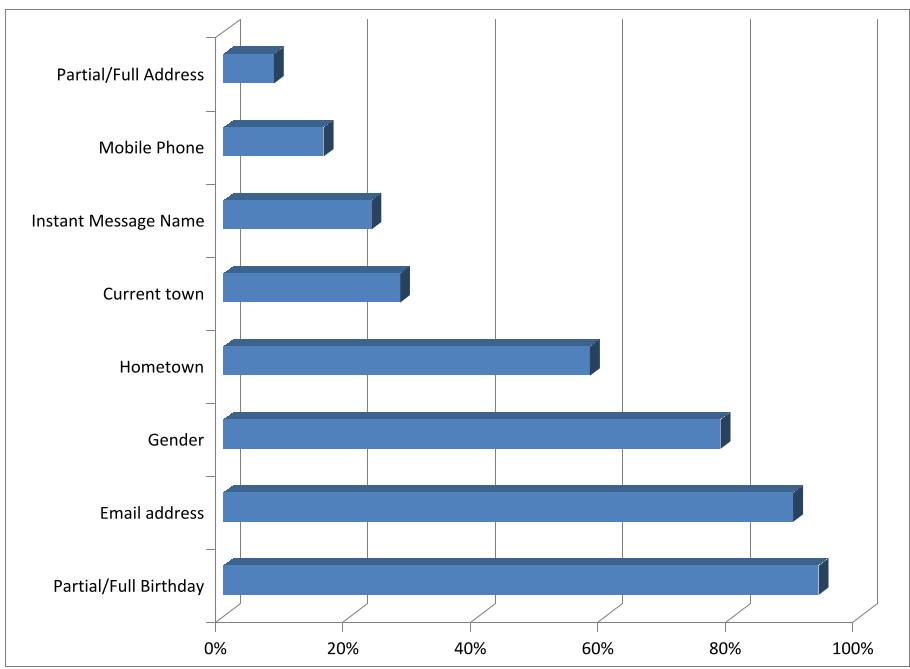 Figure 1: Percentage of users revealing sensitive demographic and contact info to "active friends."
Critical Analysis: Why This Matters Today
While this study was conducted in the earlier days of Facebook, the psychological mechanism it exposes—Transitive Trust—remains the backbone of modern social engineering.
- The Paradox of Trust: Users feel safe because they believe their "Active Friendship Graph" is a curated circle of trust. However, the study shows this circle is easily penetrable.
- Gender Bias: The study noted that males were more likely to list mobile phones and accept requests, suggesting varying risk thresholds across demographics.
- Platform Limits: The authors noted that Facebook began implementing "rate limits" to stop such bots—a cat-and-mouse game that continues today with AI-generated deepfake profiles.
Conclusion: Beyond a "Friend" Request
The takeaway is clear: your privacy is only as strong as the weakest link in your friends' network. If your friend accepts a malicious adversary, your "private" data is likely just one transitive link away from being compromised.
Future Outlook: Modern research must now address how LLM-powered bots can create even more convincing conversational "hooks" to exploit this 55% acceptance rate, moving from simple profile scraping to active identity theft and phishing.