
See Friendship, Sort of: How Data and Dialogue Shape Our Memories
See Friendship, Sort of: How Conversation and Digital Traces Might Support Reflection on Friendships
This paper explores how digital traces (Social Media data) and collaborative conversation support reflection on friendships. By studying 28 participants using Facebook’s "See Friendship" tool, the authors identify key practices in relationship reminiscence and propose design considerations for systems that facilitate social reflection.
TL;DR
Is a digital archive of your friendship an accurate mirror of your bond, or just a curated highlight reel? This CSCW research investigates how Facebook's digital traces and face-to-face conversations help (or hinder) the way we reflect on our friendships. The study reveals that while data makes reminiscing fun and easy, it often sanitizes our history by focusing on the "positive and public," suggesting that future tools need to embrace the "messy" and "mundane" aspects of human connection to be truly transformative.
Problem & Motivation: The Gap in Lifelogging
For years, the HCI community has focused on "Total Capture"—the idea that recording every email, photo, and heartbeat would eventually lead to better self-understanding. However, authors Sosik, Zhao, and Cosley argue that we haven't spent enough time considering the end use of this data.
Specifically, relationships aren't just lived; they are reflected upon. We tell stories to make sense of our past. Existing tools are often:
- Too Individual-Centric: Designed for one person looking at a screen, ignoring that we often reminisce with the people we care about.
- Technically Driven: Focused on timestamps and authorship rather than the "emotional essence" of a friendship.
The authors set out to see if tools like Facebook’s "See Friendship" page could actually serve as a meaningful environment for relationship reflection.
Methodology: The Lab as a Prism
The researchers brought 28 participants into the lab and split them into three "reflection" modes:
- Solo / No Data: Thinking about a friend for 5 minutes with no aids.
- Solo / Data: Using the Facebook "See Friendship" page alone.
- Pairs / Data: Exploring the "See Friendship" page with the friend in question.
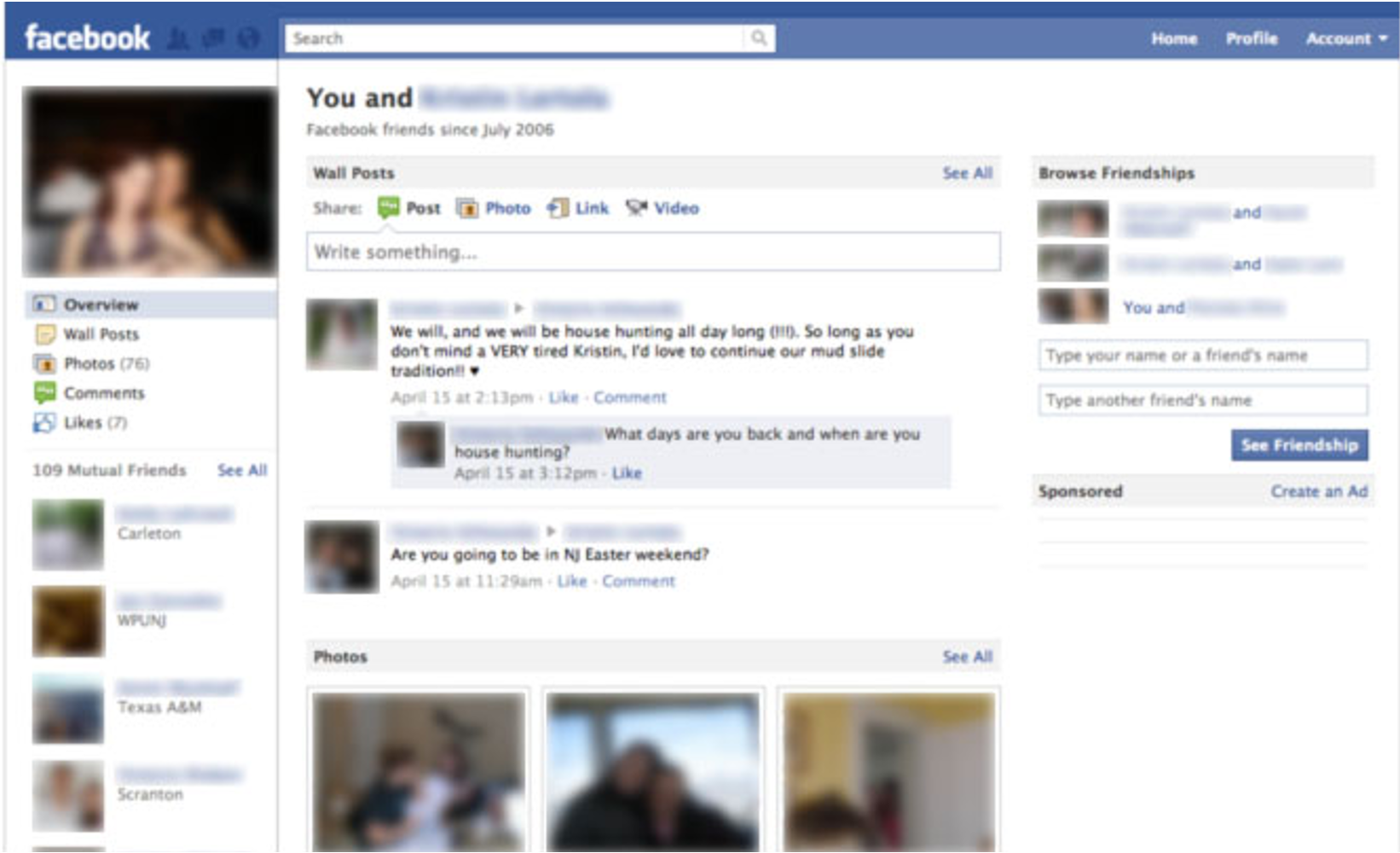 Figure 1: The "See Friendship" interface served as the primary instrument for providing digital traces (Wall posts, mutual photos, and events).
Key Insights: Why Data Isn't the Full Story
The study yielded several "Aha!" moments that challenge our assumptions about social data:
1. Data Sharpens, but Also Limits
Digital traces act as a "cognitive crutch." Participants using Facebook were able to recall specific dates and photos with ease. However, this came at a cost: they focused almost exclusively on what was on the screen. They neglected the deeper, more "traumatic" or "mundane" events that actually bonded them but weren't "Facebook-worthy."
2. The "Positivity Bias"
Reflection with data and friends is exponentially more "fun" and "positive." But relationship growth often requires grappling with the negative. Facebook's public-facing nature means it captures the "Inside Jokes" and "Happy Birthdays," but misses the private apologies or the quiet support during a crisis.
3. Reflection is Socially Embedded
Surprisingly, participants used the tool to "stalk" third parties. They compared their own friendships to others' "See Friendship" pages to gauge their social standing. Reflection, it turns out, is not just about "us"—it's about "where do we sit in the world?"
Experiments & Results
While the study was qualitative, the researchers used the Interpersonal Solidarity Scale (ISS) to measure closeness.
- Finding: Pairs who reflected together with data showed a significant increase in closeness compared to those who reflected alone without data.
- Internal Critique: The authors wisely noted that this might be "social pressure"—it’s hard to tell a researcher you feel less close to someone while they are sitting right next to you!
The "Representation" Conflict
One-third of participants felt the data was misleading. For example, a "wall-post-heavy" friendship might look close, but it could be superficial compared to a friend you text privately 100 times a day.
Critical Analysis & Future Outlook
The core takeaway is a paradox: The gaps in the data are where the meaning happens.
Design Recommendations:
- Embrace Ambient Reflection: Systems shouldn't just be archives; they should be "storytelling partners."
- Support the Mundane: Future tools should find ways to prompt memories of the "boring" stuff—cooking together or a random walk—as these are the true glue of friendship.
- Private vs. Public: We need "Private Relationship Spaces" that can aggregate sensitive data (like IMs and SMS) without the fear of third-party "creeping."
Conclusion
"See Friendship" is a misnomer; it's more like "See Interaction." To truly support reflection, technology must move beyond being a mere "data filter" and become a canvas for the messy, beautiful, and often un-capturable narratives of human connection.