
Friendship Maintenance: Why Your Twitter and Instagram Worlds Rarely Overlap
Friendship Maintenance and Prediction in Multiple Social Networks
This paper presents a comprehensive study on friendship maintenance across multiple Online Social Networks (OSNs), specifically Twitter and Instagram. It introduces novel measures for "Friendship Similarity" and "Friendship Evenness" and proposes a supervised link prediction framework that leverages cross-network behavioral features.
TL;DR
Do you have the same friends on Twitter as you do on Instagram? According to Roy Lee and Ee-Peng Lim’s research, the answer is likely "no." By analyzing 100,000 users active on both platforms, this study reveals that while we keep the same number of friends across sites, we strategically curate different communities. More importantly, they prove that your behavior on one platform can be a "dead giveaway" for predicting your relationships on another.
Background: The Multi-OSN Puzzle
In the modern digital landscape, 52% of online users engage with two or more social networks. This presents a cognitive challenge: do we replicate our social circles for ease of maintenance, or do we "partition" our friends based on platform utility (e.g., professional, personal, or interest-based)?
This paper positions itself at the intersection of Social Network Analysis and Machine Learning, moving beyond single-network silos to understand the "Higher-Order" social structure of a user's digital life.
The "Why": Motivation & Social Intuition
The authors speculate that users exhibit varied behaviors across networks to cater to different "audiences." If your Instagram is for high-school friends and your Twitter is for professional networking, the overlap should be minimal.
To quantify this, they introduce two critical metrics:
- Friendship Similarity (FSim): Measures the intersection of your friend lists.
- Friendship Evenness (Feven): Measures if you distribute your social energy equally (in terms of count) between platforms.
Methodology: The Core Framework
The researchers built a massive dataset of ~100k users. Since API data rarely links accounts explicitly, they used a multi-level matching strategy (Self-report > Username > Username Bigram) to identify the same individuals across both platforms.
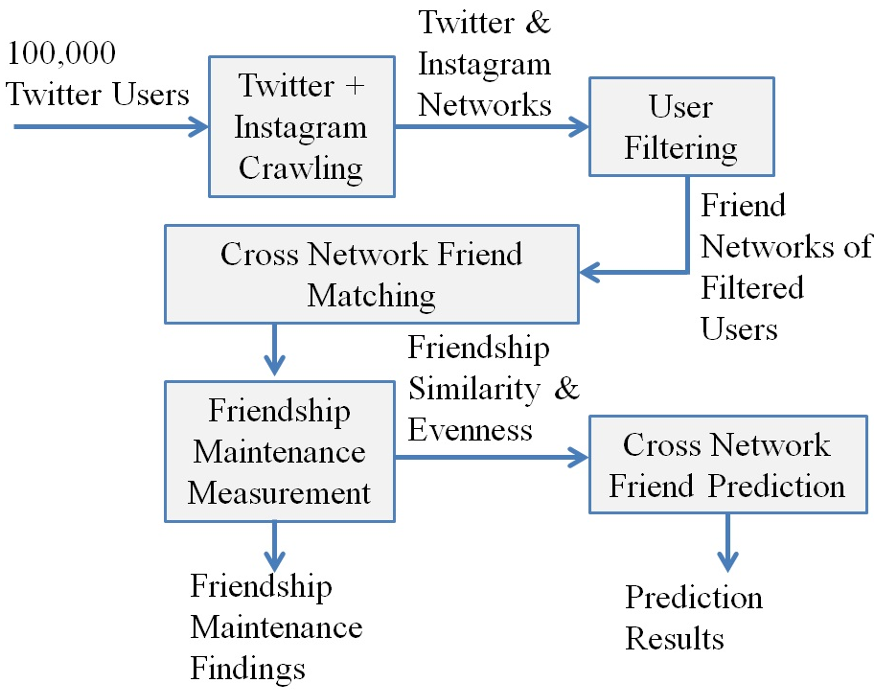
The Link Prediction Task
The most technically rigorous part of the paper is the link prediction experiment. They didn't just look at who you follow, but who your common friends follow. They categorized common neighbors based on their own maintenance styles (e.g., High Evenness/Low Similarity) to see if these "bridge" users were better predictors of a missing link.
Critical Findings & SOTA Comparison
Two major paradoxes emerged from the data:
- The Low-Similarity Paradox: Users prefer to maintain different friends (avg similarity of ~10%), keeping only a tiny "inner circle" of common friends.
- The High-Evenness Stability: Despite having different friends, users tend to maintain roughly the same volume of friends on both sites.
Performance Benchmarks
The study discovered that Instagram data is a better predictor of Twitter links than Twitter data is of itself. Using the Jaccard Coefficient of Instagram neighbors (JCI) to predict Twitter links yielded an F1 score of 0.882, significantly outperforming traditional single-network baselines.

By moving to a supervised SVM model with "Friendship Maintenance" features (NFM), the accuracy jumped to 0.93-0.95, proving that how your friends manage their networks tells you a lot about who you will connect with next.
Critical Insight & Conclusion
This work challenges the notion that social networks are independent graphs. It suggests that our social identity is a Multi-layer Manifold where the absence of a link in one layer (Twitter) can be inferred by the "shadow" cast in another layer (Instagram).
Future Work & Limitations: While the study is robust for Twitter and Instagram, the dynamics might change when comparing "Work" networks (LinkedIn) with "Leisure" networks (TikTok). The structural intuition remains: your cross-network footprints are more connected than your friend lists suggest.