
Utilizing the Friendship Paradox: A New Frontier in Social Network Inference
The Friendship Paradox: Implications In Statistical Inference Of Social Networks
This paper explores the "Friendship Paradox" as a form of observation bias in social networks and its recent generalizations to directed graphs. It demonstrates how this paradox can be leveraged for more efficient statistical inference, specifically for polling network attributes and estimating power-law degree distributions.
TL;DR
The "Friendship Paradox"—the statistical reality that your friends, on average, have more friends than you do—is often viewed as a social quirk. However, this paper reveals it to be a potent tool for statistical inference. By purposefully sampling the "friends" of random nodes, researchers can reduce variance in public opinion polling and significantly improve the accuracy of estimating power-law degree distributions in massive networks.
Background: Beyond a Social Curiosity
At its core, the friendship paradox is an observation bias. In any undirected graph, high-degree nodes (social "hubs") are overrepresented when we look at the neighbors of individuals. Since a node with 100 friends is linked to 100 people, it is 100 times more likely to be someone's "friend" than a node with only one connection.
The authors position this work as a bridge between graph theory and practical statistical estimation, moving from the what (describing the paradox) to the how (exploiting it for better math).
The Core Intuition: Why Biased Sampling Wins
Standard statistical techniques usually strive for "unbiased" uniform sampling. However, in networks with heavy tails (where a few nodes have massive influence), uniform sampling often misses the very hubs that define the network's structure.
By sampling a random friend instead of a random node, we are effectively performing degree-proportional sampling. This "biased" approach provides more information about the network's tail—the area where standard MLE (Maximum Likelihood Estimation) usually fails due to data scarcity.
Methodology 1: Neighborhood Expectation Polling (NEP)
In traditional "Intent Polling," you ask: "Who are you voting for?" In "Neighborhood Expectation Polling," you ask: "What fraction of your friends are voting for X?"
Because of the friendship paradox, the people being "observed" by the respondents are higher-degree nodes. This effectively increases the sample size and weights the most influential nodes more heavily, leading to a stabilizer effect on the variance.
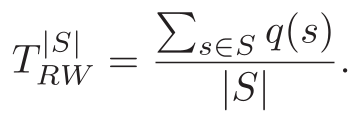 Algorithm 1: Exploiting random walks to gather neighbor expectations.
Methodology 2: Improving Power-Law Estimation
Estimating the exponent of a power-law distribution () is notoriously difficult because data points for large are rare. The authors derive a new MLE formula based on the Neighbor Degree Distribution :
By using the degrees of sampled neighbors () rather than random nodes, the estimator becomes:
Experimental Evidence: SOTA vs. FP-MLE
The results are striking. When compared against the standard Clauset et al. (2009) MLE approach, the friendship paradox-based estimator shows a significant reduction in Mean-Squared Error.
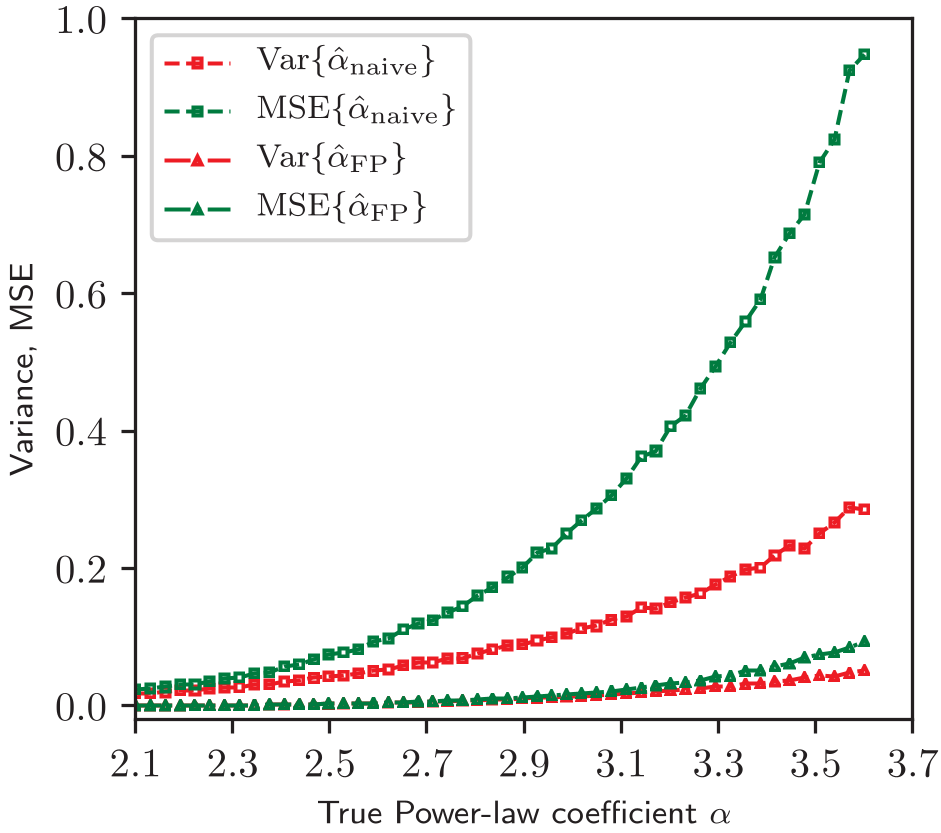 Fig 2: Empirical variance and MSE comparison. The FP-based MLE (red) consistently stays closer to the ground truth than the naive uniform approach (blue).
In polling simulations (Fig 1, not shown here but discussed in text), the NEP method demonstrated a lower variance because it leverages the "wisdom of the crowd" through the lens of social hubs.
Critical Insight & Conclusion
Why this matters
Most AI and social science models struggle with "black swan" events or extreme outliers. This paper proves that in social networks, the outliers (hubs) are the features, not the bugs. By leaning into the friendship paradox, we can:
- Survey better: Get more accurate election or health data with fewer samples.
- Model better: Characterize the backbone of the internet or social media with higher mathematical precision.
Limitations
The method assumes the graph is connected and non-bipartite for the random walk logic to hold. Additionally, the "Generalized Friendship Paradox" (attributes like happiness or income) requires a positive correlation between degree and the attribute; if high-degree nodes are outliers in a negative way, the bias could actually harm estimation.
Takeaway: In the world of networks, being "unbiased" is often a disadvantage. Precision comes from knowing exactly how to use the bias of the structure.