
Designing Social Ties for Objects: The Science of SIoT Navigability
Friendship Selection in the Social Internet of Things: Challenges and Possible Strategies
This paper explores "Friendship Selection" strategies in the Social Internet of Things (SIoT) to optimize service discovery and network navigability. The authors propose five local heuristics and demonstrate that minimizing local clustering leads to surprisingly superior local navigability by preventing hub saturation.
TL;DR
As the Internet of Things (IoT) matures into the Social Internet of Things (SIoT), objects are no longer just passive sensors—they are social agents. This paper tackles a critical question: In a world of billions of devices, how should an object choose its "friends" to ensure that any service in the network is just a few hops away? The authors find that the best way to keep the network searchable is often counter-intuitive: objects should avoid befriending those who are already part of their tight-knit circles.
The Scalability Wall in IoT
Traditional IoT search engines are centralized. When you have hundreds of billions of RFIDs and sensors, a central server becomes a massive bottleneck. The SIoT paradigm shifts this to a decentralized discovery model, mimicking the "Small World" phenomenon in human societies. However, unlike humans, objects have strict computational and battery constraints. They cannot have infinite friends. If we limit the number of connections (), we risk breaking the network's ability to be "navigable."
Methodology: Five Heuristics for Friendship
The authors tested five logic-based strategies for when an object reaches its connection limit and needs to decide whether to accept a new "friendship" request:
- Static: Refuse all new requests.
- Max-Degree: Keep friends who have the most connections (Hub-seeking).
- Min-Degree: Keep friends with fewer connections (Equalizing).
- Max-Clustering: Keep friends who share common friends (Creating cliques).
- Min-Clustering: Keep friends who bring unique, non-overlapping connections.
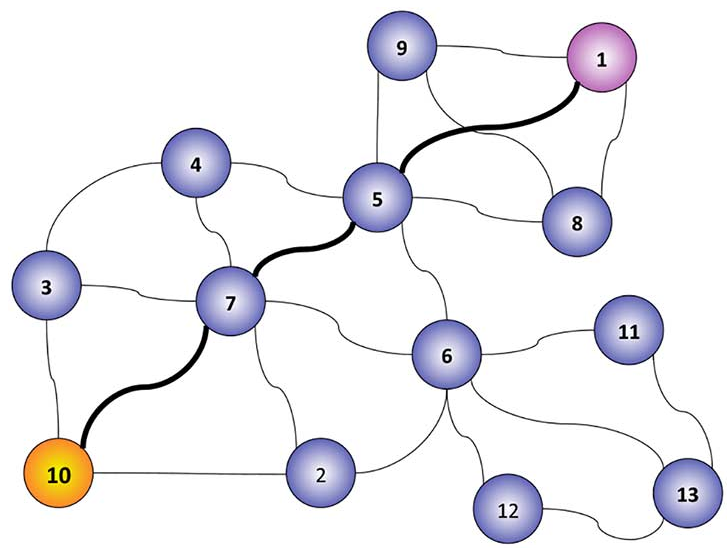 Figure 1: Example of an object deciding between potential social ties based on degree and clustering.
The "Small World" Paradox
In human sociology, high clustering (friends of friends being friends) is a hallmark of social networks. However, this study reveals an unexpected twist for SIoT: Minimizing local clustering (Strategy 5) is superior for local navigability.
Why does this happen?
When is low (e.g., an object can only have 10 friends), a network can easily become "congested" with hubs that all have the same maximum degree. If every "popular" node is capped at 10 connections, they no longer stand out as pointers to the rest of the network. By minimizing clustering, nodes are forced to create "long-range" ties, which preserves the network's power-law distribution and prevents the formation of isolated, redundant cliques.
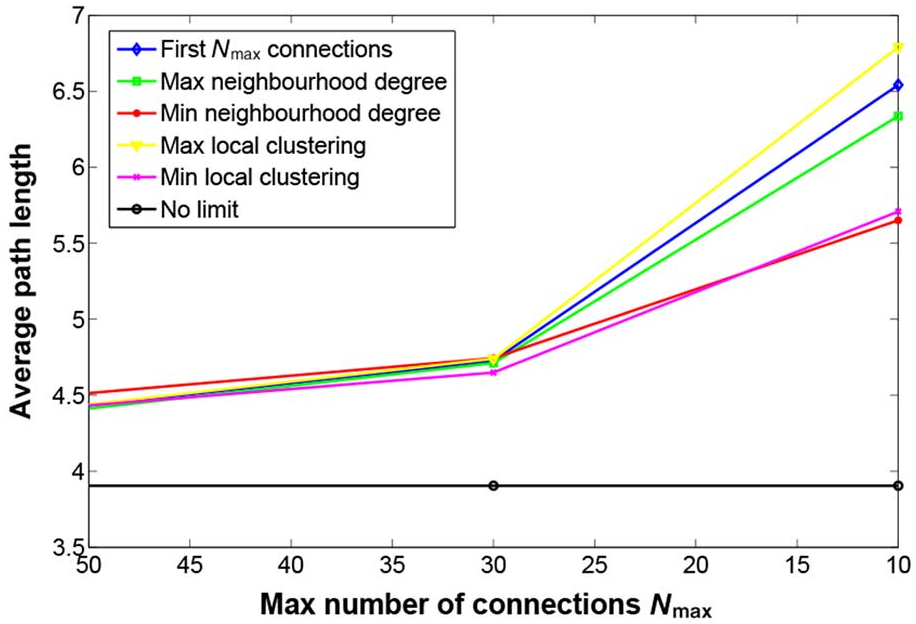 Figure 2: Performance comparison showing that minimizing clustering (Strategy 5) maintains lower path lengths as connectivity limits tighten.
Dynamic Hub Management
Because static limits can damage navigability, the authors propose a Dynamic Threshold. By monitoring the global percentage of "hubs" (nodes hitting their ), the system can signal objects to increase their capacity by 10% if the network structure begins to deviate too far from a scale-free power law.
Critical Insight & Conclusion
This paper proves that we cannot simply "copy-paste" human social dynamics into the IoT. For machines, the "optimal" social structure is one that maximizes informational reach while minimizing structural redundancy.
Takeaway for Engineers: If you are building a decentralized discovery protocol for edge devices, don't prioritize "locally popular" nodes. Instead, design your agents to seek "structural holes"—connections that bridge different parts of the network—to ensure the total network remains a Small World even under extreme hardware constraints.
Limitations
The study assumes a somewhat uniform distribution of requests and does not fully account for Homophily (the tendency of similar objects to group together). Future work should integrate "Trustworthiness" and "Node Similarity" (proximity of function) into these selection heuristics to see if the "Min-Clustering" advantage still holds in specialized industrial clusters.