
From Research Question to Execution: Bridging the Semantic Gap in Science Automation with Agentic AI
From Research Question to Scientific Workflow: Leveraging Agentic AI for Science Automation
The paper introduces a novel agentic AI architecture designed to automate the translation of natural-language research questions into executable scientific workflows. By integrating Large Language Models (LLMs) with expert-authored "Skills" and a deterministic DAG generator, the system achieves an 83% intent accuracy and a 92% reduction in data transfer for genomic workflows.
TL;DR
Researchers have spent decades perfecting Workflow Management Systems (WMS) like Nextflow and Snakemake to handle execution. However, the translation of a high-level scientific idea into a technical DAG remains a manual bottleneck. This paper introduces an agentic architecture that uses LLMs to interpret intent, but keeps the actual workflow generation strictly deterministic. By using expert-authored "Skills," the system achieves high precision, reduces data costs by 92%, and preserves scientific reproducibility.
Problem & Motivation: The Gap Between "Intent" and "Infrastructure"
In current scientific practice, a biologist wanting to "compare mutational patterns in European populations" must manually find the correct files (VCFs), determine CPU requirements, and write the code for the workflow.
The authors identify three critical failures in the status quo:
- The Barrier to Entry: Scientists must be part-time DevOps engineers.
- Error Propagation: Mismapping domain terms (e.g., population codes) leads to silent, incorrect results.
- The Non-Determinism Trap: If an LLM generates the workflow code directly, it might generate different code for the same prompt twice, violating the core scientific tenet of reproducibility.
Methodology: The Architecture of Trust
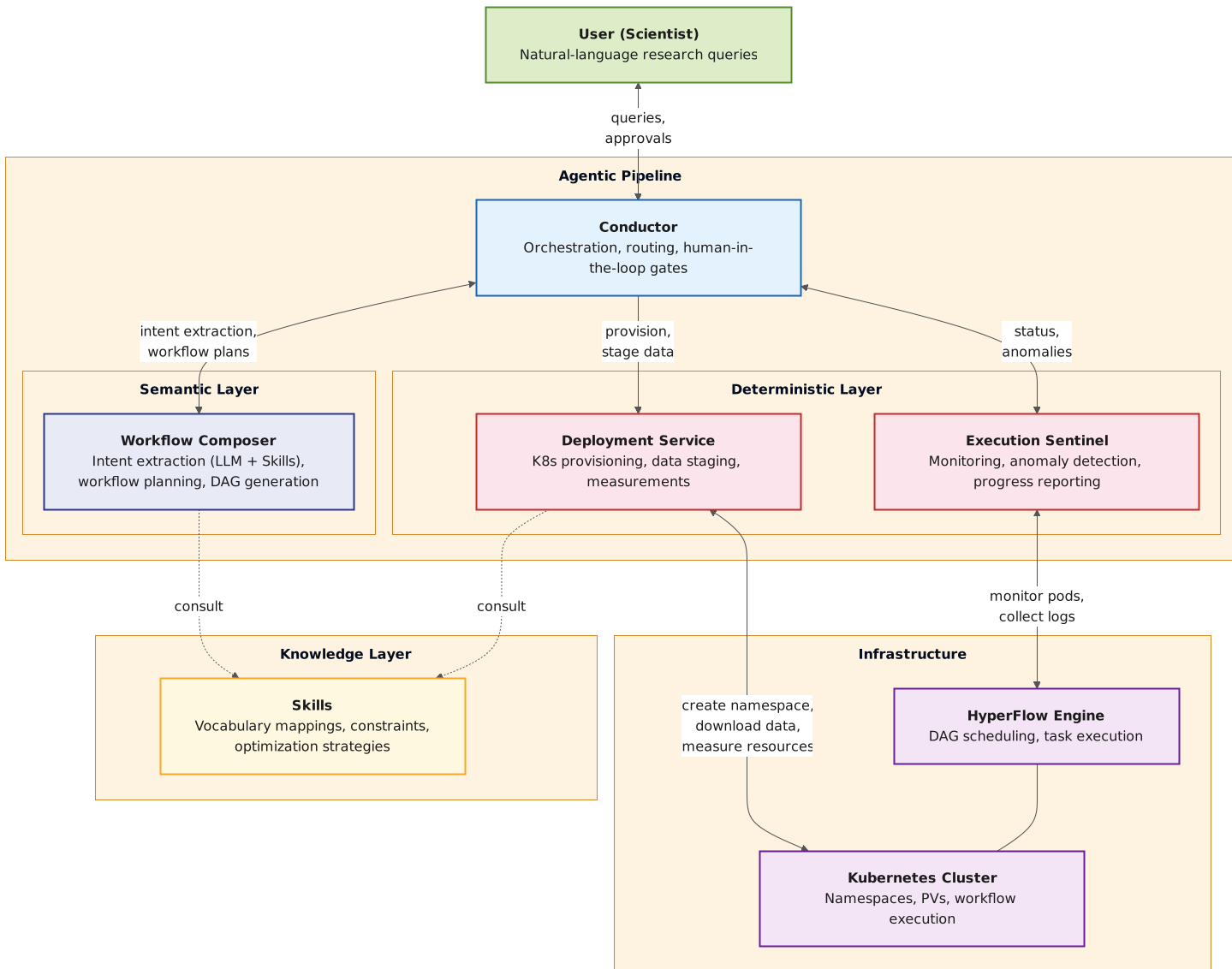
The core insight of this paper is the Three-Layer Decomposition. Instead of asking an LLM to "write a script," the authors ask it to "fill out a form" (the Research Intent).
1. The Three-Layer Stack
- Semantic Layer (LLM): Extracts a structured
ResearchIntentfrom natural language. - Knowledge Layer (Skills): Markdown files authored by humans that map "European" to
EURand provide DNA coordinates. - Deterministic Layer (Generator): A verified code module that takes the Intent and outputs a reproducible HyperFlow DAG.
2. The Multi-Agent Pipeline
The system utilizes four specialized agents:
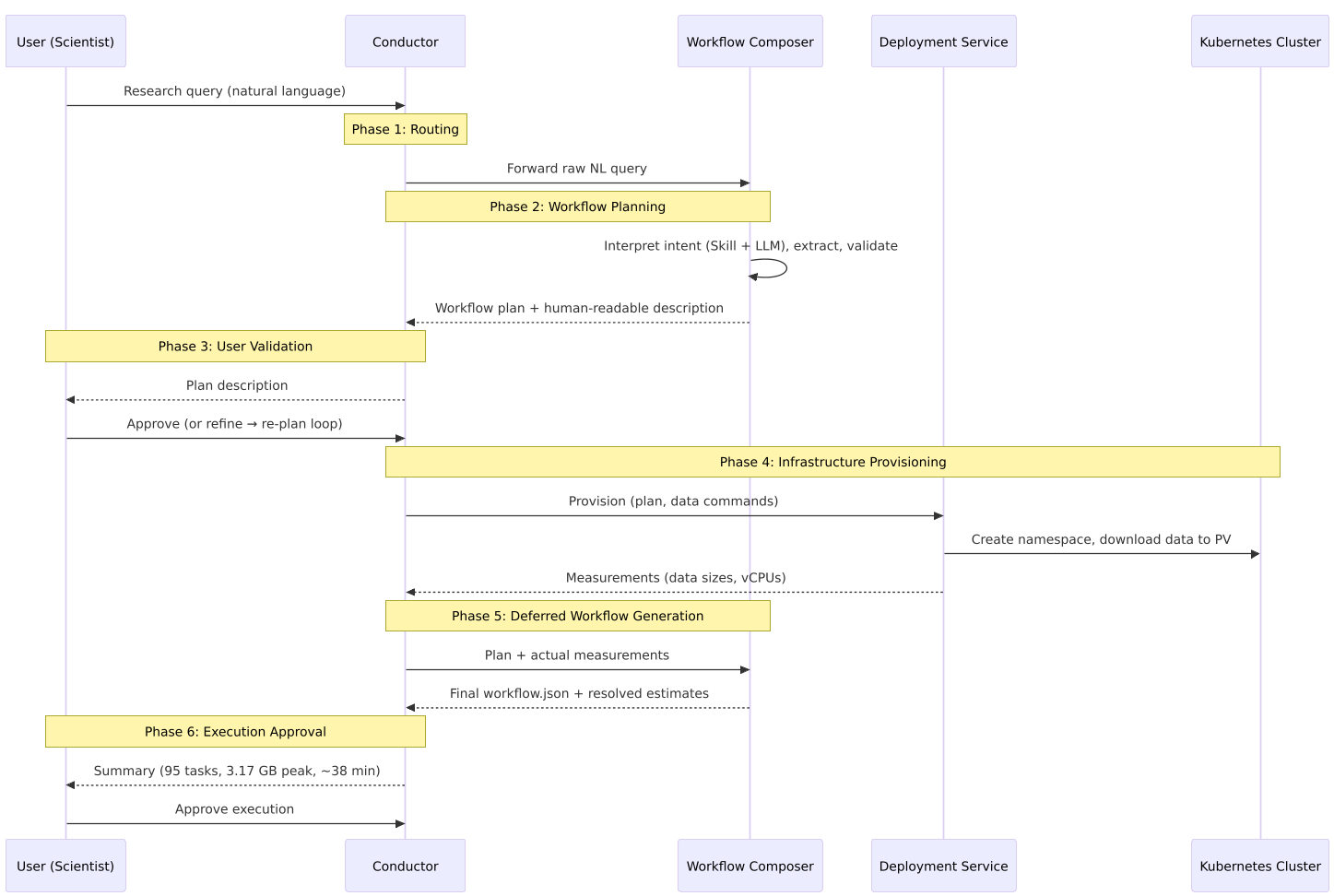
- Conductor: The interface that manages the conversation and human validation.
- Workflow Composer: Negotiates between Skills and LLMs to create the plan.
- Deployment Service: Provisions Kubernetes and, crucially, measures data size.
- Execution Sentinel: Monitors the run on the cluster.
Why "Skills" Matter
Most AI systems use "Few-Shot" examples or RAG (Retrieval-Augmented Generation). This paper introduces Skills: plain Markdown tables.
- Human-Readable: A geneticist can audit a table without knowing Python.
- Version-Controlled: They live in GitHub like code.
- Dual-Purpose: They define vocabulary (names to codes) AND optimization (how to extract data efficiently).
Experiments & Results
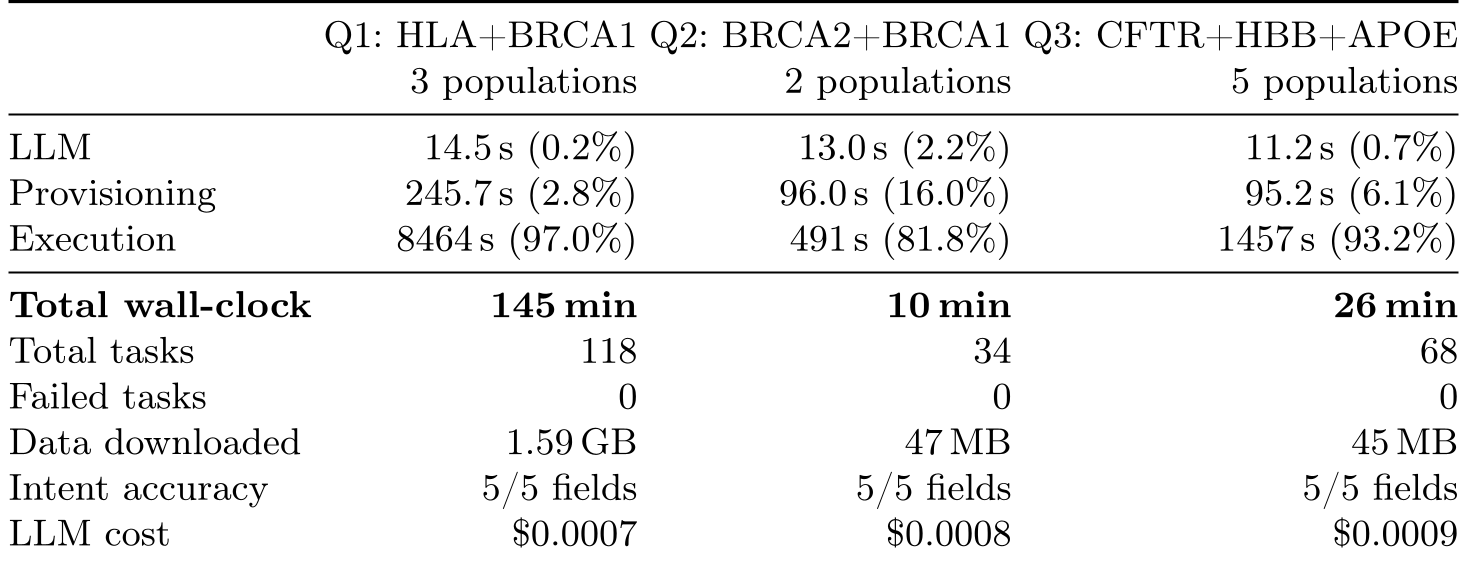
The authors tested the system using the 1000 Genomes population genetics workflow on a Kubernetes cluster.
Significant Accuracy Boost
Without Skills (S0), LLMs often hallucinate genomic coordinates or use incorrect population abbreviations. With the full Skills set (S3), "Full-Match" intent accuracy jumped from 44% to 83% for Claude Opus.
Deferred Generation: The 92% Saving
A unique feature is Deferred Workflow Generation. The system doesn't finalize the DAG until it sees how much data is actually there. For small gene regions like HBB or APOE, it automatically realized it didn't need 100 parallel jobs, reducing data transfer by over 99% for those specific tasks and 92% overall.
Critical Analysis & Conclusion
Takeaway
This work provides a blueprint for "Science 2.0." It proves that we don't need to replace scientists with AI; we need to provide AI with the "manuals" (Skills) to do the heavy lifting of infrastructure translation.
Limitations
Currently, the system is demonstrated on a single domain (Genomics). Scaling to other fields requires domain experts to put in the "upfront work" of writing the Skills markdown files. Additionally, extremely complex "implicit" reasoning (e.g., linking a vague disease name to a specific gene) still challenges modern LLMs.
Future Outlook
The authors envision a future where execution telemetry (failed runs, resource usage) feeds back into the Skills layer, allowing the system to "learn" the most efficient way to run science pipelines on specific hardware.