
From Skills to Talent: Building the First "One-Man" AI Corporation
From Skills to Talent: Organising Heterogeneous Agents as a Real-World Company
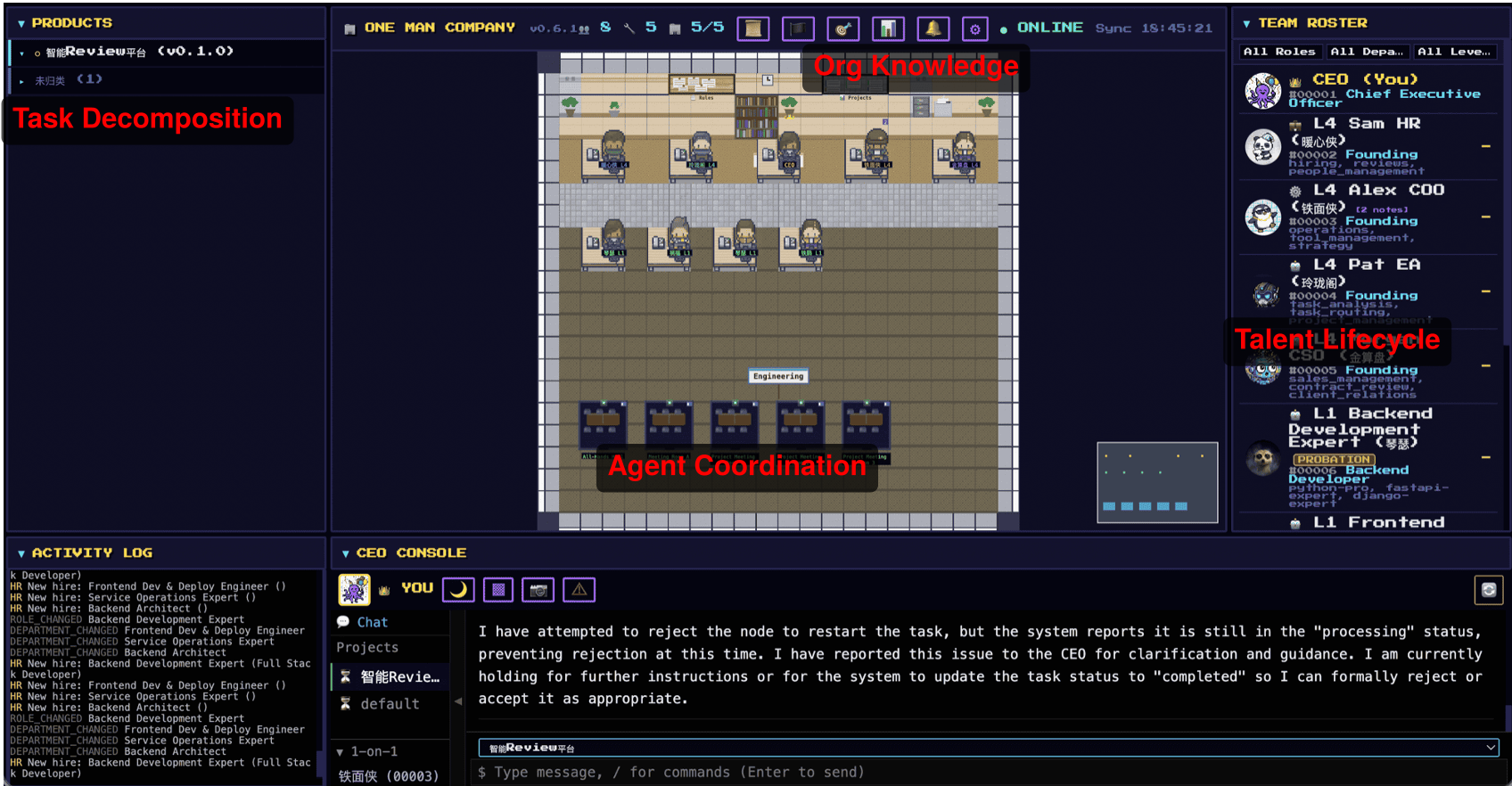
This paper introduces OneManCompany (OMC), an innovative multi-agent framework that elevates AI systems to an institutional level by organizing heterogeneous agents into a virtual "company" structure. By decoupling agent identities (Talents) from their execution runtimes (Containers), OMC achieves a state-of-the-art 84.67% success rate on PRDBench, outperforming existing baselines by over 15 percentage points.
TL;DR
OneManCompany (OMC) is a breakthrough framework that transforms a collection of AI agents into a structured, self-organizing corporation. By shifting the focus from "what an agent can do" (Skills) to "how agents should be managed" (Talent), OMC solves the brittleness of static multi-agent systems, achieving a dominant 84.67% success rate on complex software benchmarks.
Perspective Shift: Why "Skills" Are No Longer Enough
In the current AI landscape, we've become obsessed with skills—teaching an agent to use a browser, write Python, or call an API. But as tasks scale to "Company-level" complexity (like building a full-stack game or conducting a literature survey), a single agent with a million skills hit a ceiling.
The authors argue that we are missing an Organizational Layer. In human systems, companies allow heterogeneous individuals to work together efficiently even if they use different tools or come from different backgrounds. OMC brings this "HR and Management" logic to Silicon.
The Three Pillars of OMC
1. The Talent-Container Architecture
Most agent frameworks are "vertically integrated," meaning the agent's logic is hardcoded into the platform. OMC introduces Identity–Substrate Separation:
- Talent: The portable cognitive package (prompts, principles, role).
- Container: The runtime environment (Claude Code, LangGraph, or custom scripts).
Through six typed interfaces (Execution, Task, Event, Storage, Context, and Lifecycle), OMC can "hire" an agent from any family and drop them into a task without changing a line of the core orchestrator code.
2. E2R: The Strategy Search Tree
OMC doesn't just "run" a workflow; it searches for the best way to organize. The Explore-Execute-Review (E2R) tree search allows the system to:
- Explore: Propose multiple ways to decompose a prompt.
- Execute: Dispatch agents to perform tasks via a Directed Acyclic Graph (DAG).
- Review: Evaluate results. If a "Senior Developer" agent rejects a "Junior" agent's code, the system re-explores that specific branch of the tree.
This hierarchical loop provides formal guarantees that the system won't get stuck in deadlocks or infinite loops—a common nightmare in current autonomous systems.
3. Self-Evolution and the "AI HR Department"
The most "human" part of OMC is its persistent memory. Instead of forgetting everything after a session, OMC implements:
- SOP Distillation: Successful workflows are saved as "Standard Operating Procedures" for the next project.
- Performance Reviews: Agents are graded. If an agent consistently fails, they are put on a Performance Improvement Plan (PIP). If they don't improve, the system "fires" them and recruits a new Talent from the community Market.
Experimental Results: Dominating PRDBench
OMC was tested on PRDBench, which requires agents to take a high-level Product Requirement Document and turn it into working code.
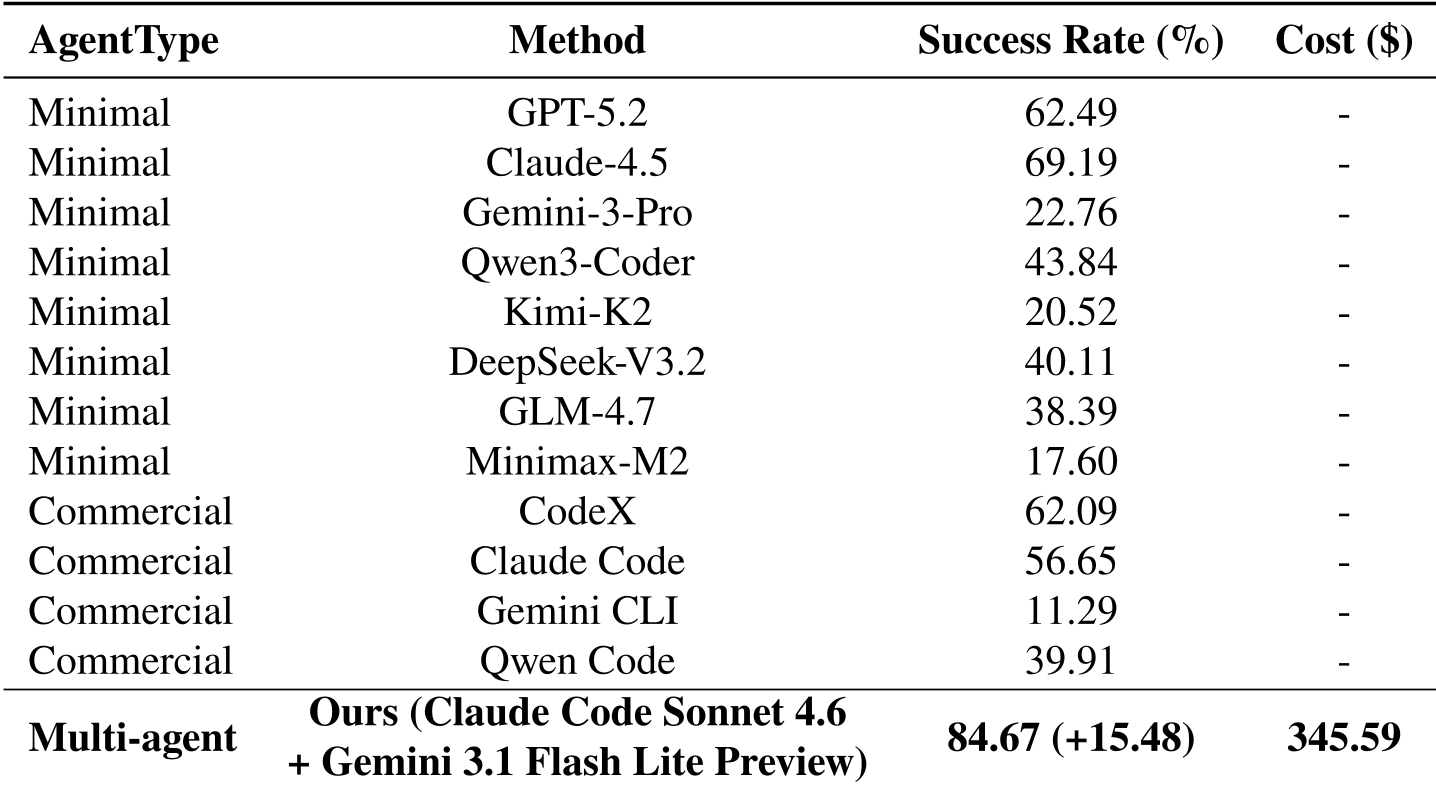
The results were clear:
- Success Rate: 84.67% (previous SOTA was 69.19%).
- Reliability: The "Review Gate" strategy ensures errors don't cascade, keeping results high-quality even in long-horizon tasks.
Deep Insight: The Value of Bounded Rationality
A key takeaway from this work is the implementation of Circuit Breakers. Real companies have budgets and deadlines; OMC does too. By setting "Review Round Limits" and "Cost Budgets," the authors acknowledge that AI agents must operate within Bounded Rationality. They aren't trying to find the "perfect" mathematical solution, but the "best possible" solution within the CEO's constraints.
Conclusion: Toward the Autonomous Enterprise
OneManCompany proves that the bottleneck in AI today isn't just model intelligence—it's coordination intelligence. By treating AI agents like employees and multi-agent systems like corporations, we move closer to a future where a single human "CEO" can truly run a multi-department enterprise with zero payroll and 24/7 productivity.
Limitations to Watch: The cost ($6.91 per task) is still high for simple queries, and the "Talent Market" requires a robust community to provide the diversity of specialists needed for niche domains.