
Frugal: Bridging the Gap Between Social Hubs and Resource-Constrained Edge Devices
Frugal: Building Degree-Constrained Overlay Topology from Social Graphs
The paper introduces Frugal, a decentralized mechanism for building degree-constrained P2P overlay topologies from Online Social Networks (OSNs). It leverages trust relationships in social graphs to establish secure VPN-like communication while ensuring that power-constrained edge devices are not overwhelmed by high social degrees.
TL;DR
Establishing P2P overlays based on social trust is ideal for Edge/Fog computing, but "social butterflies" (hubs) can crush edge devices with thousands of connections. Frugal is a decentralized framework that uses intelligent link selection and degree-constrained spanning trees to maintain a well-connected network while strictly capping the number of active links per device.
Background: The Hub Dilemma
In the world of Online Social Networks (OSNs), connectivity isn't uniform. A small percentage of users (hubs) have thousands of friends. If we were to build a P2P VPN where every "friendship" is a direct tunnel, a hub's smartphone would melt under the resource load (CPU, Battery, Bandwidth). However, simply cutting links at random breaks the network's "small-world" property and leads to fragmentation.
Methodology: The Frugal Approach
Frugal treats the social graph as a template and uses a Learning Automata heuristic to derive a "thin" but efficient overlay.
1. Local Topology Awareness
Instead of requiring a global view, each node only learns about its 2-hop neighborhood. It identifies:
- Direct Links: Friends the node can connect to.
- Indirect Links: "Friends of friends" who could potentially act as routers to bridge gaps.
2. Traffic-Aware Weighting
Not all social links are equal. Frugal assigns costs to links based on expected traffic (using a power-law distribution). It prioritizes "High-Value" links—those that carry the most data—ensuring that the most frequent communications happen in a single hop.
3. The Recommendation Engine (DCMST)
At its core, Frugal runs an iterative process to find a Degree Constrained Minimum Spanning Tree (DCMST).
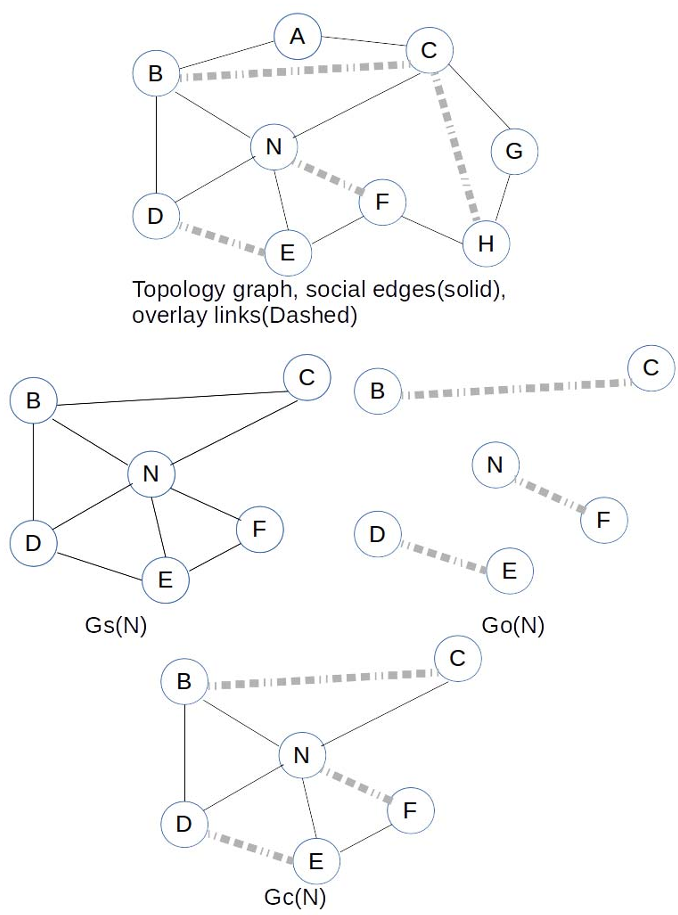 Figure: Node N builds a local topology snapshot (Gc) by merging social (Gs) and current overlay (Go) views.
Experiments: Frugal vs. The World
The authors tested Frugal against Random (randomly picking K links) and Greedy (picking top K traffic links) strategies using Facebook datasets.
Key Findings:
- Connectivity Excellence: While a Greedy approach often leads to over 1,500 partitions (disconnected islands) in the Konect dataset, Frugal keeps the network much more cohesive.
- Traffic Efficiency: Frugal ensures over 80% of social traffic travels via a direct 1-hop overlay link, significantly outperforming Random selection (~50%).
- The Power of Bootstrapping: By allowing a small "Bootstrap Quota" (extra links specifically for joining the network), Frugal avoids the isolation of new or low-degree nodes.
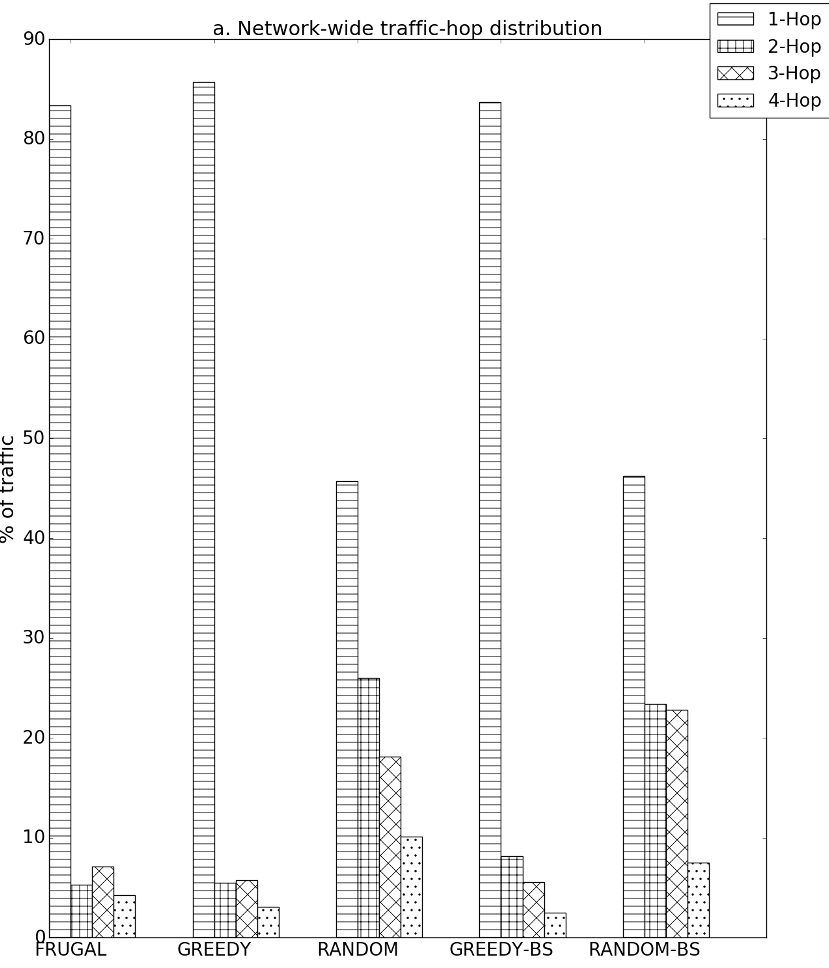 Figure: Distribution of Traffic and Average Hops for the Konect dataset. Frugal maintains low hop counts even with strict degree caps.
Critical Analysis & Conclusion
Frugal's primary contribution is proving that local, independent decisions can lead to a globally efficient topology. By using a DCMST heuristic, it balances the "selfish" need for low-latency communication with the "cooperative" need for a connected graph.
Limitations: The current study assumes a static environment. In real-world edge scenarios, "churn" (nodes going online/offline) is constant. Future Outlook: Integrating Frugal into open-source VPN/Overlay software (like SocialVPN) could be a game-changer for private, decentralized social communication on low-power IoT devices.
Summary of Results
| Scheme | Edges (Konect) | Partitions (Konect) | Partitions (SNAP) |
|---|---|---|---|
| Frugal | 333,665 | 201 | 1 |
| Greedy | 323,790 | 1,536 | 77 |
| Random | 329,928 | 1,959 | 84 |
Frugal provides the best connectivity (fewest partitions) with comparable edge counts.