
FruGar: Democratizing Plant Pathometrics via Frugal Deep Learning
FruGar: Exploiting Deep Learning and Crowdsourcing for Frugal Gardening
The paper introduces FruGar (Frugal Gardening), a responsive web application that leverages Convolutional Neural Networks (CNNs) and crowdsourcing to detect plant diseases. The system identifies health issues across 14 crop species with a top test accuracy of 97.49% using the DenseNet201 architecture, aiming to make smart city services sustainable and accessible.
TL;DR
FruGar is a web-based platform that brings professional-grade plant disease detection to the everyday citizen's backyard. By combining a high-accuracy DenseNet201 backend with a crowdsourcing workflow, the system provides instant health reports for 14 major crops while building a sustainable, community-fed database for future agricultural resilience.
Problem & Motivation: The Gap in Urban Greenery
As smart cities evolve, there is a distinct need for "frugal innovation"—creating high-value solutions under resource scarcity. Gardening is a pillar of urban sustainability, yet casual gardeners often struggle to identify diseases early enough to act. Existing tools are either hidden behind paywalls, require high-end hardware, or lack the collaborative data loop necessary to adapt to local contexts. The authors' insight was to marry Deep Learning (for precision) with Crowdsourcing (for scalability) to create a tool that is both "frugal" in cost and "rich" in data.
Methodology: The Core Engine
The FruGar system is built on a robust machine learning foundation. The researchers bypassed Transfer Learning (which they noted has shown inconsistent results in specialized agricultural domains) and instead trained four sophisticated CNN architectures from scratch using the PlantVillage dataset.
Architectural Breakdown
The system utilizes a Client-Server-Server architecture:
- The Client: A responsive Vue.js web app focused on ease of use and "mobile-first" accessibility.
- The Web Server: A Node.js intermediary managing user profiles and history.
- The AI Engine: A dedicated TensorFlow server that handles the heavy lifting of image processing and inference.
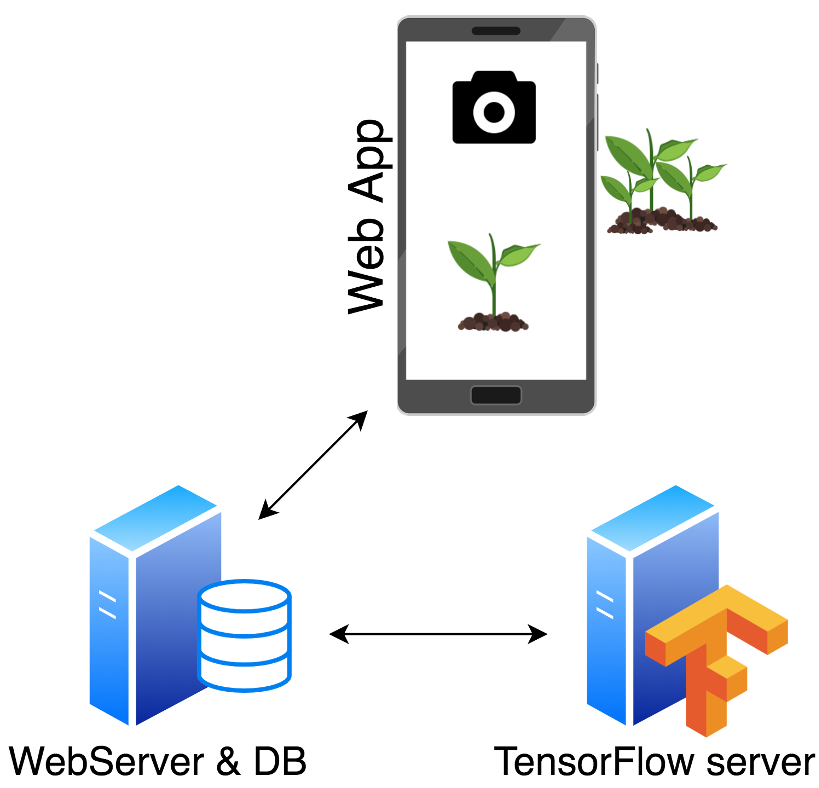
The data processing pipeline includes image augmentation (rotation and flipping) and a stratified split to ensure the model learns to identify rare diseases as effectively as common ones.
Experiments & Results: Performance at Scale
The evaluation focused on distinguishing 14 species and multiple disease states. The results indicate that deeper, more connected networks like DenseNet provide superior feature extraction for the subtle nuances of leaf pathology.
| Model | Validation Accuracy | Test Accuracy |
|---|---|---|
| InceptionV3 | 96.29% | 96.03% |
| ResNet152V2 | 97.02% | 95.90% |
| DenseNet201 | 98.28% | 97.49% |
| NASNetLarge | 94.71% | 94.31% |
The 97.49% test accuracy is particularly impressive as it demonstrates the model's ability to not only diagnose the disease but also correctly identify the plant species simultaneously—acting as a two-in-one classifier.
Deep Insight & Future Outlook
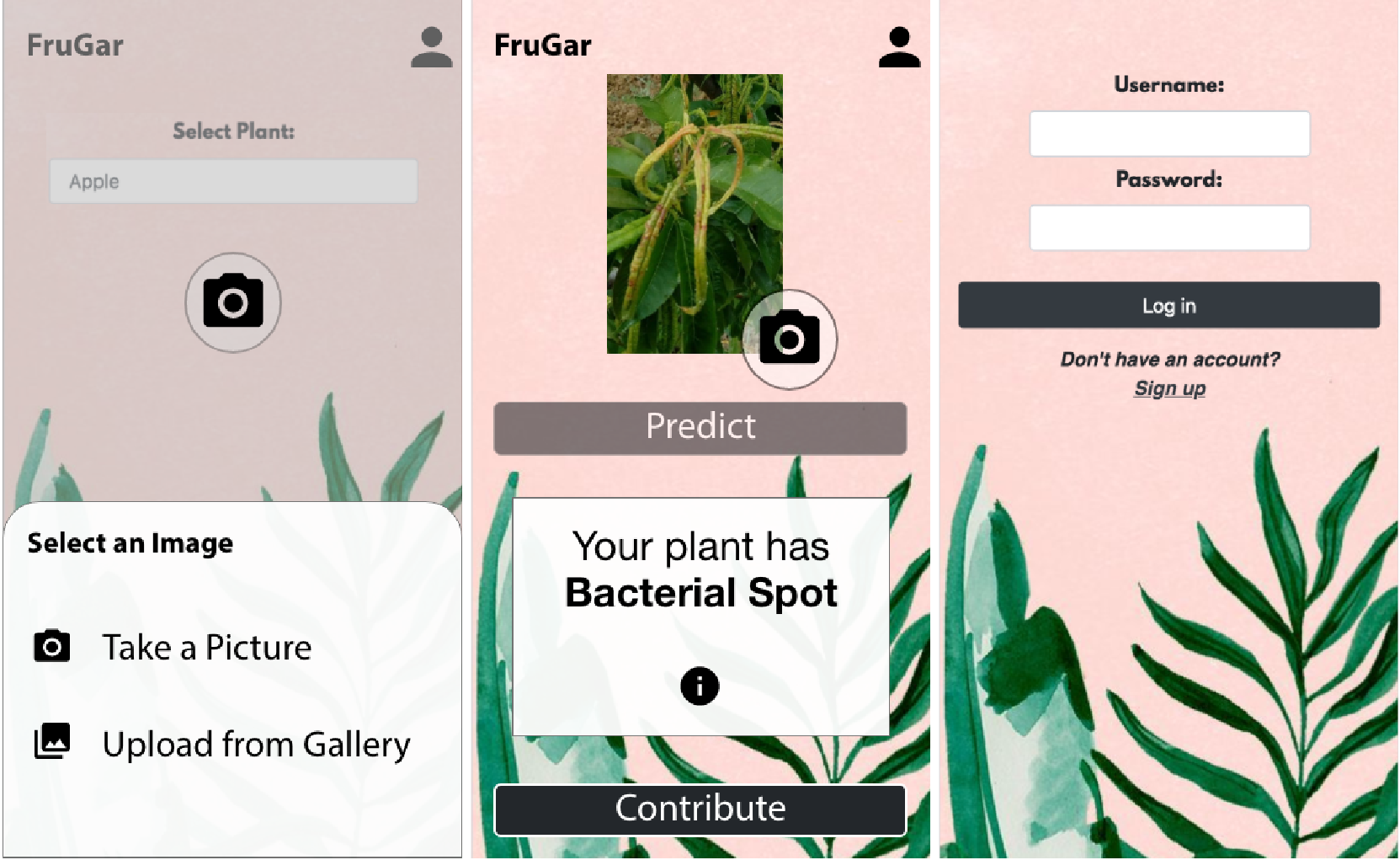
Why it works: The strength of FruGar lies in its Human-in-the-Loop design. By asking users to contribute their photos, the model overcomes the "static dataset" problem where AI models fail when faced with real-world noise (lighting, background interference).
Future Directions:
- Edge AI Translation: Moving from server-side inference to client-side (TensorFlow.js) to enable offline diagnosis in remote gardens.
- Domain Specificity: Transitioning from one "giant" model to multiple "specialist" models (e.g., a specific CNN for tomatoes) to reduce computational overhead.
- Internet of Plants: Integrating Soil/Moisture sensors (IoT) to correlate environmental stress with disease outbreaks.
Conclusion
FruGar represents a shift in smart city research—moving away from complex, expensive infrastructure toward accessible, collaborative, and intelligent tools that empower citizens to contribute to environmental resilience directly from their smartphones.