
FS-Researcher: Breaking the Context Barrier via File-System-Based Agent Scaling
FS-Researcher: Test-Time Scaling for Long-Horizon Research Tasks with File-System-Based Agents
FS-Researcher is a dual-agent framework for long-horizon deep research that overcomes LLM context limits using a persistent file-system workspace. It employs a "Context Builder" for information gathering and a "Report Writer" for section-by-section synthesis, achieving SOTA performance on DeepResearch Bench and DeepConsult.
TL;DR
Deep research is the marathon of AI tasks—it requires exhaustive searching followed by high-precision synthesis. FS-Researcher introduces a dual-agent architecture that replaces the fragile, short-term memory of a model's context window with a persistent, structured file system. By using a "Librarian" to build a knowledge base and a "Writer" to draft the report, it achieves SOTA results on PhD-level research benchmarks and proves that research quality scales with the computation allocated to evidence gathering.
The Context Budget Crisis
In the world of autonomous agents, "Deep Research" is a frontier task. Unlike simple Q&A, it demands navigating hundreds of noisy web pages and producing 10,000-word reports.
The fundamental bottleneck is Context Compression. When an agent's internal memory fills up, it is forced to:
- Discard older thoughts or observations.
- Summarize data into lossy snippets.
- Rush to a conclusion because it "runs out of room."
Existing "search agents" are often ephemeral; once the loop ends, the intermediate data vanishes. FS-Researcher argues that for long-horizon tasks, we need a persistent workspace—much like a human researcher uses a folder of PDFs and a notebook.
Methodology: The Librarian and the Author
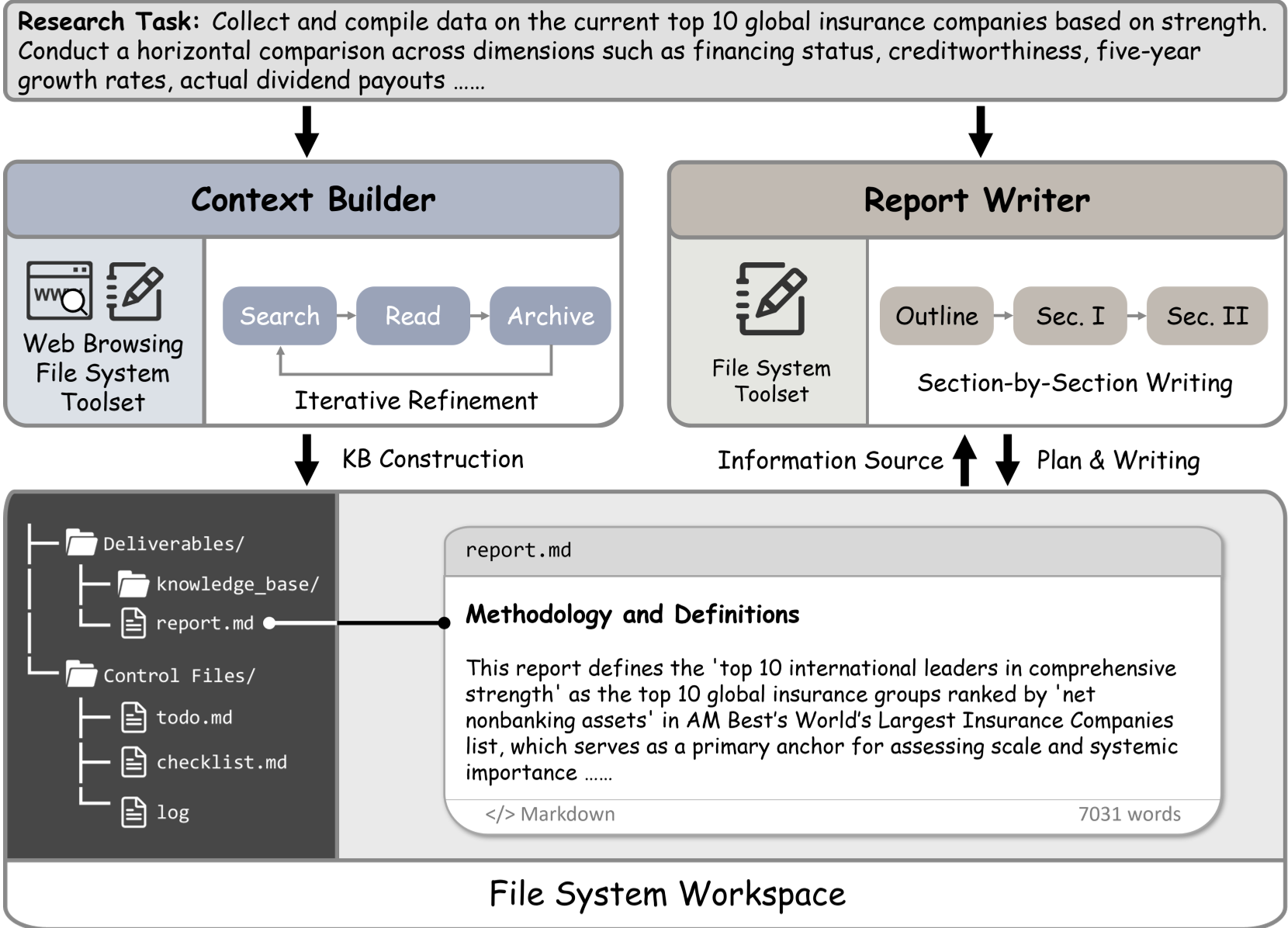
FS-Researcher splits the task into two distinct agents that share a Markdown-based workspace.
1. The Context Builder (The Librarian)
This agent's sole purpose is to populate a Knowledge Base (KB).
- Browsing: It uses search and read tools to find raw sources.
- Archiving: It saves raw HTML/text into a
sources/directory. - Distilling: It writes structured, hierarchical notes in a
knowledge_base/tree, where every claim is cited back to the raw source.
2. The Report Writer (The Author)
Once the KB is ready, the Report Writer takes over. Crucially, it is forbidden from browsing the live web. It treats the KB as its "Ground Truth." To avoid one-shot generation shallow-ness, it writes section-by-section, checking each part against a quality checklist.
The Secret Sauce: Control Files
The framework utilizes index.md, todos.md, and logs.md. These files allow the agents to:
- Track Progress: Know exactly what sections are [PENDING] or [COMPLETE].
- Iterative Refinement: If a self-check fails, the agent can re-open a task across sessions.
Experimental Results & SOTA Performance
FS-Researcher was tested against industry giants like OpenAI's Deep Research and Gemini-2.5-Pro.
| Method | RACE (Overall Quality) | Fact Accuracy |
|---|---|---|
| OpenAI-DeepResearch | 46.45 | 75.01 |
| Gemini-2.5-Pro-DeepResearch | 49.71 | 78.30 |
| FS-Researcher (Claude 4.5) | 53.94 | 76.17 |
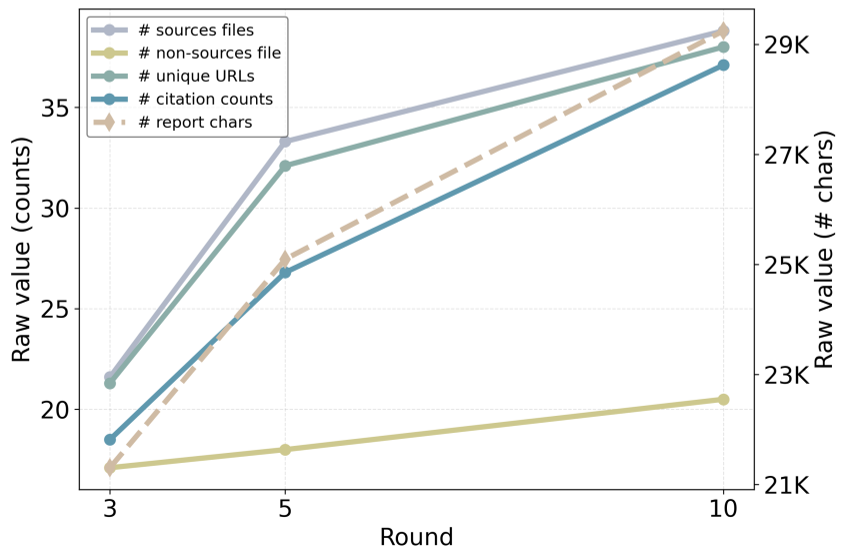
Beyond just winning on scores, the researchers proved a critical hypothesis: Test-Time Scaling. By allowing the "Librarian" more rounds to search and refine the knowledge base, the resulting report quality improved linearly.
Deep Insight: Why Why Does This Work?
The ablation studies provide the most interesting takeaways:
- Dual-Agent vs. Single-Agent: Merging the roles caused a massive drop in performance (-10.3 RACE). This suggests that "writing while searching" creates a cognitive load that distracts the model from thorough exploration.
- File System Latency: One might worry that reading/writing files slows down the AI. In reality, File I/O accounted for <0.03% of total time. LLM inference and web latency are the true bottlenecks.
- Insight over Breadth: The framework's biggest gain was in "Insight" (+4.40). Because the model has a structured KB, it can perform cross-source comparisons that a context-limited single agent would simply forget.
Conclusion & Future Outlook
FS-Researcher demonstrates that the next step in agentic intelligence isn't necessarily a larger context window, but a better interface between the model and a persistent workspace.
Limitations: The system still relies on high-tier models (Claude 4.5, GPT-5 levels) for reliable tool use. However, the authors showed that even "mini" models can perform surprisingly well if given enough "search rounds" in this framework.
In the future, we can expect research agents to not just write reports, but manage entire file-system-based "research labs" where they collaborate with humans by sharing the same persistent workspace.