
FStream: Reclaiming the Groove through Decentralized Social Streaming
FStream: a decentralized and social music streamer
FStream is a decentralized, social music streaming platform that leverages user-hosted "FStreamBoxes" to eliminate reliance on central servers. It combines P2P networking with a gossip-based recommendation system to provide seamless music discovery, searching, and streaming while ensuring user data sovereignty.
TL;DR
FStream is a decentralized alternative to giants like Spotify, using home-hosted "FStreamBoxes" to create a peer-to-peer social music network. It solves the issues of data ownership, privacy, and centralized bottlenecks by using gossip protocols to cluster users with similar tastes and implement a "social cache" for high availability.
Background & Motivation: The Centralized Stranglehold
While music streaming has become ubiquitous, it remains heavily centralized. Users are subject to the whims of service providers regarding data formats, licensing restrictions, and privacy terms. Even peer-assisted services like Spotify rely on a central index, creating a single point of failure and potential privacy concerns.
The authors argue that the rise of low-cost, high-capacity home storage and "always-on" broadband makes a fully decentralized model feasible. They propose FStream, which replaces data centers with a collective of user-managed nodes, turning every home into a piece of the streaming infrastructure.
Methodology: A Multi-Layered Gossip Architecture
FStream's genius lies in its four-layer architecture that balances connectivity, discovery, and social interaction.
1. The FStreamBox
The entry point is a hardware/software appliance based on Subsonic. It serves as the local media manager and the gateway to the P2P network.
2. Random Peer Sampling (RPS) Layer
To prevent the network from fragmenting, FStream uses a Cyclon-based gossip protocol. This layer maintains a continuously changing random topology, ensuring that the network remains connected and robust against churn.
3. Interest-Based Clustering
Beyond random connections, FStream builds a "semantic overlay." By periodically exchanging user profiles (short descriptors of listening habits), the system clusters users with similar musical tastes. This creates an "implicit" social network used for recommendations.
4. Explicit Social Network & Social Caching
Users can explicitly "friend" others to share libraries. To handle traffic spikes and node disconnections, FStream uses a Social Cache. Unlike standard caches (LRU/LFU), this cache prioritizes content that the owner and their friends are likely to enjoy.
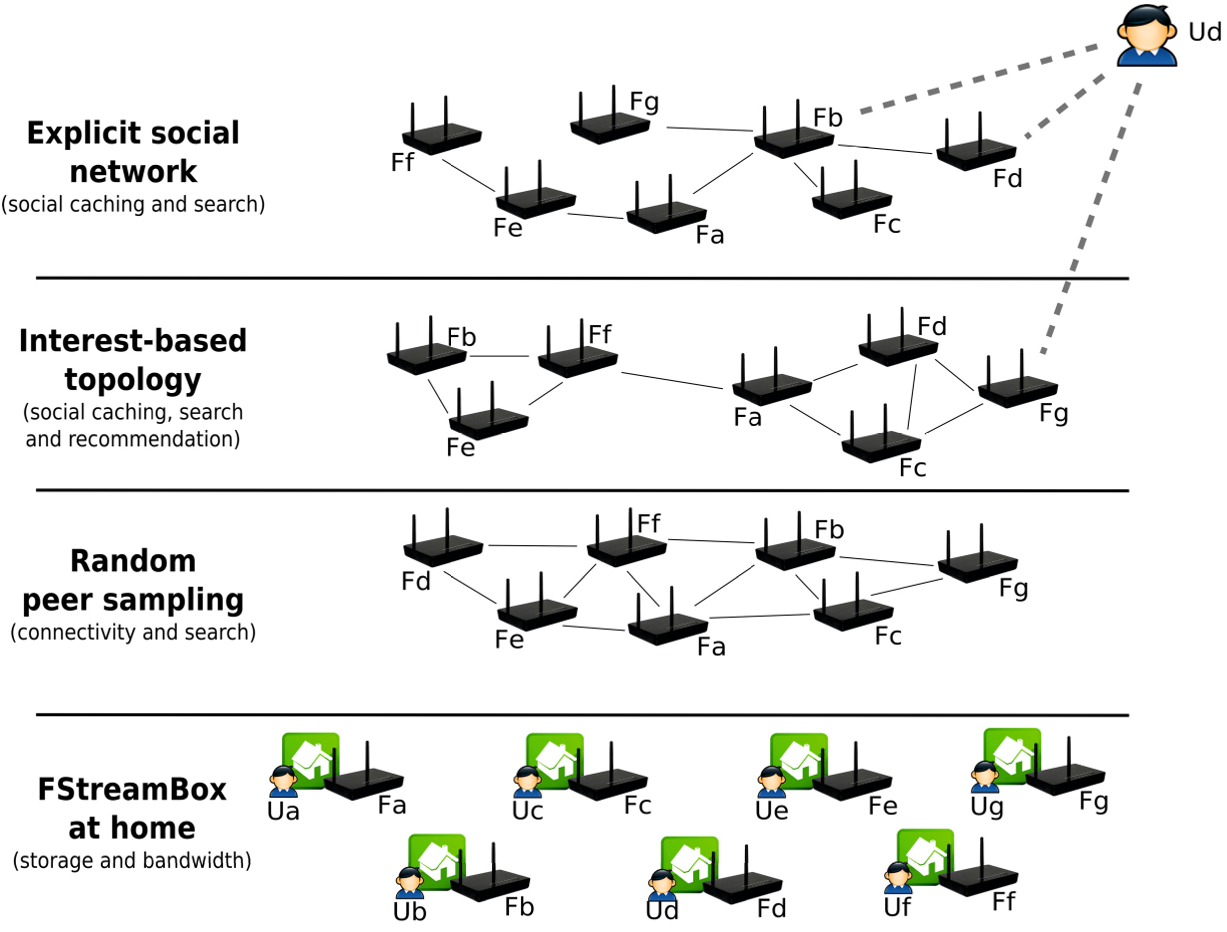 Figure 1: The multi-layered decentralized architecture of FStream, showing the interaction between explicit friends and taste-based clusters.
Key Features: Social and Sovereign
- Fine-Grained Privacy: Users have absolute control over their tracks—setting them to Private, Social (friends only), or Public.
- Decentralized Search: Searching for a track doesn't hit a central database; instead, it uses a gossip-based mechanism that fans out through the network layers.
- Collaborative Filtering: Recommendations aren't dictated by an opaque corporate algorithm but emerge naturally from the interest-based clustering of peer nodes.
Critical Analysis & Conclusion
FStream represents a significant shift toward Data Sovereignty. By moving from a client-server model to a collaborative "Nano Data Center" model, it eliminates the middleman.
Takeaway: The project proves that social networking and high-quality streaming can thrive without a central authority. However, the system's performance heavily depends on the "always-on" nature of home boxes. Future work might need to address the "vampire power" consumption of these devices or integrate more robust encryption for the profile exchanges to prevent taste-based fingerprinting.
In a world where digital platforms are increasingly fragmented by licensing wars, FStream offers a vision of a user-owned, resilient, and truly social musical ecosystem.