
FTMF: Balancing Individual Will and Social Influence for Superior Recommendations
FTMF: Recommendation in social network with Feature Transfer and Probabilistic Matrix Factorization
The paper introduces FTMF (Feature Transfer and Probabilistic Matrix Factorization), a novel social recommendation algorithm that integrates trust networks with rating data. It achieves state-of-the-art accuracy by adaptively balancing a user's personal preferences with features transferred from their trusted social circle.
TL;DR
Recommender systems often struggle when users have few interactions (the "Cold Start" problem). FTMF (Feature Transfer and Probabilistic Matrix Factorization) solves this by not only looking at what your friends like but also calculating how much you actually care about their opinions. By introducing an adaptive firm factor, the model achieves better accuracy (RMSE/MAE) across major social datasets like Epinions and Flixster.
Problem & Motivation: The Paradox of Social Influence
Most social-based recommendation algorithms operate on a simple heuristic: "If you trust someone, you'll like what they like." However, this ignores human psychology. Some users are "firm"—they have specific tastes and are rarely swayed by peers. Others are "impressionable" and rely heavily on social proof.
Current state-of-the-art methods like SocialMF or SoRec treat social influence as a static regularization term. They fail to capture three critical nuances:
- Asymmetry: Trust is not always mutual.
- Feature Transfer: Influence is a transfer of latent characteristics from a group of trusted peers to the target individual.
- Individuality: Every user has a different "firmness" level when making decisions.
Methodology: Feature Transfer and the Firm Factor
The core of FTMF lies in its hybrid probabilistic graphical model. It factorizes the user-item rating matrix and the trust matrix into three distinct latent components:
- User Personal Latent Feature (): Representing the user's inherent taste.
- Item Latent Feature (): Representing the item's characteristics.
- User Social Latent Feature (): Derived via "Feature Transfer" from the user's trusted circle in the social graph.
The Secret Sauce: The Adaptive Firm Factor ()
The most innovative part of FTMF is the prediction function: Here, is a learned parameter for each user. If is high, the user is "firm" and relies on . If it is low, they are "impressionable" and the model relies more on (the social features).
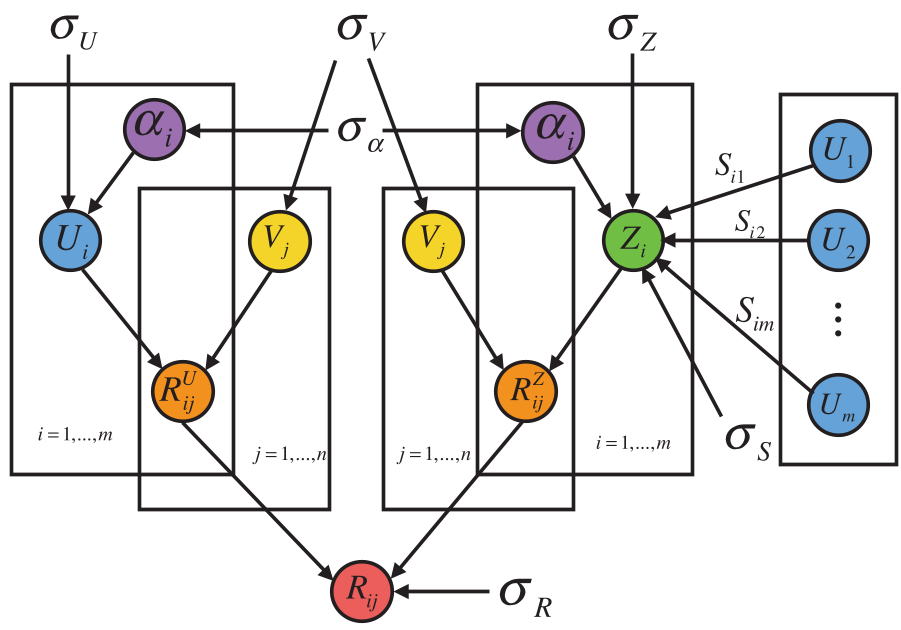 Fig 1: The FTMF model architecture showing the fusion of Social () and Personal () features.
Experiments & Results
The authors tested FTMF against 10 competing algorithms (Traditional CF, Trust-aware systems, and MF-based models).
1. Global Performance
FTMF achieved the lowest MAE and RMSE across all tested datasets. More importantly, it showed a faster convergence velocity than other matrix factorization methods.
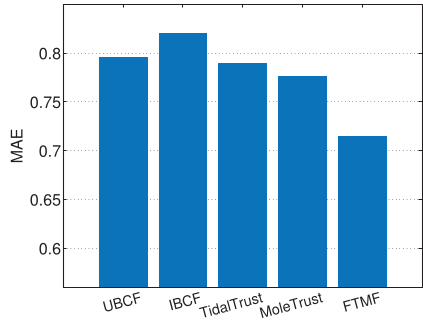 Fig 2: FTMF (bottom-most line) demonstrating superior RMSE performance over iterations compared to SoRec and PMF.
2. Solving the Cold Start
For users with fewer than 10 ratings, social auxiliary data is the only lifeline. On the Flixster dataset, FTMF achieved an RMSE of 1.051, significantly outperforming the standard Probabilistic Matrix Factorization (PMF) which sat at 1.260. This 16% improvement highlights the power of adaptive feature transfer in data-scarce scenarios.
Critical Insight & Conclusion
FTMF's success proves that social influence is not a monolithic force. By treating the "willpower" of a user (the Firm Factor) as a learnable latent variable, the system avoids over-smoothing recommendations with social noise.
Limitations: The model currently relies on binary trust relations. Future iterations could benefit from modeling "trust strength" or integrating temporal dynamics (how influence changes over time).
Takeaway for Practitioners: If you are building a social recommender, don't just aggregate friend data. Ask the model to learn how much each user typically listens to their friends. That bit of "adaptive firmness" is the difference between a generic suggestion and a personalized one.