
FTR: Leveraging Social DNA for Efficient Routing in Mobile Social Networks
FTR: features tree based routing in mobile social networks
The paper introduces FTR (Features Tree based Routing), a community-based routing protocol for Mobile Social Networks (MSNs) within Delay Tolerant Networks (DTNs). It utilizes static social features to organize nodes into a tree structure and selects optimal delivery paths based on node density within feature-defined branches.
TL;DR
Routing in Mobile Social Networks (MSNs) is notoriously difficult due to frequent disconnections. The FTR (Features Tree based Routing) protocol moves away from resource-heavy "epidemic" flooding. Instead, it uses nodes' inherent social characteristics to build a logical tree, routing packets through the "most populated" social branches. The result? A massive reduction in network overhead and a superior delivery ratio in buffer-constrained environments.
The Motivation: Moving Beyond Random Encounters
In Delay Tolerant Networks (DTNs), we can't assume a path exists from A to B. Most protocols either spray copies of packets everywhere (causing congestion) or try to predict future meetings based on history (causing high computational overhead).
The authors of FTR realized that humans don't move randomly. We move based on our social features: our workplace, hometown, or hobbies. If two people share many features, they are more likely to meet. FTR transforms these social "DNA" profiles into a structured routing hierarchy.
Methodology: The Feature Tree Architecture
The core innovation lies in how the network is structured.
- Feature Mapping: Each node is assigned a set of features (). A community is defined by a specific combination of these features.
- Tree Construction: When a packet is generated, the source node's community becomes the Root (000).
- Logical Distance: Other communities are placed on the tree based on how many features they differ from the source. A community differing by only one feature is a direct child of the root.
- Density-Based Path Selection: Since multiple paths can exist through the tree to reach the destination community, FTR calculates the total number of nodes in each path and chooses the one with the highest "carrying capacity."
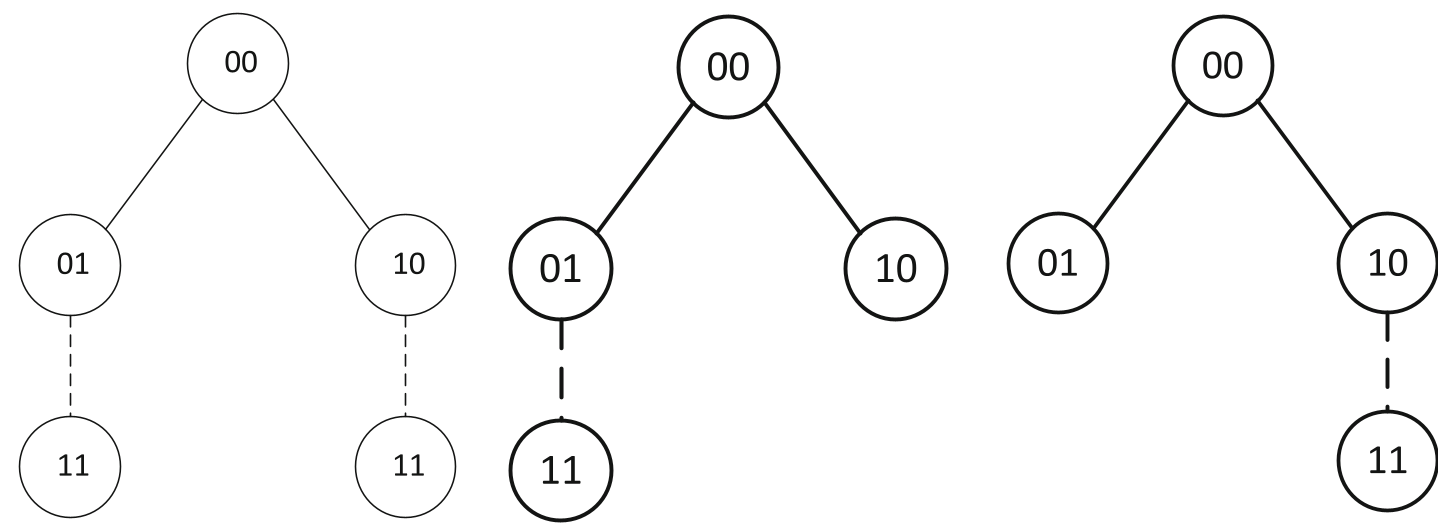 Figure 1: A logical tree representation where branches represent feature differences.
Experiments: Efficiency Over Speed
The researchers tested FTR against two stalwarts: PRoPHET (probabilistic) and OPPO (optimal copy allocation).
Key Findings:
- Delivery Ratio: FTR consistently achieved higher delivery rates across varying buffer sizes (1MB to 5MB) and Time-to-Live (TTL) settings.
- The Overhead Miracle: While PRoPHET generates thousands of redundant copies, FTR's overhead ratio remained stable and remarkably low (approx. 0.2), making it ideal for devices with limited memory.
- The Trade-off: FTR exhibits higher latency (end-to-end delay). Because it limits packet replication to specific social branches, it takes longer for a packet to "hop" to the destination compared to flooding methods.
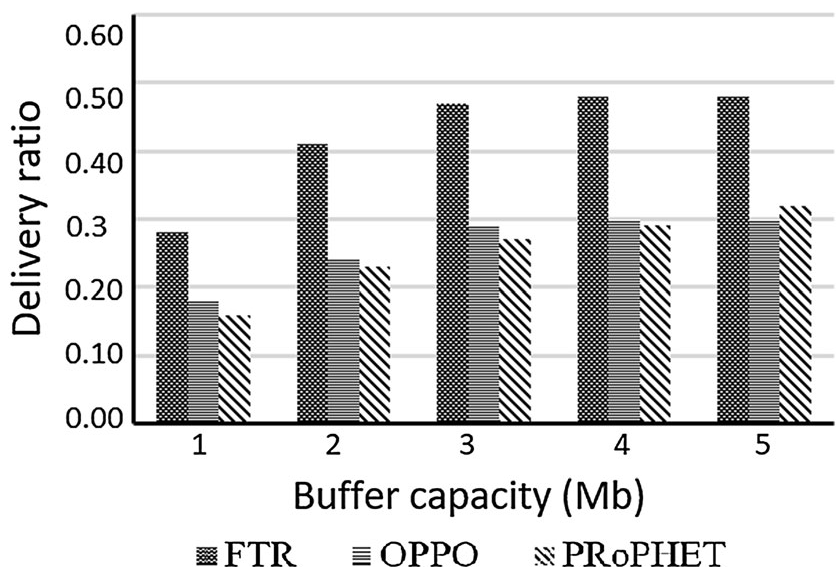 Figure 2: FTR shows a superior delivery ratio as buffer capacity increases compared to OPPO and PRoPHET.
Critical Insight: Why Does FTR Work?
FTR works because it applies a Social Inductive Bias to routing. By assuming that the "densest" social path is the most reliable, it avoids wasting bandwidth on "socially isolated" nodes. However, its reliance on fixed features suggests a limitation: if a node changes its social context (e.g., changing jobs), the tree must be re-evaluated.
Conclusion
FTR proves that in the world of mobile social networking, who you are is often more important for routing than where you have been. By structuring the network as a feature-based tree, we can achieve highly efficient data delivery even when resources are scarce. This approach is a roadmap for future "Green" networking protocols that prioritize energy and memory efficiency over raw speed.