
Functional Programming for All: How Odersky's MOOC Redefined Scalable Education
Functional programming for all! scaling a MOOC for students and professionals alike
The paper "Functional Programming For All!" presents the design and evaluation of a massive open online course (MOOC) on Scala, achieving an exceptionally high completion rate of 19.2%. It details the technical infrastructure—including IDE plugins and automated cloud-based graders—that supported over 100,000 learners.
TL;DR
This paper documents the success of the "Functional Programming Principles in Scala" MOOC, led by Martin Odersky. By deploying professional-grade developer tools (SBT, automated cloud graders, and IDE plugins), the course achieved a 19.2% completion rate—nearly three times the industry standard—and proved that online formats can outperform traditional on-campus lectures for both students and industry professionals.
Problem: The "Boredom Gap" in Online Learning
In 2014, MOOCs were criticized for high dropout rates (averaging 93%). In technical fields like Functional Programming (FP), the steep learning curve often discouraged students. Prior educational models lacked:
- Immediate Feedback: Students waited days for TA reviews.
- Professional Relevance: Theoretical courses didn't translate to real-world software workflows.
- Rigorous Assessment: Automated graders were often too simplistic to evaluate code style or complex logic.
The authors hypothesized that by providing a tight feedback loop akin to a professional development environment, they could significantly increase engagement and learning outcomes.
Methodology: Building a Virtual Lab
The core of the paper’s success lies in its sophisticated Tooling and Grading System. Unlike platforms that use simple "multiple choice" or "regex" grading, this course treated student submissions like production code.
1. The Cloud-Based Grading Infrastructure
Every student submission was handled by an AWS-backed pipeline. The system didn't just check if the code "worked"; it performed:
- Style Analysis: Using a custom Scalastyle checker to ensure students weren't using "imperative" hacks (like
varsornulls) in a functional course. - Property-Based Testing: Using ScalaTest to run the code against secret test suites.
- JVM Instrumentation: Using a custom Java Agent to monitor if students were bypassing logic constraints (e.g., ensuring a recursive function was actually called).

2. The Interactive Workspace
The introduction of Scala Worksheets allowed students to see the evaluation of each line of code in real-time within the IDE. This eliminated the friction of the compile-run cycle, encouraging exploration.
Experiments & Results: Data from 100,000+ Learners
The authors collected statistics from multiple iterations (Fall 2012, Spring 2013) to refine the pedagogical approach.
The Power of "Submission Limits"
A fascinating discovery was the impact of grading policies. In the first iteration, students had unlimited submissions. In the second, they were capped at five.
- Finding: In the capped iteration, the percentage of students achieving a perfect score on their first attempt jumped from 25% to 40%.
- Insight: Constraints force students to run local tests and think critically before hit-and-miss "submission spamming."
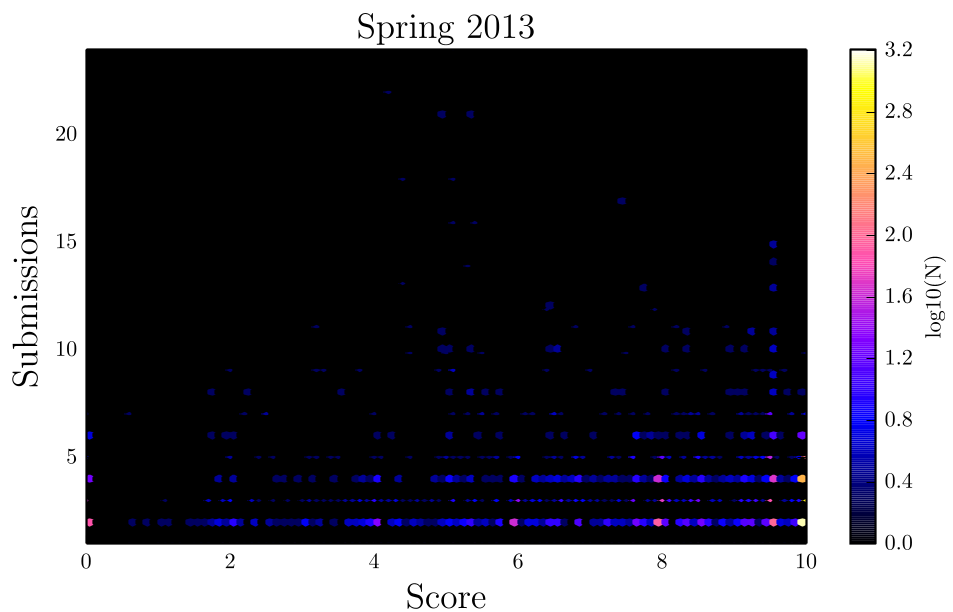 Figure: Heat maps correlating final scores with the number of submissions. Capping attempts encouraged higher-quality initial work.
On-Campus Acceptance
When 150 EPFL students were given the option to take the MOOC instead of traditional lectures, 80% rated the experience as excellent. Crucially, they preferred online forums and automated feedback over traditional TA-led "exercise sessions" (50% vs 30% satisfaction).
 Figure: The "U-Curve" of scores shows that students who engage with the feedback loop tend to reach near-perfect marks.
Critical Analysis & Conclusion
The Takeaway
The "Progfun" MOOC succeeded because it bridged the gap between academic rigor (Martin Odersky's principles) and industrial utility (the Scala ecosystem). It proves that when tools are integrated correctly—reducing the "waiting time" for feedback—students are willing to tackle highly complex subjects.
Limitations
- Technical Barrier: The requirement to use SBT and IDEs might be a hurdle for absolute beginners, though it was a "feature" for the professionals in this study.
- Cost: Maintaining an AWS auto-scaling infrastructure for 100,000 students requires significant financial backing compared to static video courses.
Future Outlook
This paper serves as a blueprint for the "flipped classroom" and "professional MOOCs." It suggests that the future of CS education is not in the lecture hall, but in the automated, cloud-integrated development environment.