
Structural Cascading: Uncovering the DNA of Social Network Formation
Fundamental principles of network formation among preschool children
This study investigates the fundamental mechanisms of social network formation in preschool children across 11 classrooms. Using longitudinal observational data and the SIENA actor-based model, it identifies a "structural cascading" process where complex network features like popularity and triadic closure emerge from simpler dyadic foundations.
TL;DR
How do human social networks actually begin? By observing preschool children—individuals with minimal prior social "contamination"—researchers have identified a process called Structural Cascading. While the urge to reciprocate is present from day one, more complex structures like popularity and closed-friendship circles take time to "crystallize," following a predictable evolutionary path from simple dyads to dense triadic clusters.
The "Clean Slate" Motivation: Why Preschoolers?
Most social network studies focus on adults (e.g., college students, office workers). The problem? Adults bring "social baggage"—pre-existing schemas about how to behave, who to like, and how to navigate status.
To see the fundamental principles of human affiliation, the authors turned to the preschool classroom. It is a unique environment where:
- Strangers Meet: For many, it's the first time they interact with a large pool of peers.
- Autonomous Choice: Unlike family or neighborhood playdates, children here choose their own partners.
- High Fidelity Data: Instead of unreliable self-reports (asking a 4-year-old "who is your best friend?"), the authors used 21,365 direct 10-second observations of actual play.
Methodology: The SIENA Framework
To analyze this evolving social architecture, the study employed the SIENA (Simulation Investigation for Empirical Network Analysis) model. This allows researchers to separate "selection" (choosing friends like yourself) from "structure" (the network itself driving new ties).
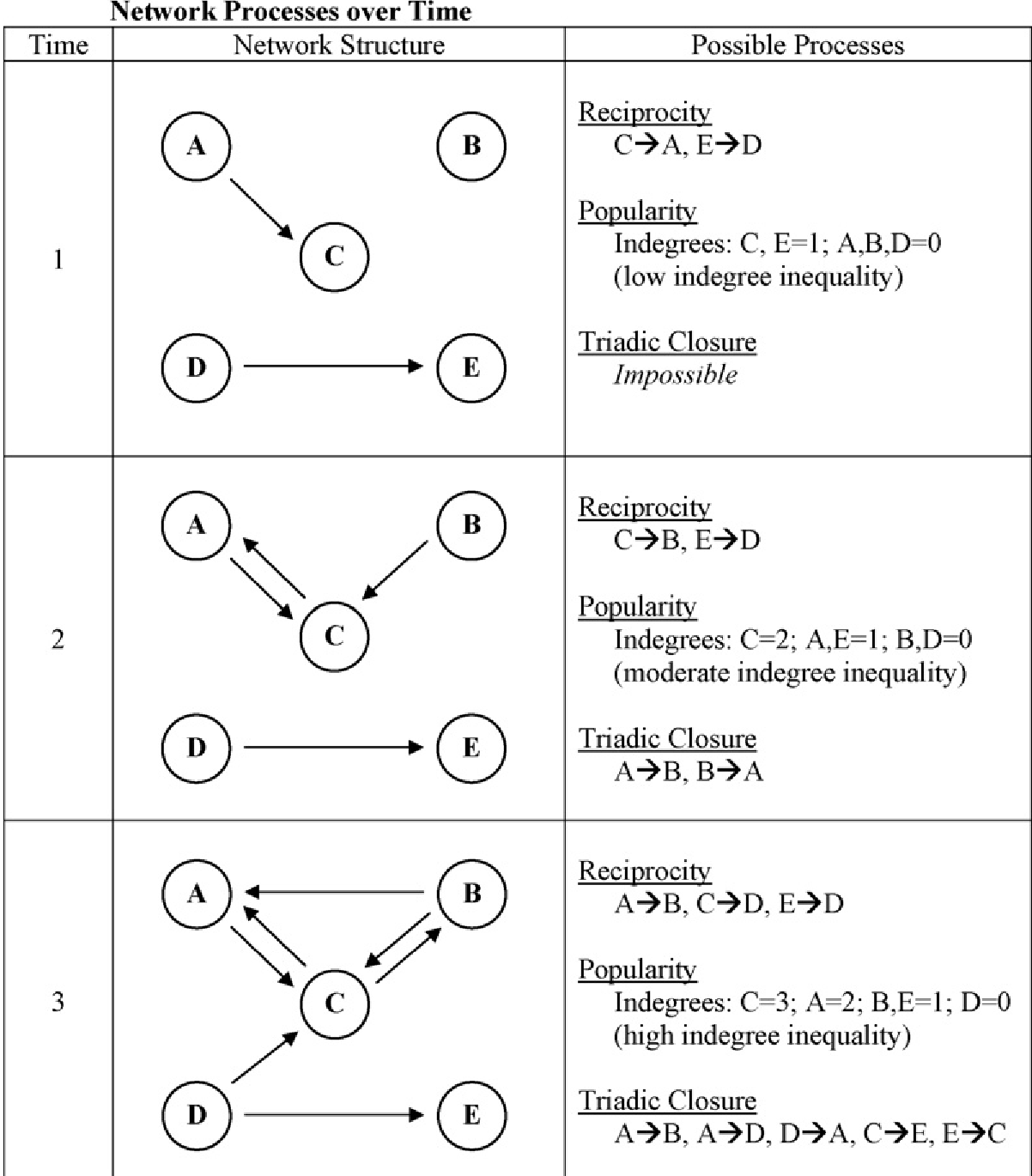 Figure 1: A conceptual model of how networks evolve from simple reciprocity to complex triadic closure.
Core Mechanism: Structural Cascading
The authors propose that network formation isn't a single event but a cascade based on structural complexity:
1. Reciprocity (The Foundation)
- The Logic: If you play with me, I play with you.
- The Finding: This is the simplest dyadic structure. It was present and strong from the very first observation period and remained stable throughout the year. It is the "universal constant" of social life.
2. Popularity (Preferential Attachment)
- The Logic: "Everyone else is playing with him, so he must be fun."
- The Finding: Popularity requires an unequal distribution of attention. The data showed that popularity became significantly more important midway through the year. As the network "crystallized," children converged on certain high-status peers.
3. Triadic Closure (The "Friend of a Friend" Effect)
- The Logic: If A is friends with B, and B is friends with C, A and C are likely to become friends.
- The Finding: This is the most complex structure, requiring both geographical proximity and the cognitive ability to perceive relationships between others. It showed the most dramatic growth, peaking in the final months of the school year.
Experimental Evidence & Results
The study transformed 9 months of observations into four discrete waves. The transition from "random interactions" to "structured networks" is clearly visible in the statistical coefficients.
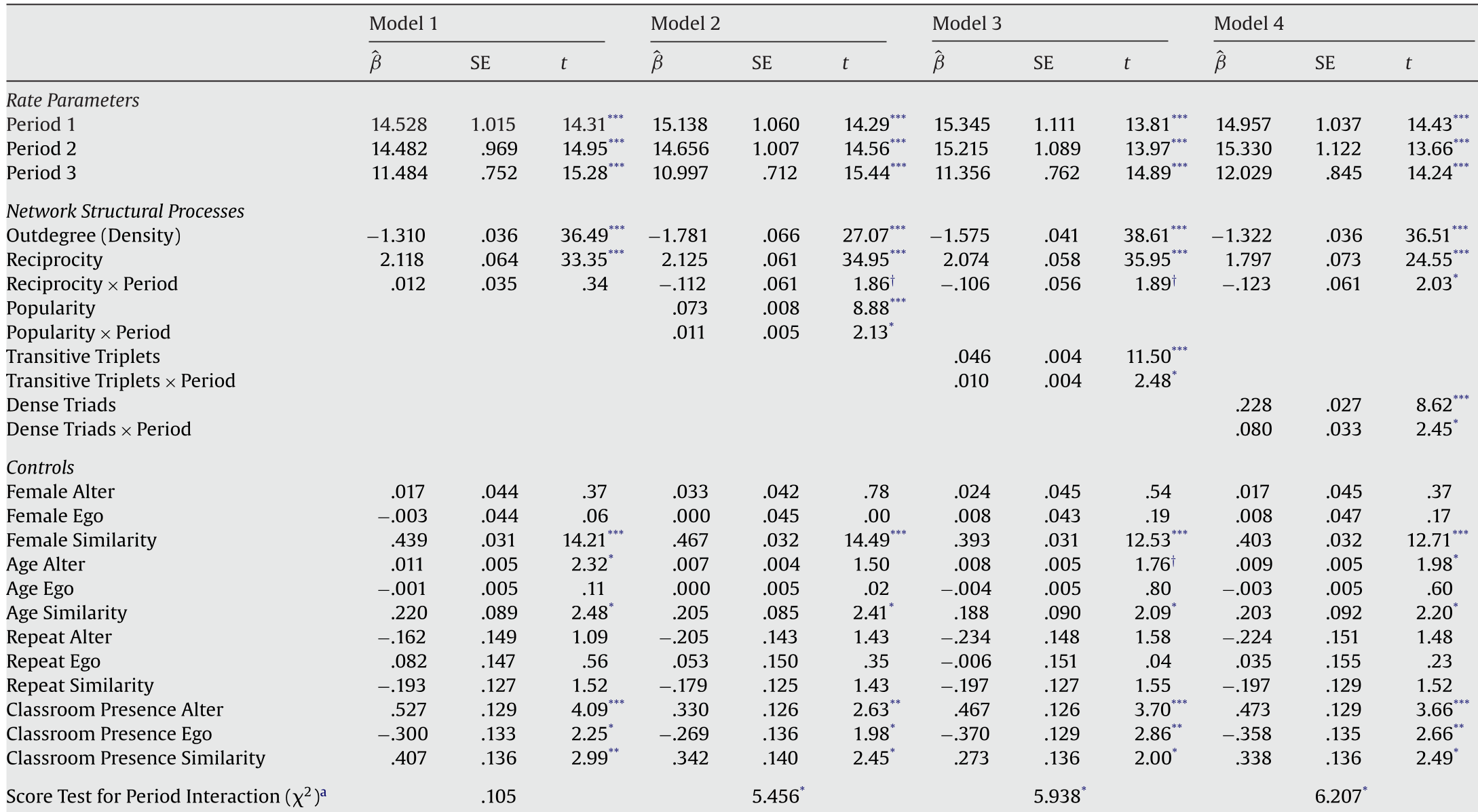 Key Analysis: Note the significant 'Interaction with Period' for Popularity (Model 2), Transitive Triplets (Model 3), and Dense Triads (Model 4).
As shown in the findings, the odds of forming a relationship through a "Dense Triad" (a group of three where all members reciprocate each other) increased from 1.16x in the first period to 1.36x by the end of the year. This suggests that the "filling in" of the network isn't random—it's highly clustered.
Critical Insight & Conclusion
The most striking takeaway is that these network processes were not moderated by age. Whether a child was 3 or 5, the "rules" of the cascade remained the same. This suggests that structural cascading is an endogenous property of human groups—a "fallback" setting for how we organize ourselves when placed in a new social ecology.
Takeaway for Practitioners: For educators and child development experts, this highlights that social "cliques" and popularity hierarchies are not just "bad behavior"—they are fundamental phases of network evolution. Understanding that triadic closure takes time can help in identifying children who are "falling out" of the cascade early on.
Limitations: The study focuses on Head Start classrooms (lower SES). While the authors argue these processes are universal, future work should explore whether high-resource environments or different cultural settings (e.g., collectivist vs. individualist) accelerate or alter the cascade's pace.