
Beyond Acquaintances: Reimagining Funding Collaborator Recommendations via Social Networks
Recommending funding collaborators with scholar social networks
The paper introduces a novel collaborator recommendation system for research funding, utilizing a "co-applicant network" modeled from NSFC data. It proposes a utility function that balances expert competence (via PageRank), collaboration possibility (via social distance), and a unique "extended degree" metric to help researchers expand their professional circles beyond existing clusters.
Executive Summary
TL;DR: This paper presents a specialized recommendation framework for research funding collaborators. By modeling the co-applicant network, the authors move beyond simple "friends of friends" recommendations. They introduce a utility function that prioritizes both the competence of a researcher and their ability to expand the user's professional circle into new, strategic clusters.
Positioning: This work bridges the gap between traditional Expert Recommender (ER) systems and Link Prediction. It specifically addresses the "funding application" niche, where the incentive is not just to work with people you know, but to form a competitive, resource-rich alliance.
The "Cohesion vs. Expansion" Paradox
In academic networking, we face a fundamental conflict. Working with people you know (High Cohesiveness) reduces communication costs and increases trust. However, a team of only acquainted people often lacks new resources and diverse perspectives—critical factors for winning prestigious national grants like the NSFC.
Most existing systems (e.g., those based on co-authorship) optimize for Likelihood (who are you likely to work with?), whereas this paper optimizes for Utility (who should you work with to grow your influence?).
Methodology: The Utility Function
The core of the paper is a multi-factor utility function designed to provide a "balanced" recommendation. The authors argue that the "goodness" of a potential edge depends on:
- Competence (Authority): Calculated using a PageRank-style random walk over the co-applicant network to identify high-impact researchers.
- Extended Degree (The Insight): This measures the "reach" a new person provides. If connecting with Person B allows you to reach 10 new researchers in a different cluster, Person B has a high extended degree.
- Possibility (Distance): A measure based on the shortest path between nodes. If someone is too far away (e.g., distance > 10), the likelihood of a successful collaboration is near zero.
Architecture & Network Modeling
The system uses a hierarchical clustering approach (Girvan-Newman) to identify "Groups" or "Clusters" within the network. These represent research communities or institutional silos.
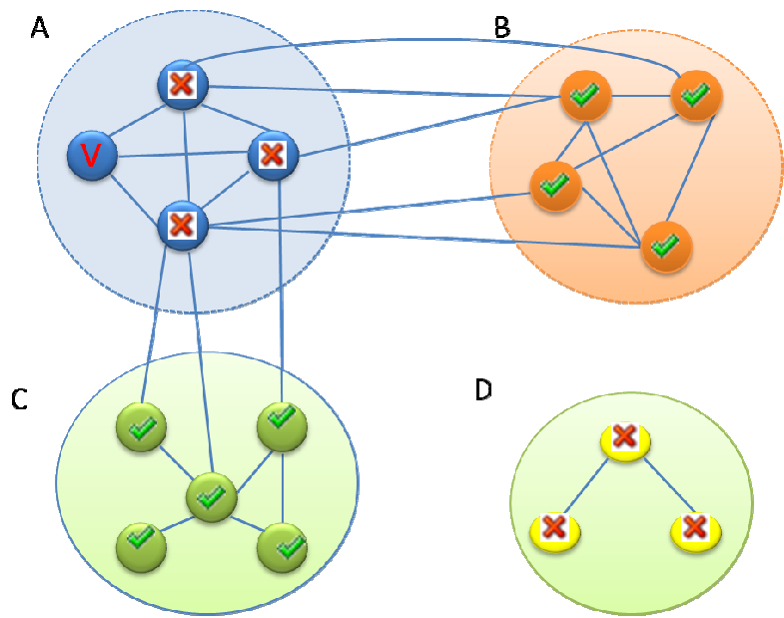 Fig 1: The model prioritizes candidates in close but distinct groups (B and C) over those in the same group (already known) or completely disconnected groups (D).
The Extended Degree is formally defined as: This captures the "newly accessible nodes" within hops after the collaboration is formed.
Experimental Results
The authors tested their model on a real-world dataset from the National Science Foundation of China (NSFC), focusing on the computer science field.
Key Comparative Findings
In a case study for researcher "Lu Huaxiang," the system filtered an initial set of 544 candidates down to 35 via cluster-closeness logic, then ranked the top 10 using the utility function.
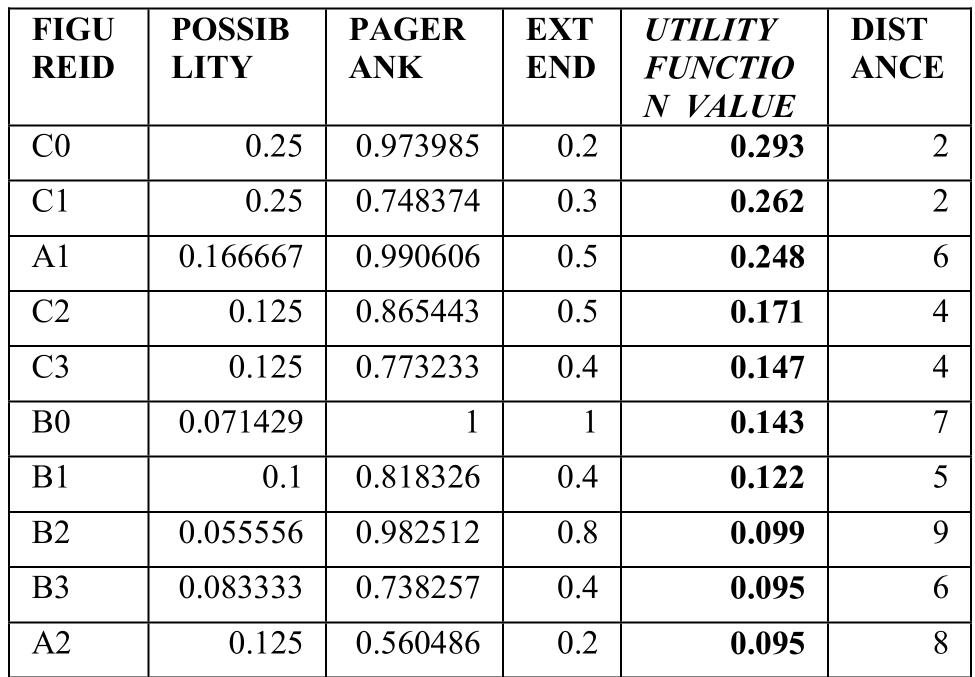 Table 1: Top 10 recommendations showing how high PageRank is balanced against social distance and expansion potential.
The visualization of these results confirms that the recommended collaborators (marked in red below) are not just immediate neighbors but are strategically distributed across the "social landscape" to facilitate circle expansion.
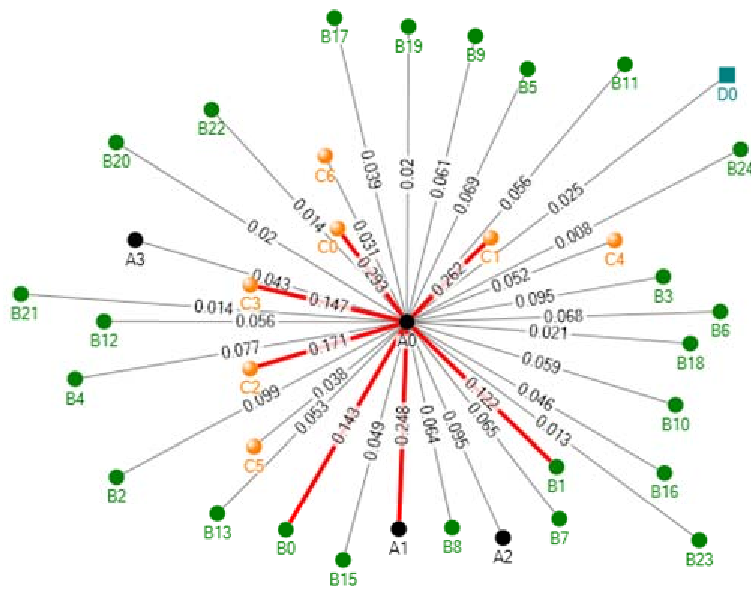 Fig 2: Recommended nodes are often bridges to other dense sub-networks.
Critical Insight & Future Outlook
The most valuable contribution of this paper is the quantification of "Circle Expansion." In the era of "Big Science," where multidisciplinary collaboration is mandatory for major funding, tools that can identify "trusted strangers" are more valuable than those that simply find similar peers.
Limitations:
- The model currently relies purely on co-applicant data. Integrating semantic topic modeling (analyzing project abstracts) would likely improve the "Competence" metric.
- The social distance threshold is static; a dynamic threshold based on the specific research sub-field might be more effective.
Conclusion: This work provides a solid foundation for the next generation of academic networking tools—moving from "who do you know" to "who should you know to win."