
TSG-MF: Decoding the Trinity of Multi-Tag, Social, and Geographical Cues for POI Recommendation
Fused matrix factorization with multi-tag, social and geographical influences for POI recommendation
This paper proposes TSG-MF, a fused Matrix Factorization framework for Point-of-Interest (POI) recommendation in Location-Based Social Networks (LBSNs). It integrates multi-tag content, social regularization, and geographical distance factors into a unified latent factor model to achieve state-of-the-art performance on the Yelp dataset.
TL;DR
Point-of-Interest (POI) recommendation is inherently more complex than suggesting a movie or a book. Your choice depends not just on what you like, but where you are and who you trust. This paper introduces TSG-MF, a fused Matrix Factorization framework that explicitly models the "Trinity" of Location-Based Social Networks (LBSNs): Multi-tag content, Social trust, and Geographical constraints. By fusing these into a unified objective function, the model achieves a significant jump in accuracy over traditional latent factor models.
The Architecture of LBSNs
The authors posit that LBSNs are not flat networks but three-layered structures. Traditional Collaborative Filtering often collapses these layers, losing vital context:
- Content Information Layer: Tags, comments, and descriptions.
- Social Relation Layer: Trust links and friendship networks.
- Geographic Space Layer: The physical coordinates and regional clusters.

Deep Dive into the "Trinity"
1. The Multi-Tag Insight: Beyond Item-Level Ratings
Two users might rate the same hotel highly, but one loves the "spa" while the other cares for the "business center." TSG-MF extracts a User-Tag Matrix from the initial User-POI data. To avoid the noise of generic tags (like "restaurant"), they employ the Wilson Score to assign statistical significance to tags, ensuring that unique, representative tags carry more weight in the latent space.
2. Geographical Influence: Tobler’s Law in Action
Geography isn't just about distance; it's about regional centers. The authors implement a normalized distance function that accounts for whether a user is looking within their current activity region or across regional boundaries. This mirrors human behavior: we are far more likely to visit a mediocre cafe nearby than a great one three cities away.
3. Social Influence: The Distance Decay
Social influence in the real world is bounded by geography. Tom is likely to visit a bar recommended by a friend, but that influence decays as the physical distance between Tom and the bar increases. TSG-MF modifies traditional Social Regularization by incorporating these distance factors, ensuring the latent user vectors and (friends) are pulled closer only when geographically relevant.
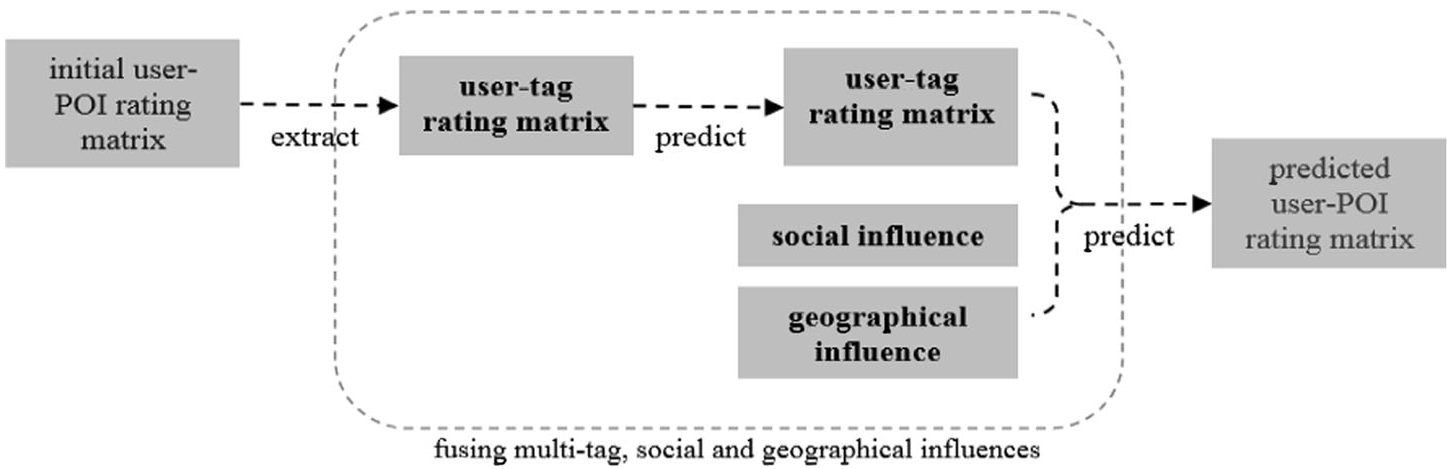
Methodology: The Fused Objective Function
The core of the paper is the optimization of a modified MF objective function:
The predicted rating is no longer just a dot product of latent vectors; it is augmented by the multi-tag influence and scaled by the geographical factor .
Experimental Results
The model was tested on the Yelp dataset (1,059 users, 1,628 POIs).
- Accuracy: TSG-MF consistently yielded the lowest RMSE and MAE across various training densities (60% to 90%).
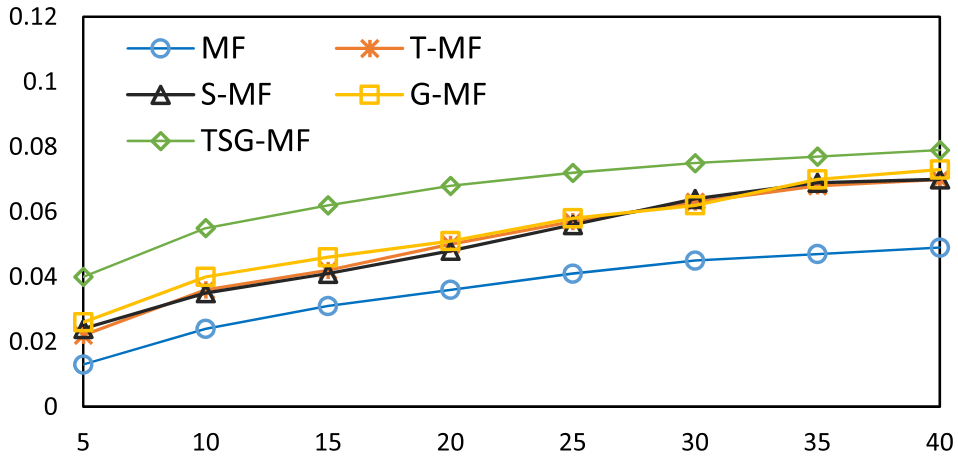
- Recall@K: In top-K recommendation tasks, the "fused" approach significantly outperformed models that only looked at a single influence (e.g., just social or just geo).
Critical Insights & Future Outlook
The "Secret Sauce" of this paper is the granularity of the tag analysis combined with the physical reality of social links. While many papers treat "social" as a purely digital link, this work correctly identifies that distance mediates trust in the physical world.
Limitations: The model relies on explicit tags and region clustering, which might be sparse in emerging LBSN platforms. Future work could benefit from incorporating Temporal Dynamics—modeling how POI preferences change from morning to night.
Final Takeaway: To build a better recommender, stop treating the user as a point in a vacuum and start treating them as a member of a physical community.