
Fusing Behavioral Projection: A Logic-Based Paradigm for OSN Identity Theft Detection
8256_Fusing Behavioral Projection Models for Identity Theft Detection in Online Social Networks.
This paper proposes a logical fusion framework for identity theft detection in Online Social Networks (OSNs) by integrating three behavioral projection models: spatial distribution (USDM), posting interests (UPIM), and social contacts (USCM). The approach achieves SOTA performance by leveraging complementary effects between coarse behavioral dimensions, significantly outperforming individual projection models on Foursquare and Yelp datasets.
TL;DR
Detecting identity theft in Online Social Networks (OSNs) is a race against "coarse" data. Users rarely leave enough digital footprints in one dimension to build a perfect profile. This paper introduces a Logical Fusion Scheme that combines spatial, semantic, and social "projections" using simple but powerful Boolean operators (AND/OR), turning weak individual detectors into a robust, customizable defense system with significantly higher True Positive Rates (TPR).
The Motivation: The "Coarseness" Trap
Most behavioral identification research assumes a "holographic" view of the user—perfectly aligned timelines of every action. In reality, OSN data is fragmented. A user might check in on Foursquare but post tips on Yelp, leaving only "projections" of their true behavior in each silo.
Existing methods often fail because:
- Intrusiveness: Frequent re-authentication ruins user experience.
- Data Sparsity: Most users have fewer than five records per dimension, making individual-level modeling nearly impossible without social context.
The authors' key insight is that while one dimension (e.g., location) might be insufficient, the complementary interaction between dimensions (Location + Interests + Friends) can reveal an impostor who might mimic one aspect of a victim but fails to replicate the entire behavioral logic.
Methodology: Building the Projections
The framework consists of three specialized modules:
- User Spatial Distribution Model (USDM): Uses Kernel Density Estimation (KDE) enhanced by Collaborative Filtering. It doesn't just look at where you go, but weights those locations based on your similarity to other users.
- User Posting Interests Model (UPIM): Utilizes Latent Dirichlet Allocation (LDA) to extract topic vectors (). It compares a user's historical interests with current posts using Jensen–Shannon (JS) divergence.
- User Social Contacts Model (USCM): Measures the change in contact patterns using Jaccard similarity between a user’s historical friends and current interactions.
The Logical Bridge
Instead of complex neural stacking, the authors use Boolean Logic. They prove there are exactly 18 valid non-negation combinations (e.g., , ).
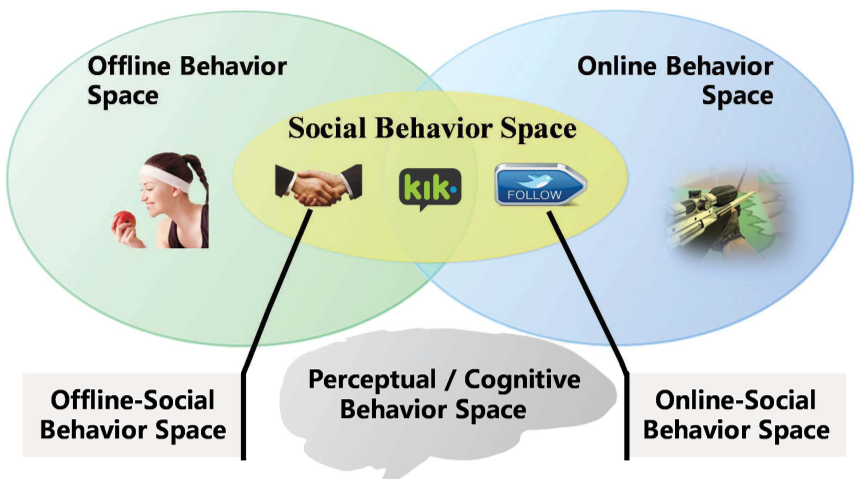 Figure: The conceptual framework of composite behavior divided into offline, online, and social categories.
Experimental Results: The Power of OR/AND
Testing on Foursquare and Yelp datasets, the results confirm that fusion models consistently outperform single-dimension models.
- Precision vs. Recall: Models incorporating the conjunction () operator significantly boost Precision (filtering out false alarms), while disjunction () maximizes the Detection Rate (TPR).
- The "Sweet Spot": The "Triple-OR" model () achieved a massive TPR of 98.2% on Foursquare, though with a slightly higher Disturbance Rate (FPR).
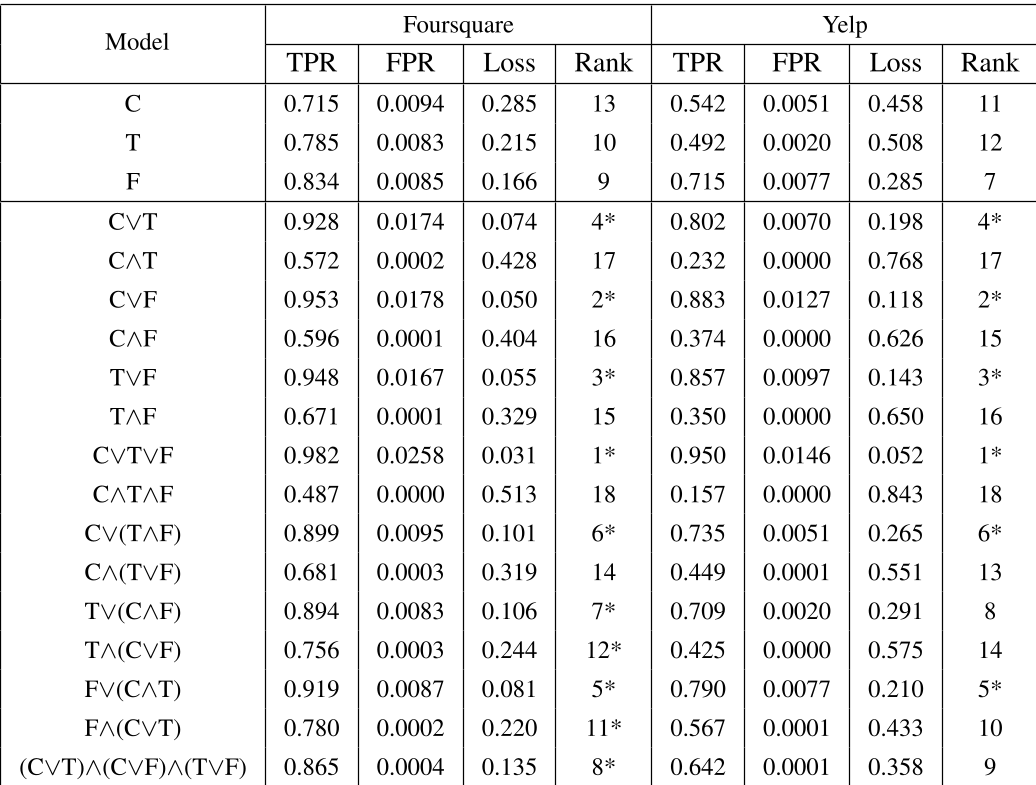 Table: Ranking of fusion models by 'Loss' (a combined metric of TPR and FPR). Note how fusion types dominate the top ranks.
Deep Insight: Customized Security
One of the most valuable contributions is the analysis of the Demand Coefficent (). In cybersecurity, different apps have different "risk appetites":
- High-Security Vaults: Focus on Precision (don't flag innocent users). Logic: Conjunction-heavy (e.g., ).
- Early-Warning Systems: Focus on Recall (catch every possible thief). Logic: Disjunction-heavy (e.g., ).
The authors provide a mathematical mapping showing that the optimal logic type is independent of the specific dataset and strictly dependent on the industry's demand for safety versus user convenience.
Conclusion & Limitations
The paper successfully moves away from the "one-size-fits-all" model. However, a notable limitation is the reliance on simulated identity theft (swapping user records) due to the scarcity of publicly labeled real-world theft data. Future work on Adaptive Selection—where the system automatically chooses the best logic for a specific user's data richness—could be the final piece in making autonomous OSN security a reality.
Takeaway: Effective security isn't about having the most complex model; it's about how you logically combine the "fragments" of evidence you already have.