
Fusion Mobile: Balancing P2P Complexity with Community-Centric Design
Fusion mobile: a case study on designing a social networking system with communities
This paper presents Fusion Mobile, a S60-platform application enabling community-based social networking and P2P file sharing. Through an iterative co-design process, the study identifies critical trade-offs in mobile UI design and the impact of community involvement on prototyping.
TL;DR
Fusion Mobile is a pioneering case study in developing a mobile Peer-to-Peer (P2P) social networking system. It investigates how to bridge the gap between complex desktop P2P file sharing and the "on-the-fly" needs of mobile users. The research reveals that technical robustness often clashes with user experience (UX) expectations, particularly regarding information density and workflow fluidity.
Problem & Motivation: The Fragmentation of Early Mobile Socializing
In 2009, the mobile landscape was a "Wild West" of fragmented operating systems and hardware constraints. Social networking wasn't just about reading status updates; it was about sharing heavy audiovisual content.
The authors identified two major pain points:
- Lack of Integrated Workflows: Users had to jump between the social app and the phone's native camera app, breaking the "immersion" and causing massive cognitive overload.
- The Feature Bloat vs. Performance Paradox: Adding "cool" social features (like real-time chat and status) often led to battery drainage and cluttered interfaces that buried essential content.
Methodology: Co-Designing with the Community
The Fusion Mobile team didn't just build in a vacuum; they adopted an Iterative Co-Design approach using Python on the S60 platform.
- The Architecture: A multi-layered approach using a "Web-bridge" to connect mobile clients to a stable desktop P2P node. This allowed mobile devices to participate in a P2P network without the full computational weight of a primary node.
- Prototyping: The team moved from functional specifications to wireframes, then to high-fidelity prototypes tested in real-world scenarios.
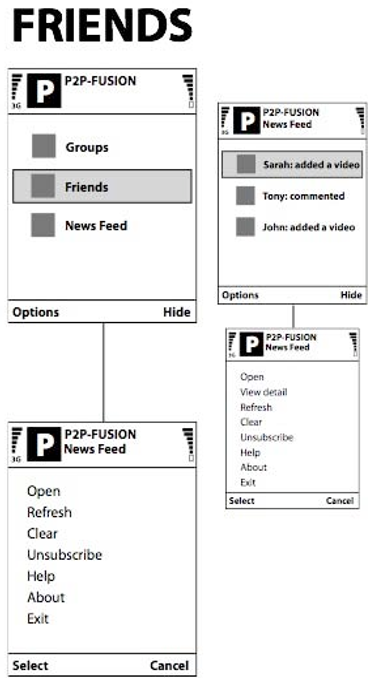 Figure: The progression from wireframes to structural interaction design.
Key Insights: The "iPod" Expectation & Information Overload
The experimental results yielded several "hard truths" about mobile design:
1. The High Bar of User Expectations
Even with a technical prototype, users compared the experience to the Apple iPod. They expected intuitive, hierarchical navigation (left/right clicking) even when the hardware didn't support it. This suggests that "minimalism" in a prototype can sometimes backfire if it falls too far below the cultural "UI bar."
2. The 60% Noise Rule
In testing the chat and notification systems, users reported that roughly 60% of the data on the screen was unnecessary. Displaying full timestamps or too many status logs created "data smog" that made the social networking component impossible to follow once user counts increased.
 Figure: Community members testing the prototype on Nokia N95 devices.
3. The Power of Terminology
The study found that "Groups" functioned differently in a P2P mobile context than on a desktop. Because all mobile users were essentially on the same node, users found the term "Groups" misleading, suggesting "Channels" as a more accurate mental model.
Critical Analysis & Conclusion
Fusion Mobile serves as a cautionary tale for any developer building community-driven tools.
Takeaway: Designing for a community is not a static task. The role of the designer shifts from "Creator" to "Facilitator." You must manage expectations (like the iPod comparison) and be prepared to strip away "cool" features to save battery and reduce cognitive load.
Limitations: The study was conducted in a stable indoor environment, which failed to account for the "real-world" instability of mobile networks (3G/WLAN handovers). Furthermore, the lack of an integrated camera API proved to be the project's biggest UX bottleneck.
Future Outlook: The lessons of Fusion Mobile—balancing real-time feedback with battery life and simplifying the sharing "pipeline"—remain highly relevant for modern decentralized social networks (DeSoc) and P2P mobile apps.