
Collective Intelligence: Engineering the Evolving Data for Future Supply Chains
Future Supply Chain Processes and Data for Collective Intelligence
The paper proposes a conceptual framework for "Future Supply Chains" leveraging Collective Intelligence. It introduces a redefined role for data using Semantics and Service Oriented Architecture (SOA) to achieve tighter integration and behavioral synchronization across diverse organizational landscapes.
TL;DR
This research challenges the traditional view of supply chain data as static records. By defining Semantics = Data + Behaviour, the authors propose a future where data "evolves" along the process cycle, utilizing Service Orientated Architecture (SOA) and Collective Intelligence to enable seamless cross-organizational coordination and autonomous decision-making.
The "Intelligence" Gap in Modern Logistics
In the current era of SCM (Supply Chain Management), organizations are drowning in data but starving for agility. The authors point out a critical flaw in current ERP (Enterprise Resource Planning) systems: they lack "extended enterprise functionality."
Most supply chains rely on disconnected calculations (like MRP) that lose context when communicated externally via purchase orders. The problem isn't just a lack of information; it's the lack of flexibility and understanding. When data moves between systems, its meaning often fragments, leading to the "garbage in, garbage out" phenomenon that has caused $100 million implementation disasters (e.g., Nike's planning failure).
Methodology: The Semantic Shift
The core insight of this paper is a move toward Behavioral Semantics. The authors argue that for a supply chain to be "smart," data must contain the rules for its own processing.
The Formula for Smart Data
The paper leverages a powerful conceptual formula:

- Data: The object/document information.
- Behaviour: Intelligent rules, decision-making processes, or mechanical batch jobs.
By embedding behavior into data, the supply chain shifts from a series of manual hand-offs to an orchestrated system where data "knows" its next step.
Evolving Data Usage
Unlike current models (Fig 1), the "Future" model (Fig 2) emphasizes high-level synchronization and semantically rich content early in the planning cycle.
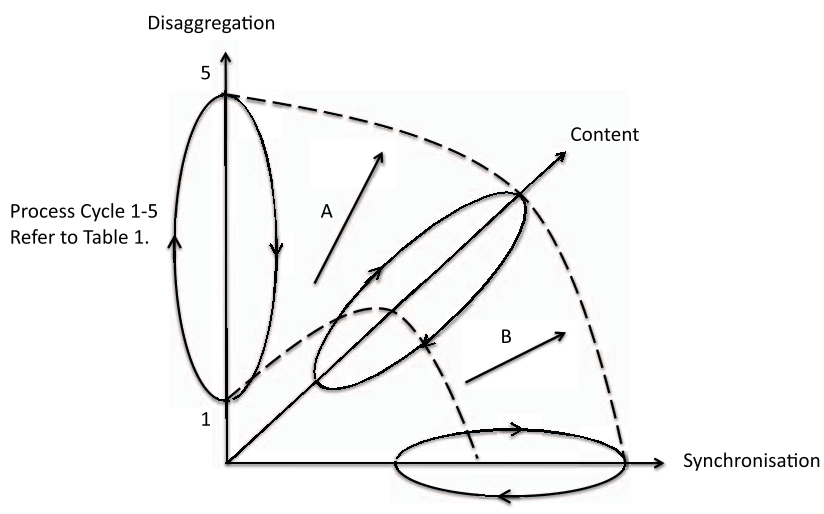 Figure 2: The Future Supply Chain emphasizes earlier information sharing and bi-directional synchronization.
Execution: Lifecycle, Ownership, and Governance
The authors break down the transition into three critical pillars:
- Lifecycle (Evolution): Data should not be deleted or replaced statically. Instead, it should "evolve." As a product moves from forecast to execution, the data set accumulates precision, eventually replacing itself with knowledge of how to source the most current real-time data.
- Ownership: Ownership must be fluid. When a product is outsourced, the "owner" of the data shifts to the recipient, requiring flexible datasets that allow for hierarchical access.
- Governance: This introduces Social Governance. Just as Wikipedia or Google use collective human-computer interaction to maintain integrity, supply chains must use "Collective Intelligence" to handle heterogeneous data from multiple actors.
Experimental Insight: The S&OP Process
The paper maps these theories against a real-world Sales and Operations Planning (S&OP) cycle.
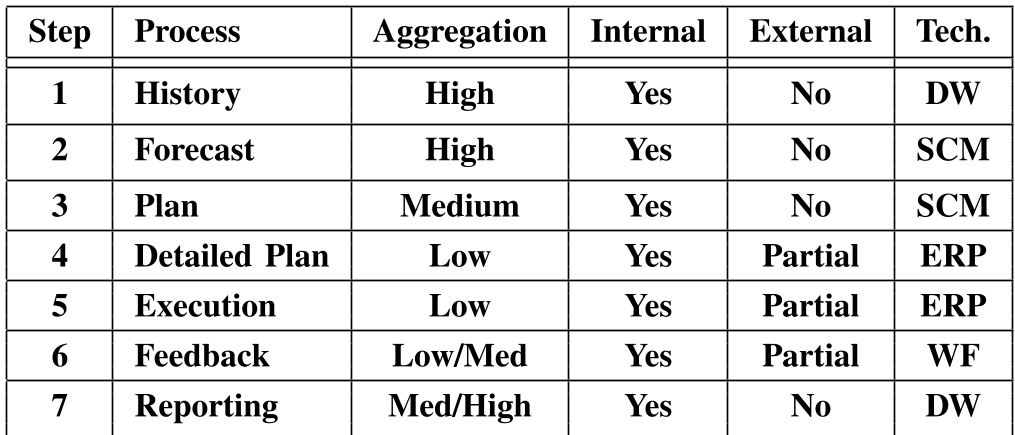
The transition from History (Step 1) to Execution (Step 5) involves a move from high aggregation to low aggregation. The authors suggest that by applying Semantic Precision, we can handle "date ranges" more effectively—starting with flexible windows in the planning phase and narrowing to rigid execution dates automatically as data flows through the SOA.
Critical Analysis & Conclusion
Takeaway
The shift towards Collective Intelligence isn't just about faster computers; it's about better Data Architecture. The value lies in "Self-aware data" that reacts to its environment, eliminating the need for manual searches across massive, stale datasets.
Limitations & Future Work
The authors acknowledge a major psychological and technical hurdle: the idea of deleting or evolving data is "alien" to current database designs. Furthermore, the goal alignment between competing organizations remains a social and strategic challenge that technology alone cannot solve.
Future supply chains will likely be a "blend of semantics, SOA, and ODS (Operational Data Stores)," creating an ecosystem where data is not just a ledger of what happened, but a blueprint for what must happen next.