
Navigating the Digital Noise: A Fuzzy-AHP Framework for Strategic Marketing Selection
The prevalence and rapid development of the Internet and mobile technology in recent decades has revamped our living styles and daily habits. To ride on the digital trend, more business activities have been engaged in the digital world. Marketing and advertising is one of typical business areas that is transformed digitally. The rise of Key Opinion Leaders (KOLs), social media platforms, and Omni-channel retailing have attracted countless business entities to consider the adoption of digital marketing tools for promoting and advertising their brands and products. However, with the increasing diversity of the types of digital marketing tools, they must be carefully selected based on a multiple number of criterion. In this paper, a fuzzy-AHP method is proposed and developed for assisting industry practitioners in systematically and effectively evaluate and select proper digital marketing tool(s) for adoption. The developed method not only streamlines the internal business process of digital marketing tool selection, but it also increases the practitioner's effectiveness of achieving the pre-defined strategic marketing objectives
This paper introduces a Decision Support System (DSS) leveraging the Fuzzy Analytic Hierarchy Process (Fuzzy-AHP) to evaluate and select digital marketing (DM) tools. The method optimizes marketing budget allocation by prioritizing channels like Social Media, Influencer Marketing, and SEM through a scientific Multi-Criteria Decision Making (MCDM) framework.
TL;DR
Marketing managers often struggle with "analysis paralysis" when choosing between TikTok influencers, SEO, or Email campaigns. This paper proposes a Fuzzy-AHP (Analytic Hierarchy Process) methodology that quantifies expert intuition. By applying this scientific lens, a case study revealed a 69% reduction in decision-making time, prioritizing Social Media and Influencer Marketing as the most impactful channels for beauty retail.
Background & Motivation: Moving Beyond "Gut Feeling"
In the modern Omni-channel landscape, the rise of Key Opinion Leaders (KOLs) and niche social platforms has made the marketing mix incredibly volatile. Historically, decision-makers relied on "gut feeling" or followed generic agency templates.
The authors argue that this lack of scientific rigor leads to two critical failures:
- Knowledge Gaps: Missing out on high-potential channels (e.g., e-WOM) due to a lack of internal expertise.
- Inefficiency: Excessive time spent in circular discussions, delaying market entry.
Methodology: The Precision of Fuzzy Logic
The core of this work lies in the Fuzzy-AHP technique. Standard AHP handles hierarchical decision-making but often fails to capture the "fuzziness" of human judgment—where an expert might feel one tool is "somewhat better" rather than "exactly 3 times better."
The Framework
The researchers built a three-tier hierarchy:
- Level 1: Goal (Optimal DM tool selection).
- Level 2: Criteria (Business Fundamentals, Demographics, Acquisition Performance, Online Exposure).
- Level 3: Sub-criteria (e.g., Geographical convenience, Purchasing power).
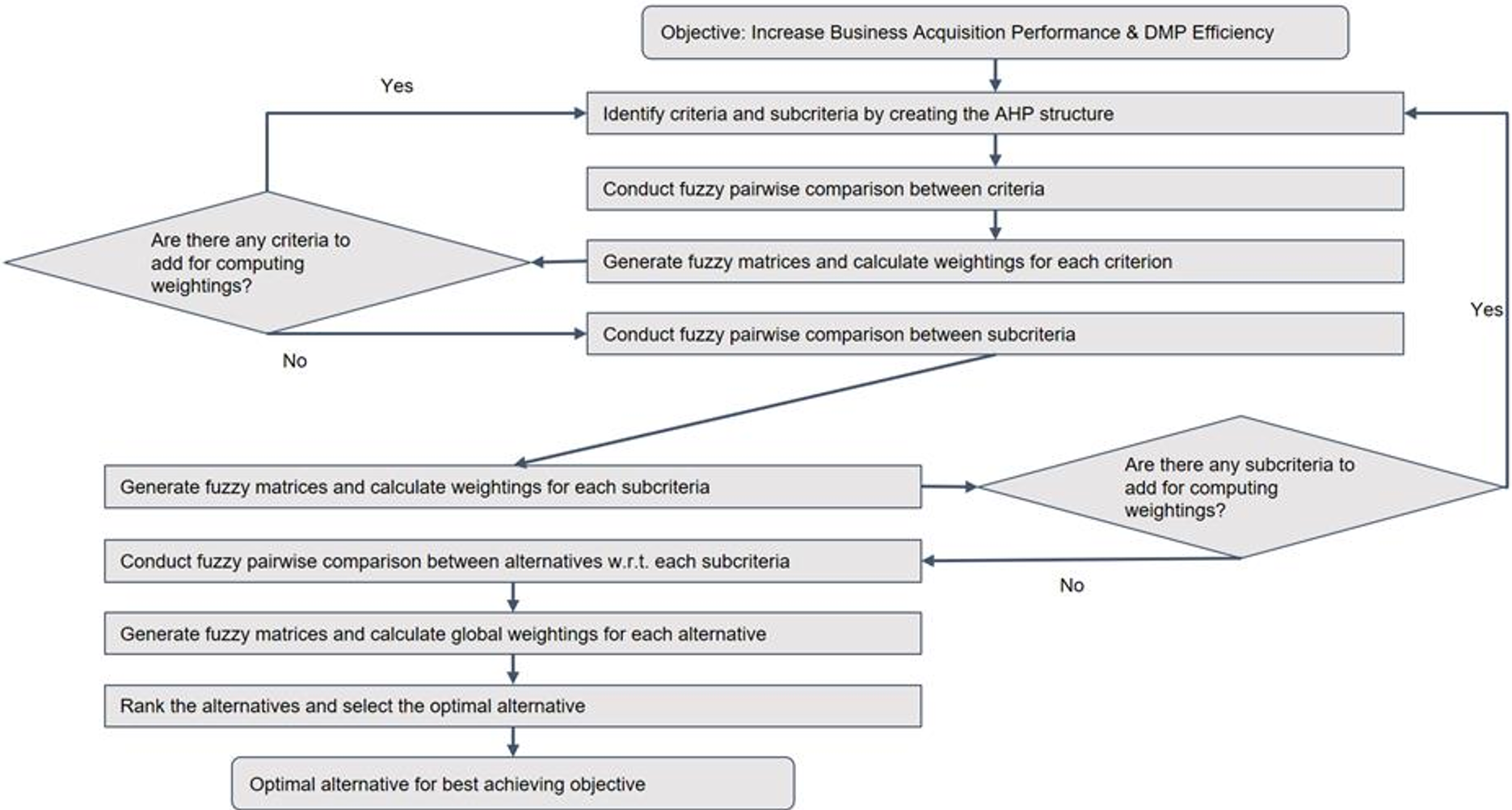
The model uses Triangular Fuzzy Scales to convert linguistic terms (like "strongly prefer") into numerical ranges. This accounts for the uncertainty inherent in professional opinions.
Results: Quantitative Insights for the Beauty Industry
When applied to a struggling beauty industry player, the model yielded surprising clarity. While Search Engine Marketing (SEM) is often considered the "gold standard," it ranked lowest in this specific strategic context.
Performance Metrics
The study measured the impact on the decision-making process itself:
- Credibility: Scored 9.67/10 by stakeholders.
- Standardization: Scored 9.67/10.
- Time Efficiency: 69.44% reduction in hours spent on planning.
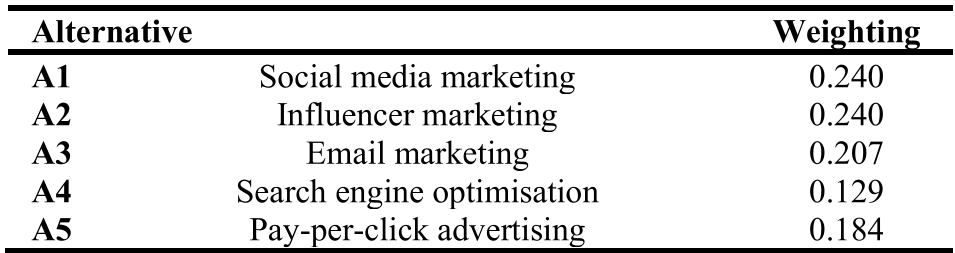
Table: Final Weightings for Digital Marketing Alternatives
Critical Analysis & Professional Takeaways
The beauty of this approach is its scalability. While the case study focused on beauty retail, the Fuzzy-AHP hierarchy can be recalibrated for any industry—from B2B SaaS to high-frequency FMCG.
The Catch: Like all MCDM models, it is "Garbage In, Garbage Out." The accuracy depends entirely on the selection of experts and the initial definition of criteria. If the stakeholders are biased against a specific technology, the Fuzzy-AHP will merely mathematically validate that bias.
Future Outlook: The next logical step is Integrating this MCDM approach with Real-time Performance Data. Imagine a system where the "weights" of the criteria are updated dynamically based on live conversion rates from Google Analytics, creating an autonomous, self-balancing marketing engine.
Conclusion
This paper serves as a bridge for practitioners who want to move from subjective "marketing art" to data-driven "marketing science." By standardizing the internal selection process, firms can stop debating and start executing.