
From Pairs to Groups: A Fuzzy Extension of Social Network Analysis
A Fuzzy Approach to Social Network Analysis
This paper introduces a fuzzy logic framework for Social Network Analysis (SNA), extending traditional binary adjacency relations to m-ary relations using Ordered Weighted Averaging (OWA) operators. It provides a mathematical basis for quantifying multi-party social cohesion and coalition potential.
TL;DR
Social Network Analysis (SNA) has long been trapped in a "binary" cage, looking only at whether two people are connected or not. This paper breaks that mold by introducing Fuzzy m-ary Relations. By using OWA (Ordered Weighted Averaging) operators, the authors allow us to calculate the "strength" of a relationship across a whole group (m-tuple), providing a mathematical bridge between simple pairwise links and complex collective behavior like political coalitions.
Background: The Limits of 1s and 0s
In classic SNA, the Adjacency Matrix is the gold standard. However, it suffers from two major flaws:
- Lack of Intensity: It treats all connections as equal (binary), ignoring that some friendships or alliances are stronger than others.
- Bidimensional Constraint: It focuses on pairs. But social phenomena like "consensus" or "cliques" are group properties that cannot always be reduced to simple 1-on-1 interactions.
The authors argue that by using Fuzzy Sets, we can replace the crude 0/1 with a membership degree in , and by using m-ary relations, we can analyze groups of any size .
Methodology: The Power of OWA Operators
The core technical contribution is the use of OWA operators to derive group relationship degrees from pairwise data.
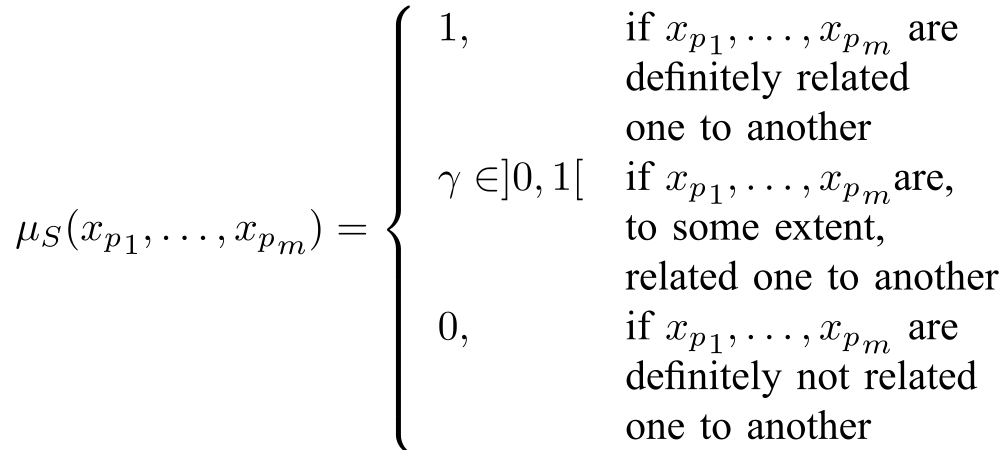
The Idea of (\rho)-dependence
If we have a group of people, there are possible pairs between them. The group's collective "strength" () is a function () of these pairwise strengths.
Why OWA?
Standard averages (arithmetic mean) are "blind" to distribution, and geometric means are destroyed by a single zero. OWA operators solve this by:
- Reordering the data from largest to smallest.
- Applying a weighting vector that can be tuned.
- "Orness" vs "Andness": An analyst can decide if a group is as strong as its strongest link (high orness) or must be held together by its weakest link (high andness).

Experiments: Finding the "Strongest" Coalition
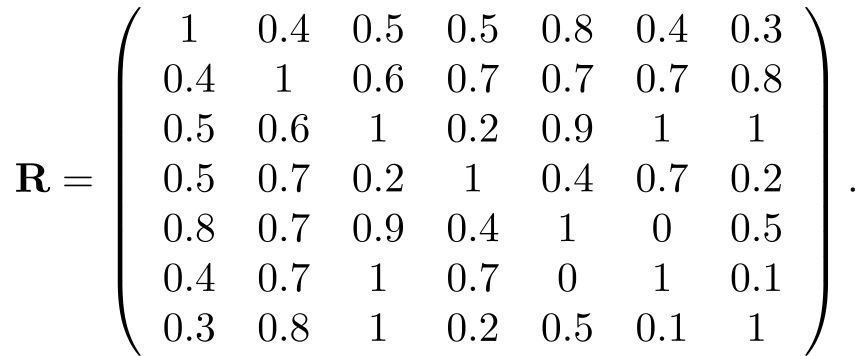
The paper provides a numerical example involving 7 objects (which could be political parties).
- Fuzzy Matrix: They start with a matrix where entries like 0.9 represent high consensus and 0.1 represent deep friction.
- Centrality: They show that a "Fuzzy Centrality" index is far more descriptive than traditional indices. While a crisp index might see three nodes as equally "central," the fuzzy version ranks them precisely.
- Coalition Discovery: By setting a majority threshold (e.g., ), the model can identify which specific subset of nodes has the highest aggregate relationship degree, essentially predicting the "Minimal Winning Coalition."
Critical Insight: Beyond Simple Graphs
What makes this work stand out is the Inductive Bias it introduces to social modeling. By adjusting the OWA weights, a researcher can simulate different social "atmospheres":
- Competitive environments: Where low relationship values are penalized heavily (high "andness").
- Synergistic environments: Where a few strong leaders can drive the group (high "orness").
Limitations
The primary hurdle is Computational Complexity. As (group size) increases, the number of combinations to check for grows exponentially. For large-scale social networks (millions of nodes), this exact approach would require significant optimization or heuristic search methods.
Conclusion: A New Lens for SNA
Brunelli and Fedrizzi have successfully moved SNA from a rigid, binary graph theory toward a fluid, logical framework. By treating social relations as fuzzy and multi-dimensional, we gain a toolset capable of modeling the nuance of human organizations, making it a precursor to contemporary "Hypergraph" analysis in machine learning.