
Decoding Student Behavior: Why Fuzzy Logic is Better for Web Mining
Fuzzy C-Means Clustering of Web Users for Educational Sites
This paper applies the Fuzzy C-Means (FCM) algorithm to perform Web Usage Mining on access logs from three educational websites. By treating user behavior as overlapping sets, the authors successfully categorized visitors into three distinct behavioral profiles: Studious, Crammers, and Workers.
TL;DR
Not all website visitors fit into neat boxes. In the context of educational websites, a student might be a "worker" on Tuesday but a "crammer" before a Friday exam. This paper leverages the Fuzzy C-Means (FCM) clustering algorithm to move beyond rigid categorization, successfully identifying student profiles across three university courses by embracing the inherent ambiguity of web usage data.
The Problem: The "Messiness" of Web Data
Traditional data mining often assumes that an object belongs to exactly one group. However, web logs are inherently "fuzzy." A single user session might involve downloading notes (Studious behavior) while also checking a discussion board for a lab assignment (Worker behavior).
The authors argue that "Hard Clustering" ignores this reality. Furthermore, educational data is plagued by:
- Incomplete Sessions: Users often leave tabs open or lose connection.
- Overlapping Boundaries: The transition between a regular student and a "crammer" is a spectrum, not a binary switch.
Methodology: The Power of Fuzzy Membership
The core of this research is the Fuzzy C-Means (FCM) algorithm. Unlike K-means, which assigns a point to the nearest center, FCM calculates a membership function matrix .
The Objective Function
The algorithm minimizes a weighted sum of squared errors, where is the "fuzzifier" (set to 2 in this study):

Feature Engineering
To capture behavior, the authors used five key attributes:
- Location: On-campus vs. Off-campus.
- Temporal: Day vs. Night access.
- Context: Access during scheduled lab/class hours.
- Volume: Number of hits.
- Action: Number of class-note downloads.
Experimental Analysis & Results
The study analyzed three distinct computer science courses at Saint Mary's University. Using FCM, they identified three key personas:
- Crammers: High hits, but even higher downloads. They show up late in the term and "hoard" resources.
- Studious: Balanced access, consistent downloads of current notes.
- Workers: High hit counts but low document downloads, likely using the site for interactive labs or discussion boards.
Performance Evidence
The following table demonstrates how the cluster centers (centroids) differ across the three courses:
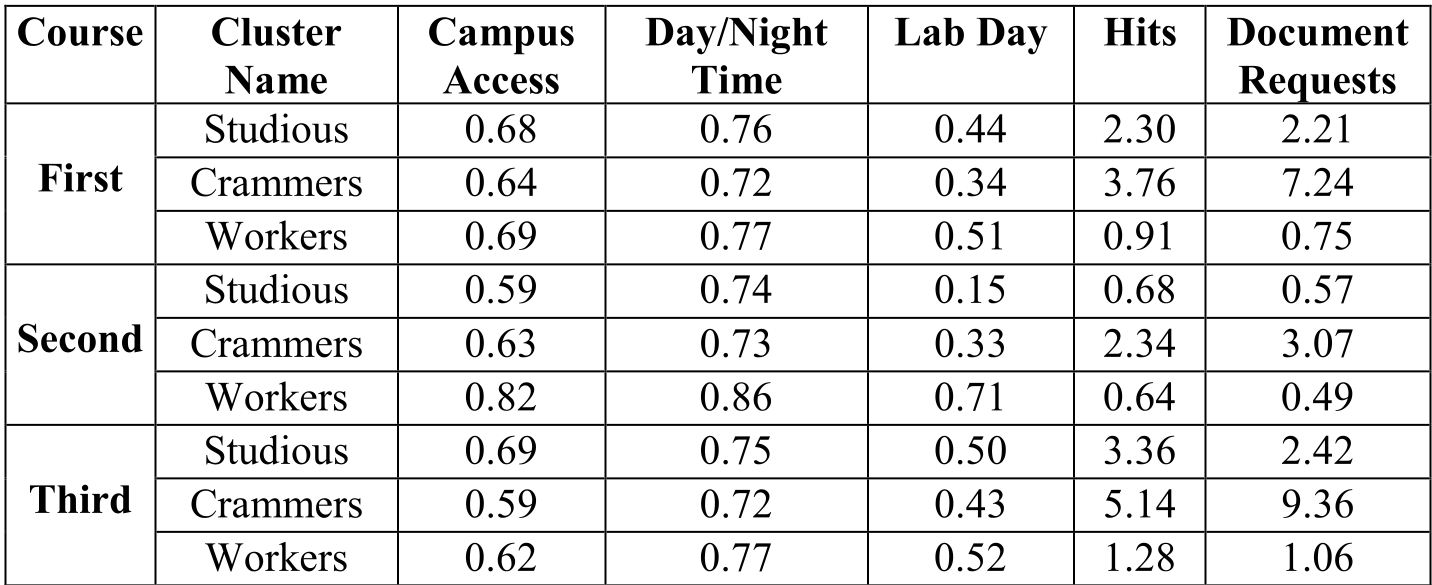
A key insight from the results was the temporal evolution of students. In the second-term course, the "Studious" cluster was significantly larger than in the first term, suggesting a "survival of the fittest" effect where more disciplined students progressed further.
Critical Insight: Beyond the Hard Label
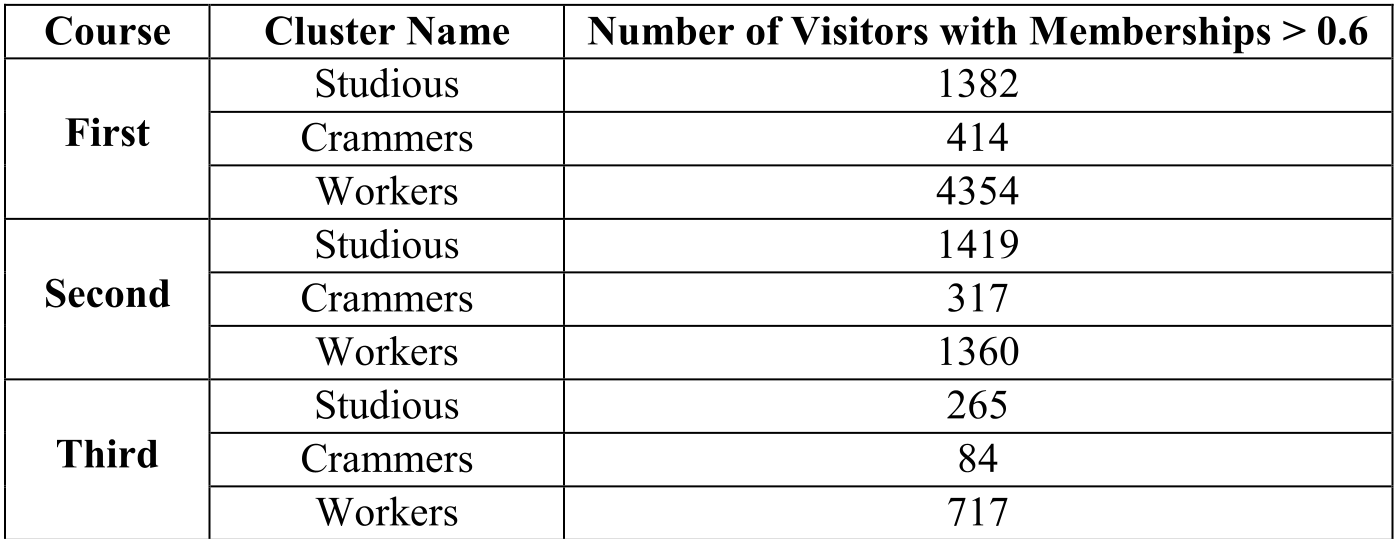
By using a threshold (membership > 0.6) to identify "strong" members of a cluster, the authors could still provide counts for administrative reporting while maintaining the mathematical flexibility of fuzzy sets.
Conclusion & Future Outlook
This work demonstrates that Fuzzy C-Means is a robust alternative for modeling human behavior. While the paper focuses on educational sites, the implications are much broader. In e-commerce or streaming services, users rarely fall into a single "customer segment."
Limitations: The study relies on manually cleaned data (removing 3-10% of logs). Modern applications would need automated ways to distinguish between a "Crammer" and a "Web Scraper" bot, which often share similar high-intensity download patterns.
Takeaway: The "fuzziness" of a model is not a weakness; it is a reflection of the complexity of the human subjects it seeks to understand.