
Scaling Speaker ID: Solving the Large Population Bottleneck with Fuzzy Decision Trees
12166_Fuzzy-Clustering-Based Decision Tree Approach for Large Population Speaker Identification.
This paper introduces a fuzzy-clustering-based hierarchical decision tree approach for large-scale speaker identification under noisy conditions. By partitioning the population using vocal source features independent of MFCCs and applying GMM-based identification only at the leaf nodes, the method achieves superior accuracy and lower computational complexity than standard MFCC-GMM-UBM baselines.
TL;DR
As speaker populations grow into the thousands, traditional GMM-UBM systems become slow and inaccurate, especially under noise. This paper presents a hierarchical solution: a Fuzzy-Clustering-Based Decision Tree that uses vocal source features to narrow down the search space before applying standard MFCC-GMM identification. The result is an 8% accuracy boost and a 6x reduction in processing time.
The Problem: The "Large Population" Penalty
In speaker recognition, there is a hidden tax on population size. For a small group (10–50 people), MFCC-GMM models are almost perfect. However, as the population scales to 3,800+ (as tested here), two things happen:
- Likelihood Overlap: With more speakers, the Mel-Frequency Cepstral Coefficients (MFCC) space becomes "crowded," increasing the chance of false matches.
- Computational Explosion: Scoring a 30-second clip against 4,000 models in real-time is computationally prohibitive.
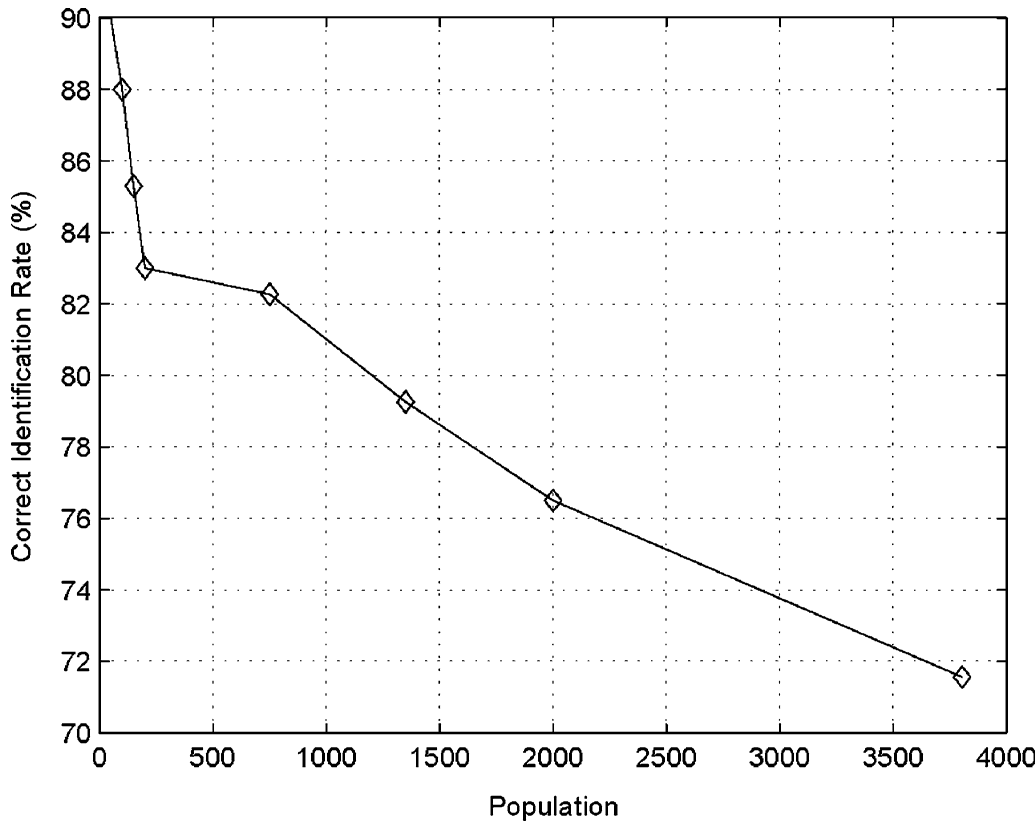 Visual evidence shows a steady decline in accuracy as the registered population grows, particularly under noisy (AWGN) conditions.
Methodology: Pruning the Search Space
The authors' core insight is to treat identification as a coarse-to-fine filtering task. Instead of comparing the test sample to every model, they use a 6-level decision tree built on features that are independent of MFCCs.
1. Robust Vocal Source Features
The system uses six levels, each corresponding to a specific vocal source attribute:
- Pitch (Fundamental Frequency): The most discriminative feature, used at the root.
- Five Vocal Source Characteristics: Extracted from the LP residual signal, including Pulse Width, Skewness (Positive/Negative), and Peak-to-Average Ratio (PAR).
These features are robust because they describe the physical movement of vocal cords (glottal source), whereas MFCCs describe the vocal tract.
2. The Logic of "Fuzzy" Redundancy
A major risk of decision trees is error propagation: if you go down the wrong branch at Level 1, you can never reach the correct speaker. To solve this, the authors use Fuzzy Clustering. Unlike a "hard" tree where a speaker exists in only one node, a speaker here can exist in multiple nodes simultaneously. This redundancy acts as a safety net, ensuring the "correct" speaker group is likely to be captured even if the test signal is noisy.
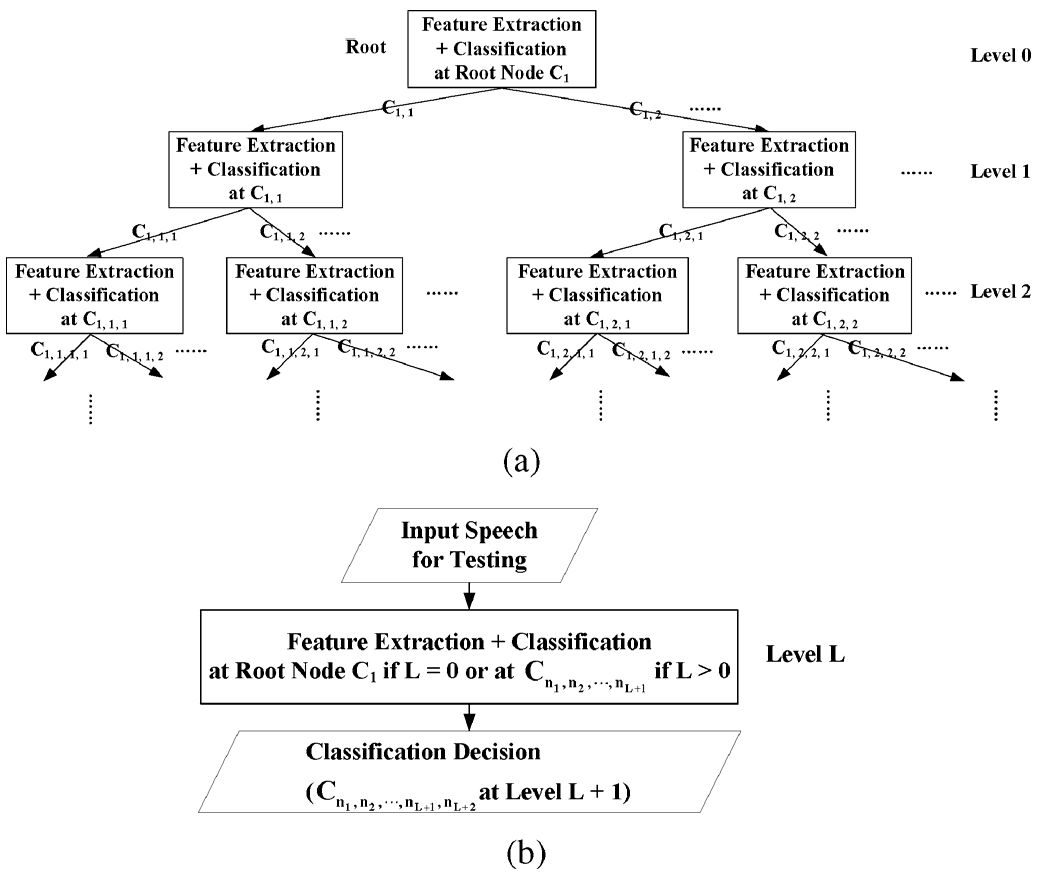 The architecture demonstrates how a single input follows a path through enabled nodes to a specific leaf node containing a small sub-population.
Experimental Results: High Accuracy, Low Latency
The approach was tested against 3,805 speakers using audiobooks. The benchmarks were standard GMM and GMM-UBM.
- Accuracy (30dB SNR): The Fuzzy Tree reached 88.8% CIR, outperforming GMM-UBM (80.93%).
- Speed: Most impressively, the average execution time dropped from 73 seconds down to 12 seconds. This makes the system "faster than real-time," as the processing time is shorter than the 30-second audio sample.
Hard vs. Fuzzy Clustering
The authors proved that "Hard" clustering is insufficient for this task. In a 30dB SNR scenario, a hard tree dropped to ~61% accuracy, while the fuzzy tree maintained over 97% classification accuracy at the leaf level.
| Level | Feature | Population Reduction | Fuzzy Accuracy |
|---|---|---|---|
| 1 | Pitch | 51.24% | 99.03% |
| 6 | Width (Pos) | 94.50% | 97.06% |
Critical Insight & Conclusion
The real brilliance of this work isn't just the tree structure, but the selection of features. By using vocal source features to prune the population, the authors essentially "pre-sort" the speakers so that those remaining at the leaf node have very different MFCC profiles. This maximizes the effectiveness of the final GMM stage.
Future Outlook: While this paper focuses on GMMs, the "Fuzzy Tree" logic could theoretically be applied to modern Deep Learning embeddings (like d-vectors or x-vectors) to speed up vector database searches in massive biometric systems.