
Cotton Yield Prediction: Bridging Expert Intuition and Machine Intelligence with Fuzzy Cognitive Maps
Fuzzy cognitive map based approach for predicting yield in cotton crop production as a basis for decision support system in precision agriculture application
This paper introduces a Decision Support System for precision agriculture based on Fuzzy Cognitive Maps (FCM) to predict cotton yield. By fusing fuzzy logic with expert knowledge representation, the model characterizes the complex interactions between eleven soil properties (e.g., pH, Organic Matter, N, P, K) to classify yield potential into "low" or "high" categories.
TL;DR
Predicting crop yield in precision agriculture is notoriously difficult due to the non-linear interplay of soil chemistry and environmental factors. This paper presents a Fuzzy Cognitive Map (FCM) approach that translates expert knowledge into a computational model. Tested on Greek cotton fields over six years, the method matches the accuracy of "black-box" Neural Networks while providing a visual, interpretable logic that farmers can actually trust.
The "Black Box" Problem in Precision Farming
Modern agriculture generates massive datasets from soil sensors and yield monitors. However, traditional statistical methods (like linear regression) often lack the flexibility to handle the "fuzziness" of biological systems. On the other hand, Artificial Neural Networks (ANNs), while powerful, provide little insight into why a certain yield is predicted. For a farmer, understanding the causal link between Potassium (K) levels and final output is more critical than a simple numerical prediction.
Methodology: The Architecture of Thought
The researchers built an FCM consisting of 12 concepts—11 soil factors and 1 final yield output. Unlike a standard neural network where weights are learned purely from data, FCM weights can be initialized by experts using natural language.
How it Works:
- Knowledge Elicitation: Soil scientists and farmers define relationships using linguistic variables (e.g., "If Phosphorus is high, then Yield increase is Medium").
- Fuzzification: These words are converted into fuzzy sets and then into numerical weights in a matrix.
- Inference: The system uses a modified iterative process: This "rescaled" version ensures that missing data (treated as ) doesn't skew the results toward zero, solving a common limitation in older FCM models.
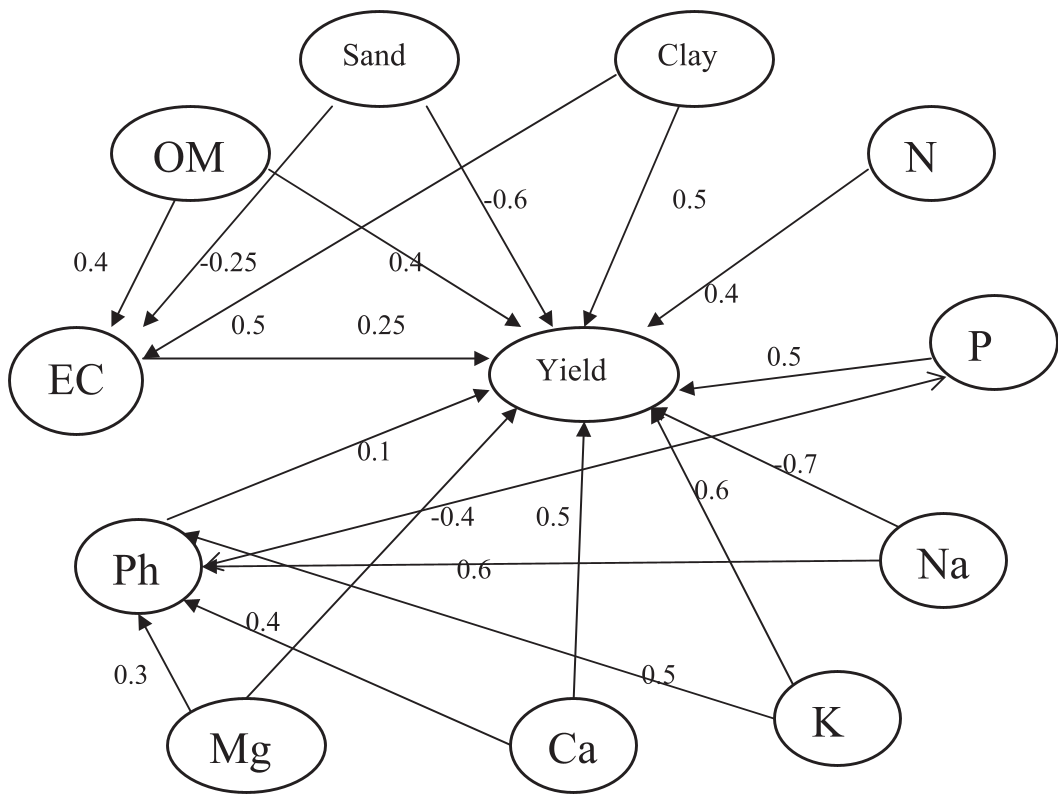 Figure 1: The FCM model showing the causal web between soil properties like pH, Organic Matter (OM), and Clay towards the final Yield.
Experiments & Results
The model was validated against 360 spatial "cells" in a 5-hectare field. The authors didn't just stop at their own model; they pitted it against the titans of Machine Learning: C4.5 Decision Trees, MLP Neural Networks, and Naïve Bayes.
| Year | FCM Accuracy | Best ML Benchmark |
|---|---|---|
| 2001 | 73.80% | 73.61% (ANN) |
| 2002 | 75.83% | 74.44% (DT) |
| 2005 | 75.00% | 76.39% (ANN) |
The statistical analysis (t-test and F-test) showed no significant performance gap between FCM and ANNs. This is a massive win for FCM: it provides the same accuracy as a Neural Network but stays fully interpretable.
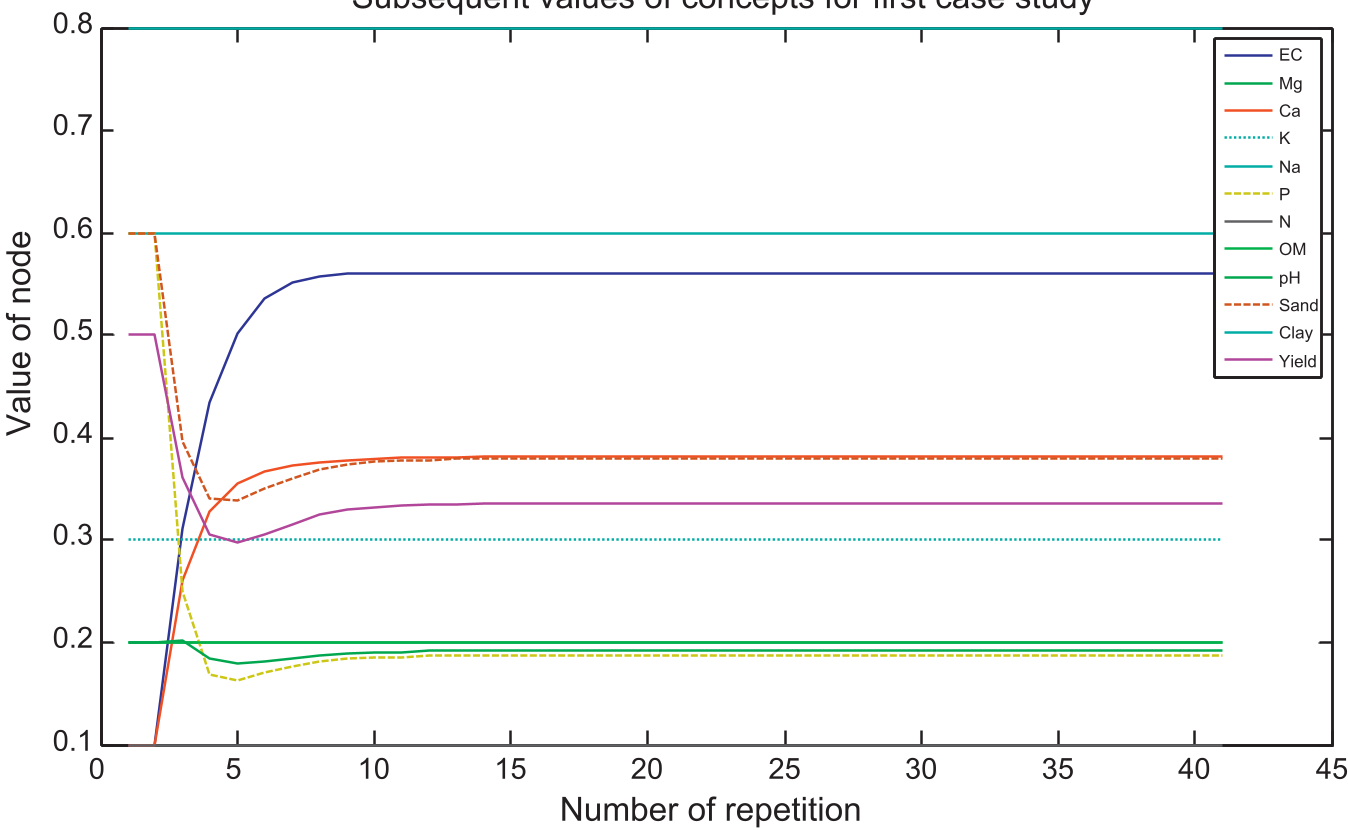 Figure 2: This graph illustrates how the system concepts (soil factors) evolve during the simulation until they reach a steady-state equilibrium, signifying the final yield prediction.
Critical Insight: Why Does This Matter?
The real value of this work is "Social Scalability." In many global agricultural sectors, data is sparse but experience is rich.
- Adaptability: If a new factor (like irrigation frequency) needs to be added, you don't need to retrain a heavy model; you simply add a node and ask an expert for its relationship to the others.
- Transparency: Every prediction can be traced back to a specific "causal path," allowing for real decision support (e.g., "My yield is low because the is suppressing uptake").
Limitations and Future Outlook
While the soil-based prediction is robust, the authors acknowledge that weather conditions (rainfall/temperature) were not integrated into the static map. Future iterations utilizing Relational Data Mining to automatically extract "If-Then" rules from historical datasets could further reduce the subjectivity of expert elicitation.
Takeaway: In the race for higher yields, the most effective AI might not be the most complex one, but the one that best encapsulates human expertise.