
Beyond the Ego: Mastering Duocentric Community Detection with Type-2 Fuzzy Logic
Fuzzy duocentric community detection model in social networks
This paper introduces the "Fuzzy Duocentric Community Detection Model," a novel graph clustering approach designed to identify communities structured around two central nodes. By leveraging interval Type-2 fuzzy numbers, the method effectively maps node belongingness in overlapping and uncertain social network structures.
TL;DR
Social networks aren't always centered around a single "influencer." Many real-world communities—like research groups or commercial partnerships—revolve around two pillars. This paper introduces a Type-2 Fuzzy Duocentric Model that moves beyond single-node clustering to detect communities anchored by a pair of central nodes, providing a more mathematically rigourous way to handle overlapping social boundaries.
Background: The Limits of Egocentricity
In social network analysis (SNA), we often think of communities as egocentric (one center) or complete (fully connected). However, a significant gap exists for communities built around duocenters. Think of a husband and wife, a PhD student and their supervisor, or a strategic alliance between two firms.
Previous methods like Fuzzy C-Means (FCM) or Possibilistic C-Means (PCM) treat nodes as having a degree of belonging to a single center. When applied to duocentric structures, these models lose information, often splitting one cohesive dual-node community into two or failing to identify the shared relevance of the two anchors.
The Proposed Solution: Dual-Center Objective Functions
The authors redefine the objective function () to account for two centers ( and ). The critical innovation is the use of Interval Type-2 Fuzzy Numbers.
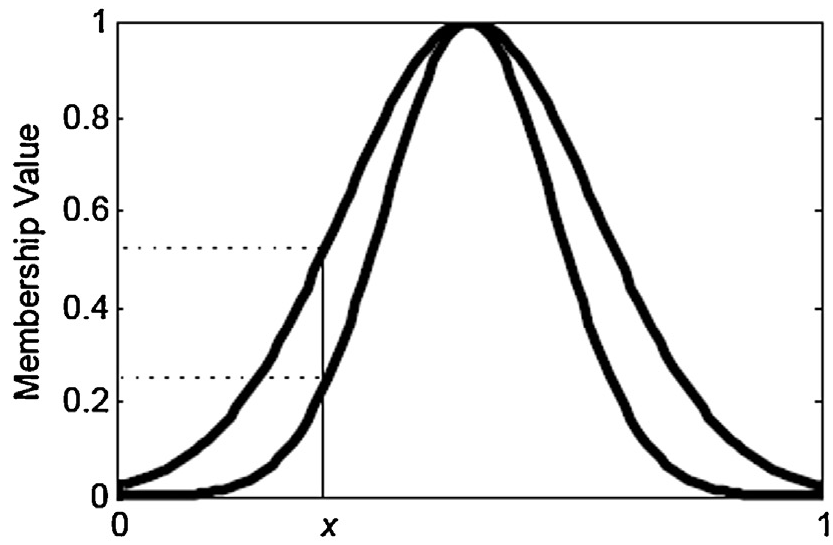
Instead of a single membership value, each node is assigned an interval .
- Lower Membership (): Represents a node's distance to the "farther" of the two centers.
- Upper Membership (): Represents a node's distance to the "closer" of the two centers.
The Core Algorithm
- Preprocessing: Identify potential duocenters (pairs of nodes) that meet a minimum connectivity threshold ().
- Iterative Minimization: Update membership values based on the distance to the dual centers.
- Center Re-calculation: Dynamically adjust the location of the duocenters based on the fuzzy memberships of their "alters."
Mathematical Intuition
The model uses a modified distance metric that incorporates node weights (), effectively penalizing distances to less important nodes. The objective function balances two goals:
- Minimizing the weighted distance to the closer and farther central nodes.
- Maximizing the overall membership (preventing the trivial solution of zero belonging).
Experimental Results & Performance
The model was tested against PCM (a strong Type-1 fuzzy baseline). Across varied datasets—from a small 10-node group to a large co-authorship network of 1,589 scientists—it consistently achieved a lower Verification Index ().
| Dataset | No. Nodes | PCM () | Proposed () | Improvement |
|---|---|---|---|---|
| Artificial Network | 75 | 0.3339 | 0.3113 | Significant |
| Facebook Ego-Net | 86 | 0.4312 | 0.4194 | Notable |
| Co-authorship | 379 (component) | 0.1079 | 0.0925 | Substantial |
Visual Interpretation
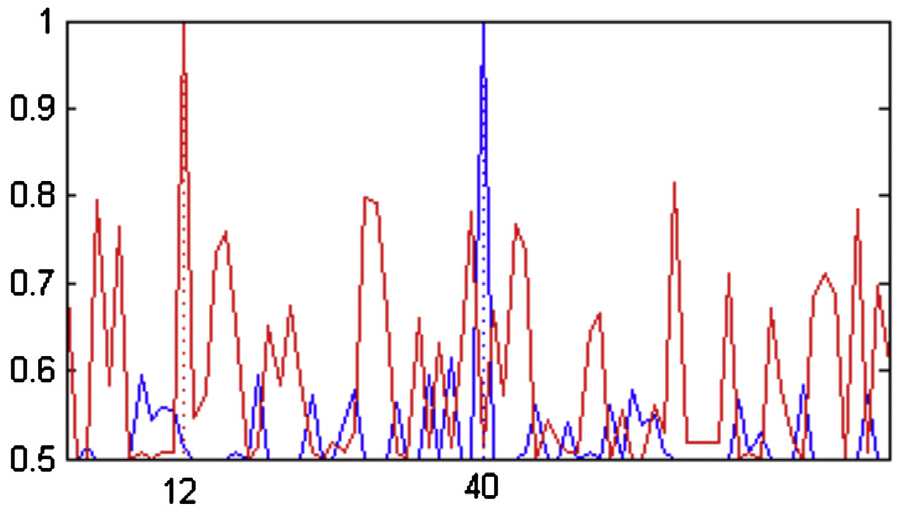
In "Example 4" (Facebook friendships), the duocentric model correctly identified pairs like as the anchors. While PCM might force a choice between centers, the Type-2 fuzzy membership allows nodes to float between these two pillars, perfectly capturing the "fuzzy" reality of real-world overlapping friendships.
Critical Insight: Why Type-2?
Type-1 fuzzy logic provides a "crisp" probability of belonging. Type-2 fuzzy logic provides an uncertainty interval. This is crucial because social connections are rarely static or perfectly measurable. By using an interval, the researchers can differentiate between a node that is "equally close to both centers" and one that is "weakly connected to both but vaguely more associated with one."
Conclusion & Future Outlook
This work represents a key shift in how we structure community discovery. By mathematically defining the "duocenter," researchers can better analyze partnerships, mentor-mentee relationships, and competitive duopolies in market networks. Future extensions could potentially expand this into multi-centric clustering, though the computational complexity of searching for optimal -node centers remains a challenge.
Takeaways
- Complexity is Key: For modeling human relationships, single-center egocentric models are often insufficient.
- Type-2 Fuzzy Logic: This is a powerful tool for representing the "nuance within the fuzziness" of social boundaries.
- Optimization: The proposed model is mathematically stable and convergent, making it a reliable choice for large-scale social graph analysis.