
From Pixels to Perceptions: Automated BI-RADS Reporting via Fuzzy Expert Fusion
Combining Fuzzy Experts' Decisions Fusion with Linguistic Summarization of Mammograms for Computer-Aided Breast Diagnosis Éldman de O. Nunes
This paper presents a computational framework for the automatic generation of standardized BI-RADS medical reports from mammograms. The method combines Multi-Criteria Group Decision Fusion with a Granular Linguistic Model of Phenomena (GLMP) to translate expert clinical observations into structured natural language summaries.
Executive Summary
TL;DR: This paper bridges the gap between expert visual analysis and standardized medical reporting by introducing a system that fuses multiple radiologists' opinions using fuzzy logic and generates natural language BI-RADS reports via Granular Linguistic Modeling.
Academic Positioning: This work is a specialized application of the Computational Theory of Perceptions (CTP), specifically adapting the Granular Linguistic Model of Phenomena (GLMP) to the highly standardized domain of breast cancer diagnostics (BI-RADS). It stands as a "human-in-the-loop" clinical support tool rather than a fully autonomous diagnostic engine.
1. The Challenge of Linguistic Subjectivity
In mammography, the BI-RADS (Breast Imaging - Reporting And Data System) is the gold standard for reporting. However, two radiologists might look at the same "irregular mass" and describe it with slight variations in confidence or terminology. This inconsistency leads to:
- Varied management recommendations for patients.
- Communication gaps between radiologists and oncologists.
- Difficulty in providing expert-level reporting in isolated rural areas where specialists are scarce.
Existing Computer-Aided Diagnosis (CAD) systems often focus purely on classification (Cancer vs. No Cancer), but they fail to explain the "why" in a language clinicians can trust.
2. Methodology: Modeling Perception via Fuzzy Fusion
The system operates through a two-stage pipeline: Fuzzy Decision Fusion and Linguistic Summarization.
A. Expert Decision Fusion
Instead of relying on a single opinion, the system collects questionnaires from multiple experts. To handle the inherent uncertainty in human judgment, it uses:
- Interval-valued Fuzzy Numbers: To capture the "imprecise" nature of confidence levels.
- Fuzzy Weighted Average (FWA): This calculates a "consensus" perception by weighting experts based on their seniority (e.g., Radiologists vs. General Practitioners).
B. The GLMP Architecture
The "brain" of the reporting engine is the Granular Linguistic Model of a Phenomenon (GLMP). It breaks down the mammogram analysis into a hierarchy of Computational Perceptions (CPs).
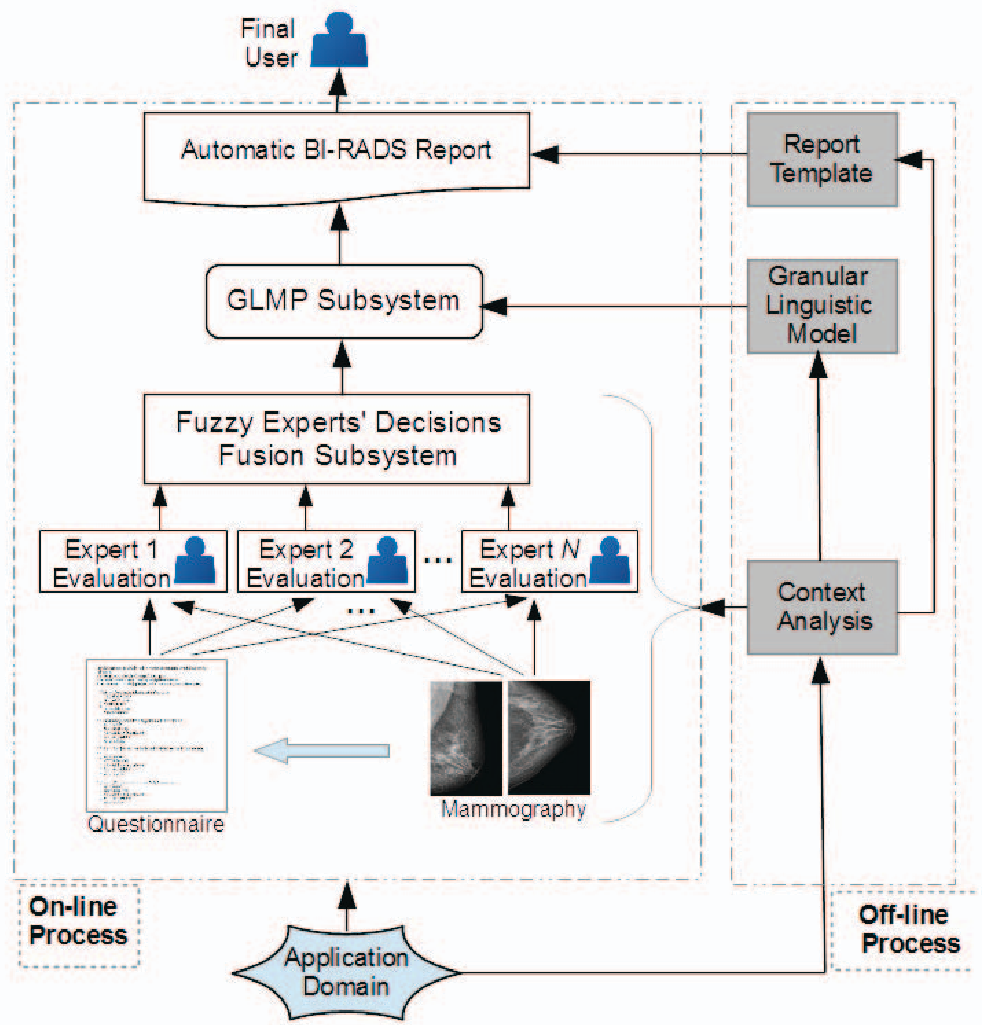
As shown in the architecture above, the system processes four critical features:
- Breast Composition (Density)
- Asymmetry & Architectural Distortions
- Masses (Shape, Margin)
- Calcifications (Distribution, Type)
For each feature, like Calcifications, a specific network of CPs is defined to determine the validity of labels like "punctiform," "isodense," or "irregular."
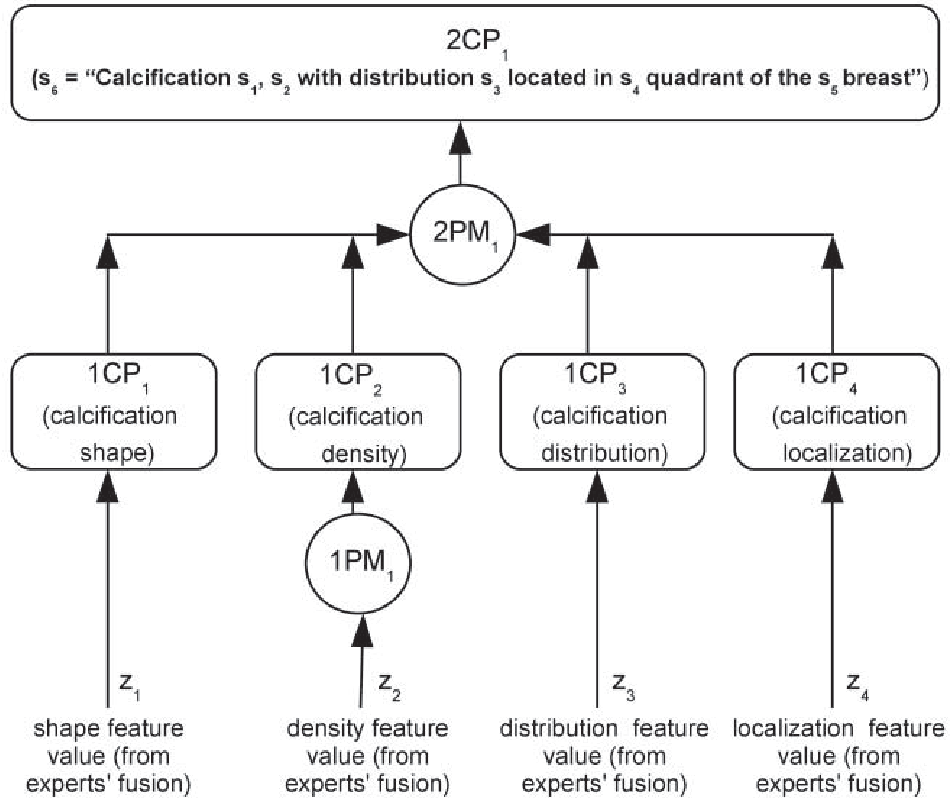
3. Turning Logic into Language
The final step uses fuzzified expert rules to map the fused perceptions to a final BI-RADS category. For example:
IF Mass Contour is Irregular AND Density is High THEN BI-RADS is 4c (High Suspicion).
The system then populates a template-driven report generator to produce sentences such as: "Calcification rounded, dense with distribution grouped located in external upper quadrant of the left breast."
4. Experimental Results and Specialist Validation
The researchers validated the prototype using real-world mammograms and a panel of medical experts.
| Metric (Score 0-10) | Healthy Patient (Report #1) | Suspicious Patient (Report #2) |
|---|---|---|
| Content Relevance (Q1) | 10.00 | 7.00 |
| Medical Vocabulary (Q3) | 9.67 | 9.67 |
| Text Ordering (Q4) | 10.00 | 9.67 |
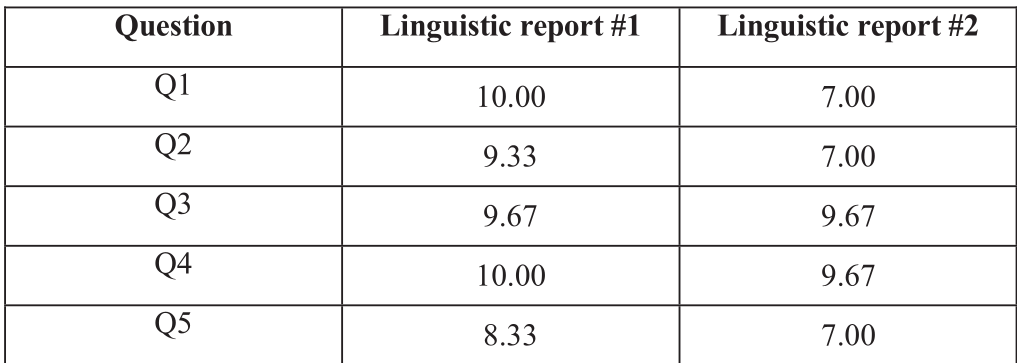
The results indicate that while the system is nearly perfect for standard healthy screenings, complex cases (malignancy) require more nuanced linguistic triggers, as reflected in the slightly lower relevance score (7.0).
5. Critical Analysis & Future Outlook
Strengths:
- Explainability: Unlike black-box Deep Learning models, every sentence in this report can be traced back to a specific fuzzy rule and clinical finding.
- Standardization: It enforces BI-RADS terminology, reducing the potential for "lexical drift" in hospital reports.
Limitations:
- Input Dependency: The system still requires human experts to fill out an initial questionnaire. True "Computer Vision" integration (automatic feature extraction from pixels) is the missing link.
- Static Templates: The linguistic variety is limited compared to the natural prose of a senior radiologist.
Takeaway for the Field:
This research demonstrates that Fuzzy Logic remains a powerful tool for Interpretable AI in medicine. As we move towards 2026, combining these granular linguistic models with Modern Vision-Language Models (VLMs) could lead to the next generation of truly autonomous, yet explainable, radiology assistants.