
Beyond Binary Classification: Using Fuzzy Fingerprints to Tackle the Real-World Cyberbullying Imbalance
Using Fuzzy Fingerprints for Cyberbullying Detection in Social Networks
This paper evaluates the use of Fuzzy Fingerprints (FFP) for the automated detection of cyberbullying in social networks. By reframing cyberbullying detection as a retrieval task rather than a simple binary classification, the authors show that FFP can outperform standard baselines like SVM, Naive Bayes, and Logistic Regression in realistic, unbalanced data scenarios.
TL;DR
Cyberbullying detection is often academicized into a neat 50/50 classification task, which is far from the reality of social media. This paper shifts the focus to a retrieval-based approach using Fuzzy Fingerprints (FFP). By prioritizing the detection of the rare "Cyberbullying" (CB) class in highly unbalanced datasets, the authors demonstrate that FFP offers better recall and performance stability than traditional SVMs or Naive Bayes classifiers when tested in realistic scenarios.
The "Balanced Data" Illusion
In academia, researchers often report high F-measures (0.80+) by tailoring balanced datasets. However, the authors argue this is fundamentally flawed. In the wild, cyberbullying is a "needle in a haystack." If a system is optimized for a balanced dataset, its precision collapses when deployed in an environment where 99% of messages are benign.
The authors' core insight is that Cyberbullying detection is fundamentally an Information Retrieval problem, not just classification. The goal isn't to be "accurate" about the majority class (which is easy); it is to successfully retrieve the high-specific, low-volume instances of aggression.
Methodology: The Anatomy of a Fuzzy Fingerprint
A "Fingerprint" in this context is a compact information block that identifies a class. For cyberbullying, the authors create a ranked list of the most relevant features (words/tokens).
1. Feature Ranking & ICF
Instead of just counting words, the algorithm uses Inverse Class Frequency (ICF)—a variation of TF-IDF—to demote common words (like "the" or "and") that appear across both bullying and non-bullying categories.
2. Fuzzification via Pareto Rule
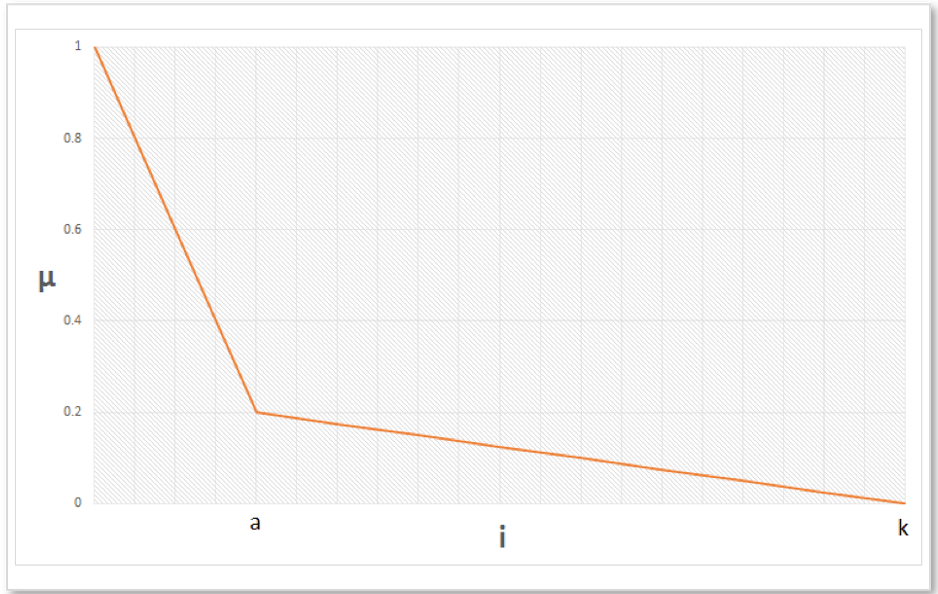
The ranked list is then converted into a fuzzy set. Using a member function derived from the Pareto rule (80/20), the top-ranked words are assigned significantly higher membership values than those further down the list.
3. T2S2 Similarity
To classify a new post, the system calculates the T2S2 (Text to Silk Fingerprint Similarity). It sums the membership values of words present in both the post and the fingerprint, normalized by the post length. If the similarity score exceeds a tuned threshold, it is flagged as cyberbullying.
Experiments and Results
The study utilized the Formspring dataset, testing across balanced and unbalanced splits.
The Realistic Scenario
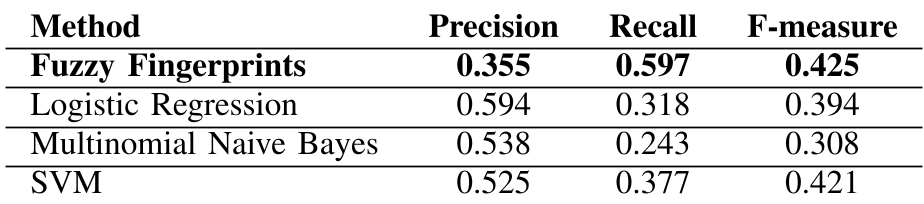
When the testing set was kept unbalanced (reflecting real-world distribution), the performance of all models dropped significantly, proving that previous "SOTA" results were indeed inflated. However, Fuzzy Fingerprints (FFP) maintained a slight lead.
Key Observations:
- Recall Dominance: FFP achieved a recall of 0.597 in the "Balanced Train / Unbalanced Test" setup, outperforming SVM's 0.377. For safety applications, catching more bullying cases (high recall) is often more critical than occasional false positives.
- Parameter Sensitivity: The authors found that a high value (up to 5000) was necessary for binary classification to capture the thematic broadness of the "No-Cyberbullying" class.
Critical Analysis & Takeaways
The paper delivers a sobering conclusion: Cyberbullying detection is far from solved. Even with optimized FFP, the F-measure remains below 0.5 in realistic settings.
- The Context Gap: The authors acknowledge that a single message is often insufficient. Real cyberbullying involves repetition and power dynamics. A word that is "hate speech" in one context might be a joke between close friends.
- Conclusion: FFP provides a robust, interpretable alternative to traditional black-box classifiers, specifically excelling in the retrieval of minority classes. Future work must integrate conversational context and user relationship history to push performance beyond the current ceiling.