
Enhancing KDD: Fuzzy Linguistic Summaries for System Performance Mining
Mining time series data by a fuzzy linguistic summary system
The paper introduces a Knowledge Discovery in Databases (KDD) system that utilizes Fuzzy Linguistic Summaries to extract human-readable rules from large datasets. It specifically demonstrates the method on MVS (Multiple Virtual Storage) performance logs to predict resource utilization ranks using a disjunctive fuzzy property approach.
TL;DR
This classic paper addresses the challenge of making sense of massive system logs by transforming raw data into "fuzzy rules." By using a Fuzzy Linguistic Summary approach, the researchers built a system that analyzes IBM mainframe (MVS) performance, identifies resource bottlenecks through natural language-like rules, and achieves 85% predictive accuracy.
Background & Motivation: The Data Overhaul
In the late 90s, system administrators faced a "data explosion" dilemma. An IBM MVS system generated roughly 500 MB of SMF (System Management Facility) data daily—a massive volume for the era.
The authors observed two critical pain points:
- Expert Dependency: Only highly experienced programmers could interpret raw performance metrics.
- Property Rigidity: Existing mining tools tried to assign a single "label" to data groups. However, real-world data is messy; a group of users might be "mostly engineers OR managers," not strictly one or the other.
Methodology: The Logic of "Mostly"
The core innovation lies in the Disjunctive Property. Instead of forcing a data cluster into one category, the system allows for a logical "OR" ().
1. The Architecture
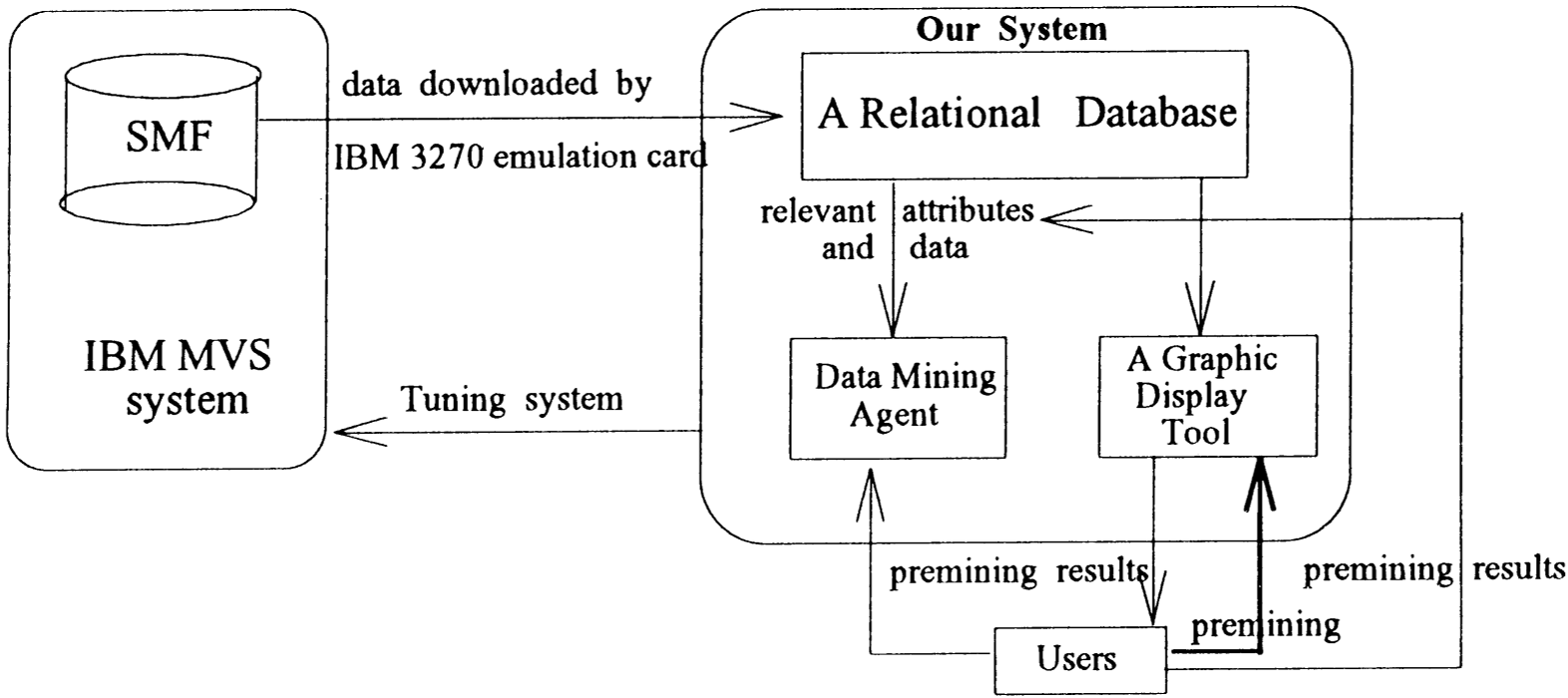
The system consists of a graphic display tool for "premining" and a Data Mining Agent.
2. Fuzzy Relational Model
The authors define a fuzzy relation where membership () isn't binary (0 or 1) but a degree of "appropriateness." For instance, a CPU usage of 37% might have a membership degree of 1.0 for "Rank 5" but 0.85 for "Rank 4."
3. Truth Value Calculation
To summarize data, the system evaluates the proposition: "Most objects in Group X have property F." The Truth Value is calculated using Zadeh’s quantifier: This formula effectively measures how "true" it is that a linguistic quantifier (like "most") applies to the average membership of the dataset.
Experimental Results: Tuning the MVS
The researchers tested their system on CPU utilization data from April to August 1996.
Mining the Rules
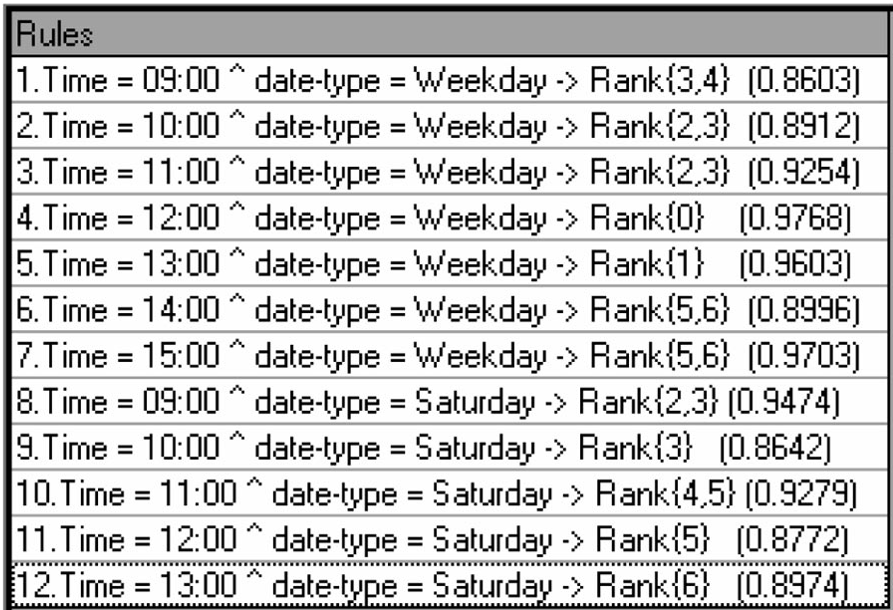
By processing the data, the system generated clear linguistic rules:
- Rule 6 & 7: Peak time on weekdays occurs between 13:00 and 15:00 (Rank 5 or 6).
- Rule 4: Leisure time (low usage) occurs at 12:00 (Rank 0).
Performance Validation
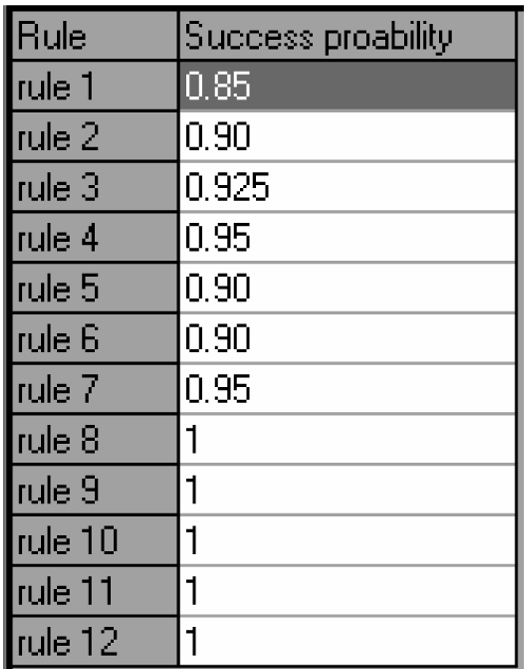
Testing against October data confirmed that these rules were not just descriptive but predictive. As shown in the success probability table, most rules achieved predictive accuracy between 85% and 100%.
Critical Insight & Conclusion
The beauty of this approach is its human-centricity. Instead of outputting a black-box neural weight, the system tells the admin: "Time = 14:00 on Weekdays implies Rank 5 or 6 with 89% confidence."
Future Implications: While this paper was written in the context of mainframes, the logic of using fuzzy disjunctive properties is highly relevant today for interpretable AI. The transition from "Big Data" to "Useful Knowledge" requires tools that can handle the inherent "fuzziness" of human categories and system behaviors.
Limitations
- Heuristic Dependency: The system relies on predefined linguistic properties (ISA hierarchies) provided by users.
- Static Thresholds: The accuracy is highly sensitive to the threshold in the EQUAL relation.
Ultimately, this work laid the groundwork for integrating human intuition into automated data discovery, a goal that remains a frontier in modern AIOps.