
Deciphering the TikTok Growth Engine: A Fuzzy Logic Approach to Content Quality
A fuzzy model for assessing the content’s quality impact on the growth of users on the TikTok social network
The paper introduces a fuzzy logic model developed in the fuzzyTECH environment to quantify the impact of content quality on subscriber growth on TikTok. By deconstructing content into variables like music popularity, trends, and "beauty" (editing effects), the model predicts follower growth rates and ranks the importance of different growth drivers.
TL;DR
Researchers from the Ural State University of Economics have developed a fuzzy logic model to demystify TikTok's viral nature. By analyzing variables such as music popularity, video effects (Beauty), and trend alignment, the model quantifies how specific content improvements translate into follower growth. The findings suggest that a 40% improvement in content clarity and editing can yield a significant 20% jump in weekly subscribers.
Background & Motivation: The Black Box of Virality
In the digital age, TikTok has emerged as a juggernaut with over 1 billion daily views. However, for most creators, the "For You Page" (FYP) remains a mystery. While we know "quality" matters, qualitative excellence is notoriously hard to measure. Previous studies have analyzed marketing strategies, but few have built intelligent, formalized models to weigh the impact of specific creative choices.
The authors argue that because social media variables are often vague and subjective, traditional linear models fail. They turn to Fuzzy Logic—a mathematical framework designed to handle the "shades of gray" in human decision-making and algorithmic behavior.
Methodology: Mapping Creativity to Math
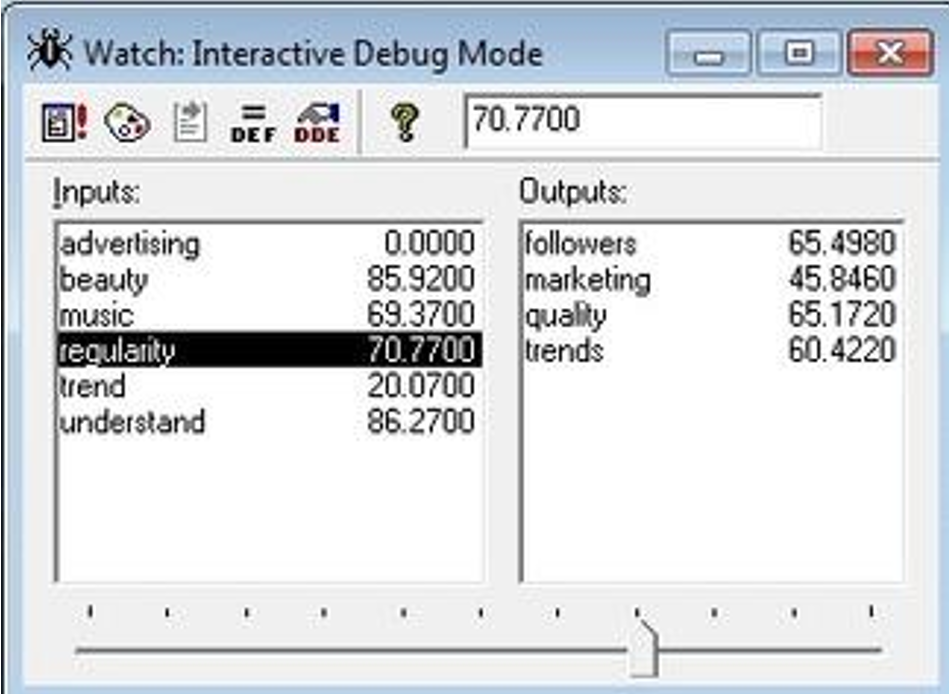
To build the model, the researchers identified six key input pillars:
- Music: Popularity of the track used (scaled from the top 40 charts).
- Trend: Correspondence to current viral formats.
- Advertising: Inclusion of paid promotions.
- Regularity: Frequency of posting (optimal being ~2-3 times/week).
- Beauty: Use of built-in TikTok tools like filters, masks, and editing effects.
- Understand: Clarity of the message and niche consistency.
The Model Architecture
Using the fuzzyTECH environment, the authors structured a hierarchical decision tree. Input variables feed into intermediate layers—Trends, Marketing, and Quality—which finally aggregate into the Followers output variable.
 Above: The fuzzy logic structure used to map creative inputs to growth outputs.
The "Intelligence" of the model lies in its Rule Block. For instance, a rule might state: IF Marketing is High AND Quality is High AND Trends are High, THEN Followers growth is [High] with a degree of support (DoS) of 1.00.
Experiments and Key Findings
By simulating different data points, the authors analyzed how sensitivity to different variables affected the outcome.
- The "Beauty" Multiplier: The model demonstrated that the "Beauty" variable (technical editing quality) often carries more weight in determining overall video quality than the raw content itself.
- The Power of Regularity: When combined with popular music, post regularity became the strongest predictor of success.
- Quantifiable Growth: The researchers found that a synchronized 40% increase in the "Beauty" (editing) and "Understand" (clarity) variables resulted in a 15% to 20% increase in subscriber growth per week.
 Figure: Surface plot showing the non-linear interaction between posting regularity, music popularity, and the resulting follower growth.
Critical Analysis & Future Outlook
This work represents a vital bridge between social media marketing and data science. By using fuzzy logic, it provides a tool for creators to rank factors based on their specific influence on growth, allowing for more efficient resource allocation.
Limitations
- Variable Subjectivity: While fuzzy logic handles vagueness, the initial scoring of a video's "Beauty" or "Understandability" still relies on manual input, which could introduce bias.
- Dynamic Algorithms: TikTok's recommendation engine (partially based on Google’s Wide & Deep Learning) is constantly evolving, meaning the rule blocks in this model would require frequent retraining.
Conclusion
The study proves that TikTok success isn't just "luck." It is an optimization problem where technical editing, trend-surfing, and regularity create a synergistic effect. For future iterations, integrating this fuzzy model with Computer Vision (to automatically score "Beauty") could lead to a fully automated content auditing tool for digital marketers.