
Fuzzy and Neutrosophic Modeling: A New Frontier for Link Prediction
Fuzzy and neutrosophic modeling for link prediction in social networks
This paper introduces specialized similarity measures for link prediction in social networks using fuzzy and neutrosophic logic. By extending classical measures like Common Neighbors and Adamic-Adar into Neutrosophic Fuzzy environments (NFCN, NFAA, NFJC), the authors achieve superior prediction performance on co-authorship networks compared to traditional crisp and SVM-based methods.
TL;DR
Predicting future collaborations in social networks is hard because relationships are rarely "black and white." This paper introduces Neutrosophic Similarity Measures (NFCN, NFAA, NFJC) that account for truth, falsehood, and—crucially—indeterminacy. Combined with semi-supervised fuzzy clustering, this approach outperforms traditional SVM and Gboost models in predicting co-authorship links.
The Problem: The Ambiguity of "Connection"
In a social network, an "edge" isn't just a 0 or 1. Relationships evolve, data is missing, and sometimes the connection between two people is simply "uncertain." Traditional link prediction methods (like Common Neighbors or Jaccard Coefficient) operate on crisp logic, which fails to capture the "fuzzy" nature of real-world interactions.
The authors identify three main pain points in prior work:
- Uncertainty Blindness: Inability to handle the "maybe" in social dynamics.
- Feature Sparsity: Weighting training data effectively when features are missing.
- Inflexible Measures: Proximity measures that don't account for the varying degrees of node influence.
Methodology: Beyond Binary Logic
The core innovation lies in the extension of similarity measures into Neutrosophic Sets (NS). Unlike standard fuzzy sets (membership/non-membership), Neutrosophic sets include an Indeterminacy component.
1. Re-imagining Similarity
The paper redefines three classic measures:
- Fuzzy Common Neighbors (FCN): Uses the (min) operator on membership degrees.
- Fuzzy Adamic-Adar (FAA): Weights common neighbors by the log of their membership, penalizing "highly connected" but generic nodes.
- Fuzzy Jaccard Coefficient (FJC): Normalizes the intersection and union of neighbors using fuzzy operators.
2. The Link Prediction Pipeline
The authors utilize a specific workflow for co-authorship networks:
- Feature Extraction: Paper titles/abstracts are converted into fuzzy graph vectors.
- Neutrosophic Processing: Similarity scores are calculated using the formulas below.
- Clustering: A semi-supervised fuzzy clustering (SSSFCRC) algorithm classifies author pairs into "will link" or "won't link."
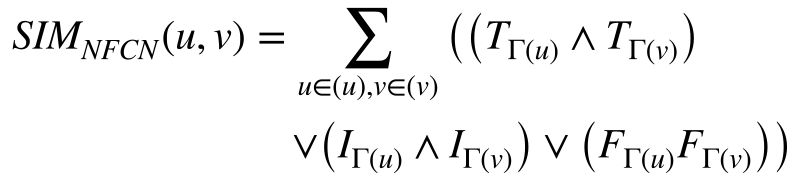 Equation: The Neutrosophic Common Neighbor (NFCN) score integrating Truth, Indeterminacy, and Falsehood.
Experiments: Does it Work?
The team tested their method on a large-scale dataset from the Biophysical Journal, covering papers from 2006 to 2016.
SOTA Comparison
The proposed SSSFCRC method was compared against industry standards like SVM (Support Vector Machines) and Gboost.
| Metric | SSSFCRC (Proposed) | SVM | Gboost |
|---|---|---|---|
| Recall | 0.91 | 0.53 | 0.72 |
| F1-Measure | 0.65 | 0.54 | 0.62 |
Note: Results shown for FCN-FAA-FJC feature sets.
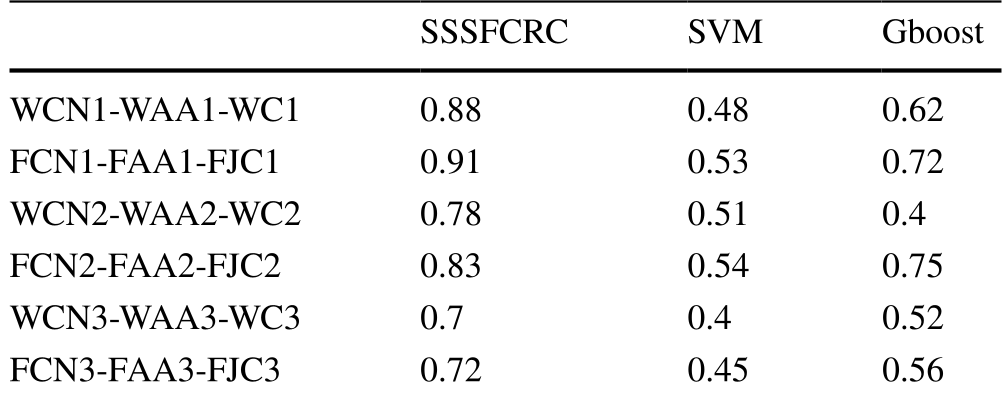 Table 1: Comparison of Recall values across different methods. The fuzzy/neutrosophic approach consistently leads.
Key Insights from Results
- Fuzzy > Weighted Crisp: The fuzzy versions of Common Neighbors (FCN) consistently outperformed the standard weighted versions (WCN).
- Semi-Supervised Advantage: The clustering approach allowed the model to learn from both labeled and unlabeled relational data, vital for sparse networks.
Critical Analysis & Future Outlook
Takeaway
The power of this research lies in its Inductive Bias—it assumes that network evolution is inherently uncertain. By including "Indeterminacy" in the math, the model becomes more resilient to noise than binary classifiers.
Limitations
- Computational Complexity: Neutrosophic operations (min/max/log variations over triple sets) are more expensive than simple graph traversals.
- Feature Dependence: The quality of the prediction heavily relies on the initial fuzzy vectorization of paper abstracts.
Future Work
The authors suggest incorporating Neutrosophic Cognitive Maps to further model the causal relationships between nodes. As social data becomes more complex, moving from logic to a tri-partite degree of Truth-Indeterminacy-Falsehood may become the standard for robust AI.
Summary Entry: Link Prediction | Neutrosophic Sets | Fuzzy Clustering | Social Network Analysis