
Beyond Binary Sentiment: Decoding Emotion Intensity via Fuzzy Logic
An Approach of Fuzzy Relation Equation and Fuzzy-Rough Set for Multi-label Emotion Intensity Analysis
The paper introduces a novel framework for Multi-label Emotion Intensity Analysis by combining Fuzzy Relation Equations (FRE) with an improved Fuzzy-Rough Set (FRS) theory. It specifically targets the challenge of predicting multiple co-existing emotions and their continuous intensity scores (0-1) in social media texts, achieving State-of-the-Art performance on the Quan's blog emotion corpus.
TL;DR
Human emotions are rarely "either-or." A single sentence can be 70% happy and 30% anxious. This paper tackles Multi-label Emotion Intensity Analysis using a sophisticated mathematical blend of Fuzzy Relation Equations (FRE) and Fuzzy-Rough Sets (FRS). By treating emotional intensity as a fuzzy degree rather than a hard constant, the authors achieve superior accuracy in predicting complex emotional profiles in social media posts.
Problem & Motivation: The Complexity of Human Feelings
Most sentiment analysis tools are too "blunt"—they tell you if a text is positive or negative. But consider the sentence: "The movie was fantastic, but the dinner sucked!" It contains Joy, Love, and Anger simultaneously.
The authors identify two critical gaps in prior work:
- Multi-label Co-existence: A single document can trigger 8 basic emotions (Joy, Hate, Love, Sorrow, Anxiety, Surprise, Anger, Expect).
- Intensity Variation: The word "fantastic" carries a much higher intensity of Joy than the word "OK."
The challenge lies in the fact that we rarely have datasets where every single word is labeled for intensity. How do we learn the "weight" of a word when we only have the "score" of the whole sentence?
Methodology: The "Mathematical Back-projection"
The authors propose a framework that treats emotion prediction as an uncertainty classification problem.
1. Modeling with Fuzzy Relation Equations (FRE)
To find the intensity of individual words, the authors set up a matrix equation:
- VW: Sentiment word matrix (which words are in which sentence).
- VE: The unknown word-level emotion intensity matrix (what we want to find).
- VS: The known sentence-level labels.
By solving this equation, they derive a fuzzy range (upper and lower bounds) for every word, capturing its emotional potential across different contexts.
2. Predicting with Improved Fuzzy-Rough Sets (FRS)
Once they have the word intensities, they don't just add them up. Human language isn't simple arithmetic. They use Fuzzy-Rough Set theory to calculate:
- Upper Approximation: The most optimistic estimate of emotion intensity.
- Lower Approximation: The most conservative estimate.
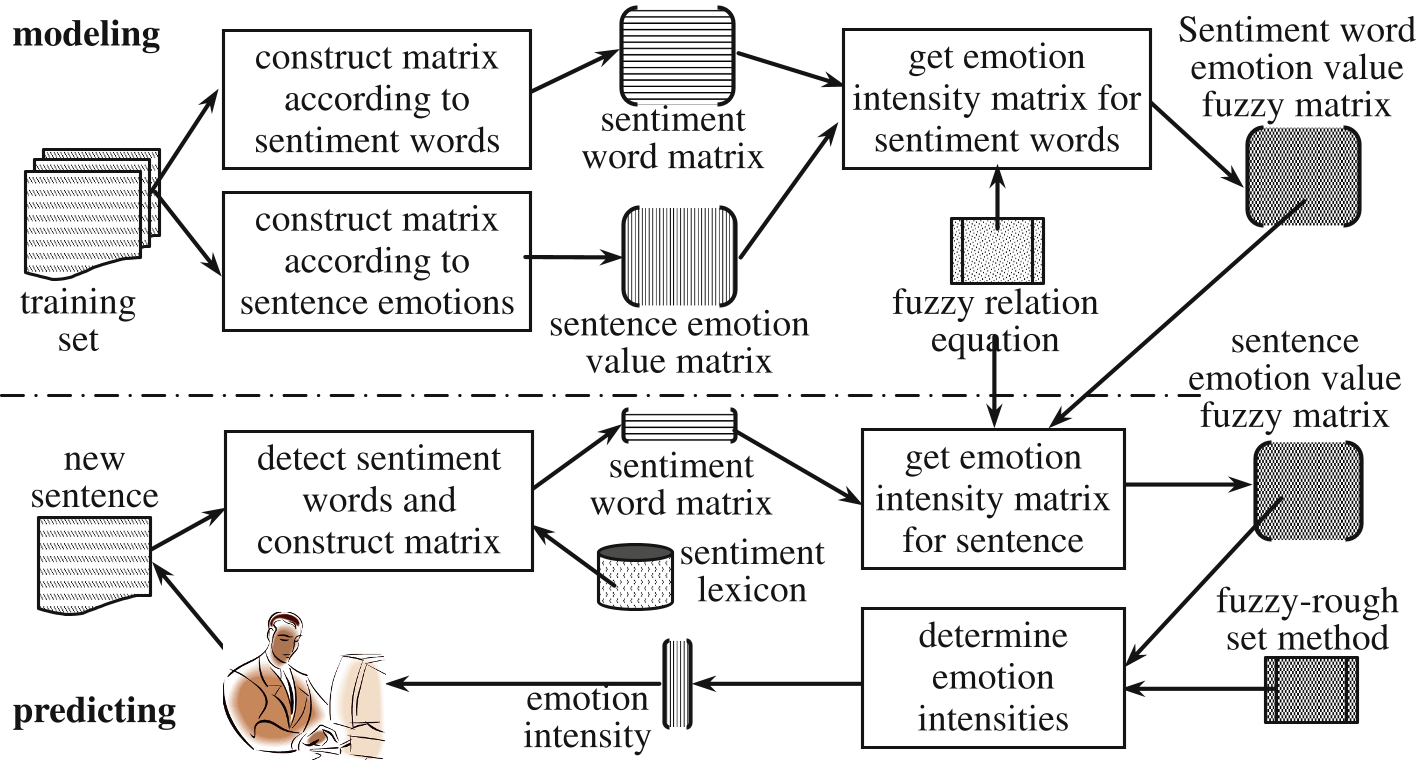 Figure 1: The architecture showing the flow from training (Modeling) to real-world prediction.
Experiments & Results
The model was tested on a large-scale blog corpus containing over 38,000 sentences.
Key Performance Metrics:
- Subset Accuracy: The model achieved 87.3% accuracy at the sentence level, vastly outperforming standard Regression Analysis (78.4%).
- Precision: In the "Average Precision" metric, the proposed FRE-FRS method showed a significant margin over Naive Bayes and Fuzzy Union baselines.
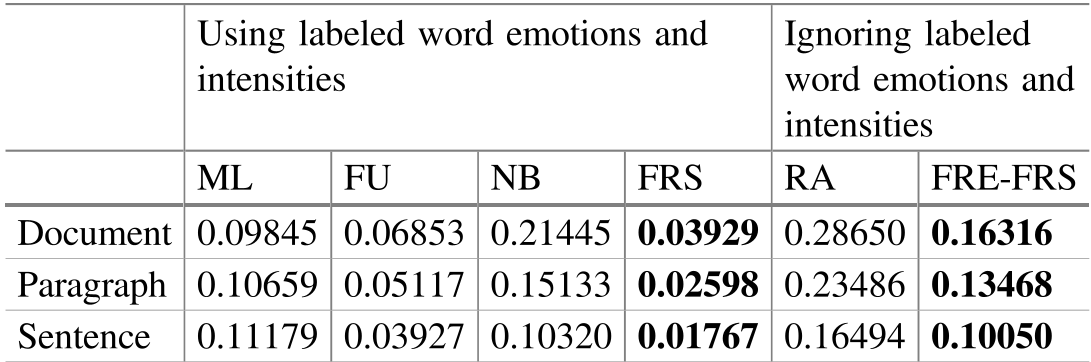 Table 1: Hamming Loss comparison. Note that FRE-FRS maintains low error even when ignoring word-level intensity labels.
Critical Analysis & Conclusion
Why it Works
The "magic" of this approach is its handling of vagueness. Traditional machine learning tries to force a word like "maybe" or "fantastic" into a single number. This model acknowledges that a word's emotional impact is a distribution or a range. By using rough sets to find the overlap between these ranges, the model naturally handles the "noise" and "uncertainty" of social media slang.
Limitations
Despite its mathematical elegance, the model currently struggles with the role of adverbs (e.g., "very," "slightly") and negations (e.g., "not happy"). These "valence shifters" can invert or amplify the intensities calculated by the fuzzy equations.
Future Outlook
The authors suggest that the next frontier is integrating this fuzzy logic with modern social media platforms like microblogs. Incorporating linguistic structures (like negation handling) into the Fuzzy-Rough Set operators could potentially create the most robust "emotional AI" to date.
Takeaway: If you want to model human feelings, stop using "crisp" logic and start embracing the "fuzzy" nature of how we speak.