
Cognitive Machines: Bridging Zadeh’s Fuzzy Logic and Simon’s Bounded Rationality
Fuzzy Theory in cognition, economic man and organization behavior
This paper proposes a theoretical unification of Fuzzy Theory, Bounded Rationality, and Cognitive Theories of Categorization to develop "Cognitive Machines." It leverages Lotfi Zadeh's fuzzy logic to materialize the cognitive concepts of Jerome Bruner and Eleanor Rosch, specifically targeting the computational limitations of Herbert Simon's "economic man" model in organizational behavior.
TL;DR
This seminal work advocates for a paradigm shift in how we design "intelligent" organizational systems. By unifying Fuzzy Theory (Zadeh), Bounded Rationality (Simon), and Cognitive Categorization (Bruner/Rosch), the paper introduces a framework for Cognitive Machines. These are not mere calculators but agents capable of "satisficing"—making human-like, satisfactory decisions in complex, "fuzzy" environments where traditional optimization fails.
Context: The Limits of the "Economic Man"
For decades, the "Economic Man" model assumed agents had perfect information and infinite processing power. Herbert Simon shattered this with Bounded Rationality, winning a Nobel Prize by proving that humans are limited by their cognitive architecture. However, Simon lacked the mathematical "glue" to model the inherent vagueness of human thought.
The author argues that Lotfi Zadeh’s Fuzzy Theory is that missing piece. While classical AI struggles with precise formulations in imprecise worlds, Fuzzy Theory provides the logic for "natural concepts"—categories like "high risk" or "moderate growth" that don't have hard boundaries.
Methodology: The Architecture of a Cognitive Machine
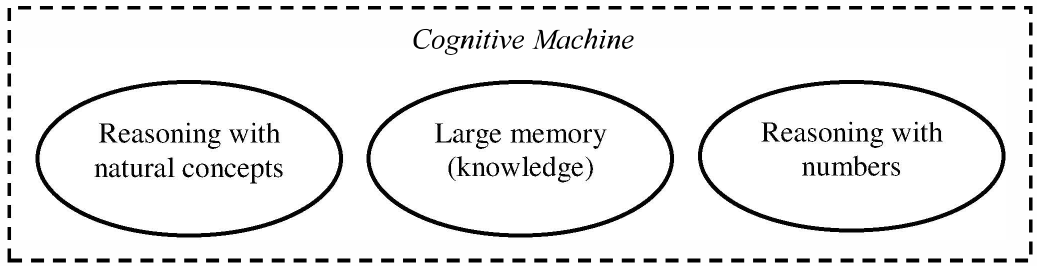
The core of the paper is the design of a machine intended to function as a social member of an organization.
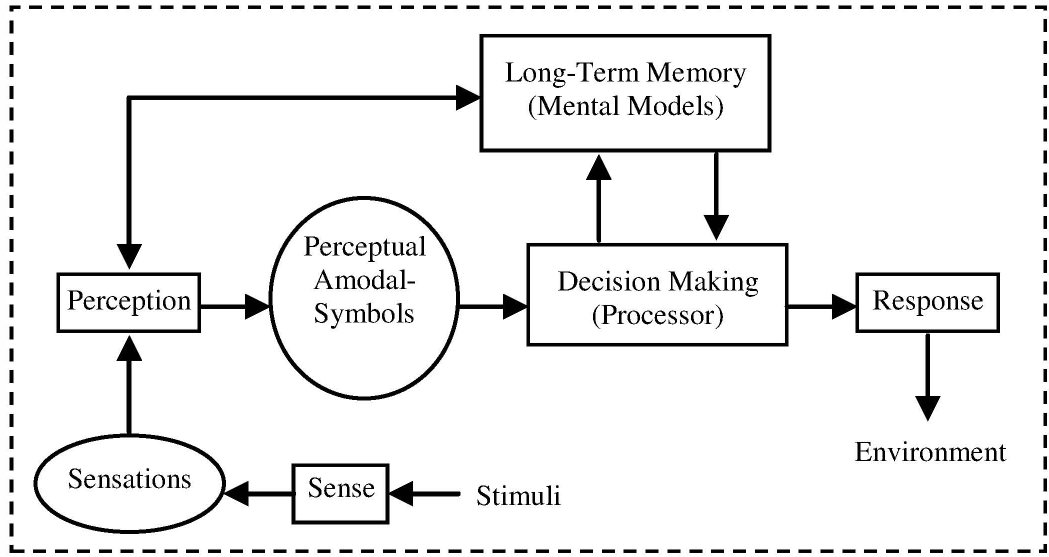
1. Symbolic Processing Levels
The paper defines a hierarchy of information processing, moving from raw sensory data to "amodal-symbols" and finally to mental models described by natural language.
2. The Fuzzy Advantage
The "Cognitive Machine" uses Computing with Words (CW) to bridge the gap between human intuition and machine execution. Instead of forcing a "Yes/No" (Crisp) logic, it employs fuzzy constraints to mirror how managers actually perceive the world.
Experiments & Core Insights: Solving Organizational Conflict
The author posits that organizational friction often arises from three "dysfunctional conflicts." The Cognitive Machine addresses these through fuzzy logic:
- Uncertainty: Solved by managing "fuzziness" as a specific type of uncertainty rather than just probability.
- Incomparability: Instead of picking one "best" rule (which is often impossible), the machine aggregates multiple "good" rules using s-norm operators.
- Unacceptability: Ensured by the "completeness" of the fuzzy knowledge base, guaranteeing that every input state has a corresponding output.
Critical Analysis & The Path Forward
The paper is a masterclass in interdisciplinary synthesis. It repositions Zadeh’s work from a control-engineering niche to a fundamental pillar of economic and organizational science.
Takeaways for Modern AI:
- Beyond Optimization: High-level strategic decisions require "satisficing," not maximization. AI must learn to be "satisfied" with approximate solutions in high-cost environments.
- Linguistic Cognition: The machine’s memory is represented through "clusters of propositions" (Mental Models), a concept that pre-dates but deeply resonates with today's Interest in Knowledge Graphs and LLM symbolic reasoning.
- Ethics and Responsibility: The paper concludes with a forward-looking legal framework, defining "Artificial Designers" and the contractual responsibilities of those who deploy cognitive machines in human social systems.
Conclusion
By mapping the "fuzzy" nature of human cognition onto a rigorous mathematical framework, Farley Simon Nobre provides a roadmap for elevating machines from technical tools to social, decision-making agents. It is a powerful reminder that "Intelligence" depends as much on the ability to handle ambiguity as it does on raw computational speed.