
GA-Net: Evolving the Discovery of Communities in Social Networks
GA-Net: A Genetic Algorithm for Community Detection in Social Networks
GA-Net is a community detection algorithm for social networks that utilizes a Genetic Algorithm to optimize a novel "Community Score" fitness function. It successfully identifies densely connected clusters without requiring the number of communities (k) to be predefined, achieving State-of-the-Art performance on benchmarks like the Zachary’s Karate Club and the American College Football network.
TL;DR
GA-Net is a specialized Genetic Algorithm designed to uncover the hidden community structures within complex social networks. By optimizing a "Community Score" and utilizing "Safe" genetic operators that respect the physical topology of the network, it eliminates the need for manual input of cluster counts and outperforms traditional divisive methods in both accuracy and efficiency.
Problem & Motivation: The Complexity of Social Ties
Detecting communities—groups of nodes with dense internal ties and sparse external ones—is a fundamental task in network science. However, two major hurdles persist:
- The "k" Problem: Most algorithms require you to guess how many communities exist beforehand.
- Search Space Explosion: In a network of nodes, the number of possible partitions is astronomical. Generic optimization tools often waste time exploring "impossible" configurations where disconnected nodes are grouped together.
The author, Clara Pizzuti, argues that we can solve both by moving away from purely hierarchical or greedy methods and instead leveraging the global search capabilities of Genetic Algorithms (GAs), provided they are "tethered" to the actual graph structure.
Methodology: The Power of "Safe" Evolution
1. The Fitness Function: Community Score
Instead of using the standard Modularity , GA-Net introduces the Community Score (). It calculates the density of each community sub-matrix by combining its volume (number of edges) with a power mean of its row/column averages.
A higher exponent in the power mean allows the algorithm to focus on extremely dense cores, which is particularly useful when the network structure is "fuzzy" or overlapping.
2. Genetic Representation and "Safe" Operators
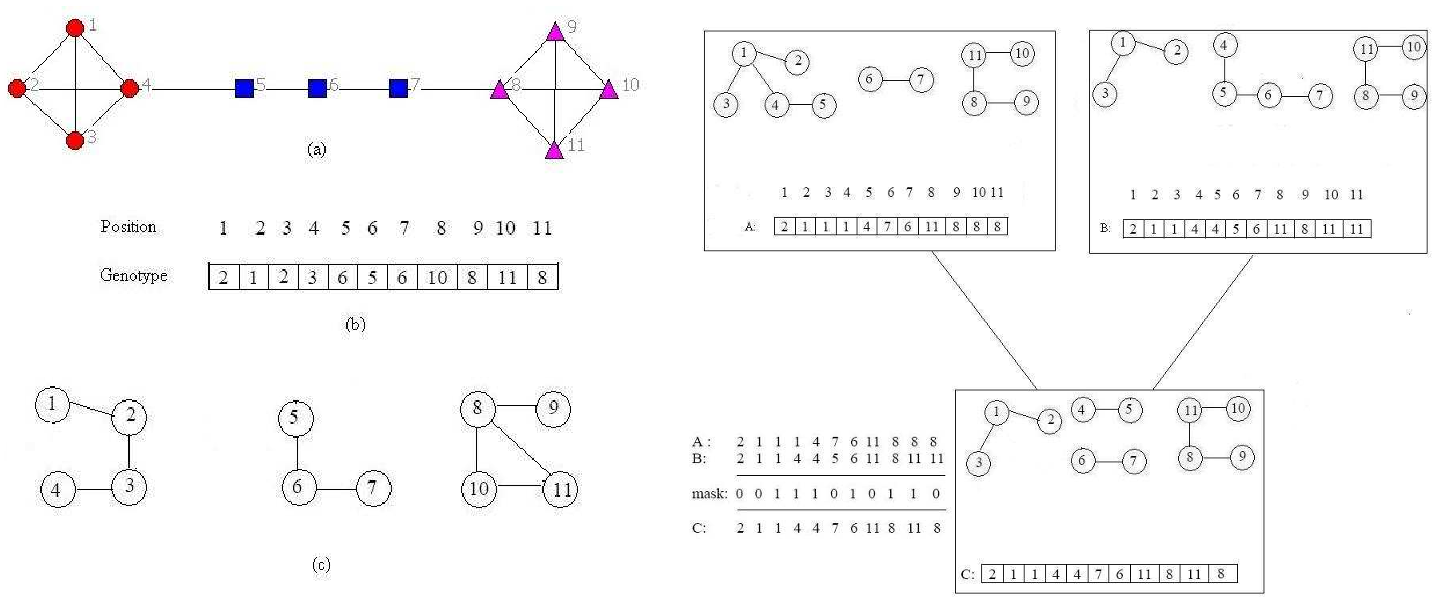
The algorithm uses Locus-based Adjacency Representation. Each gene stores an allele , signifying a link between node and node .
- Safe Initialization: Unlike standard GAs, an individual is only "Safe" if an actual edge exists in the graph. If a random assignment picks a disconnected , it is immediately repaired to a real neighbor.
- Safe Crossover & Mutation: By ensuring parents are safe, uniform crossover naturally produces safe children. Mutations are likewise restricted to the neighborhood of a node. This drastically reduces the search space from to .
Experiments: Beating the Girvan-Newman Baseline
The paper validates GA-Net against the gold standard: the Girvan-Newman (GN) algorithm.
Synthetic Benchmarks
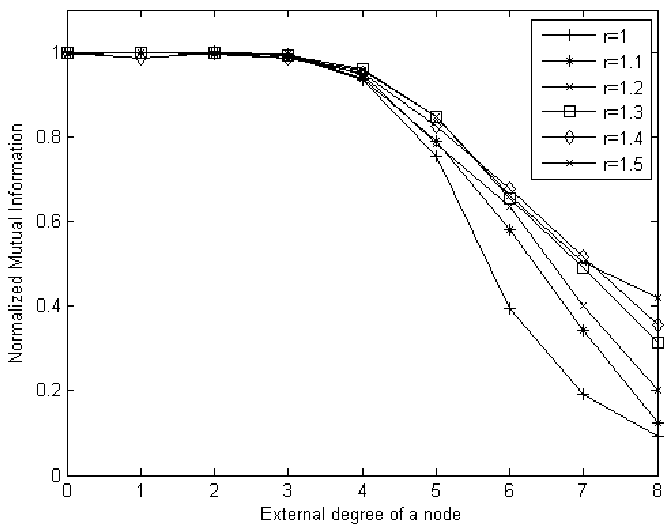
Using a network of 128 nodes (4 communities), the author tested the limit of "fuzziness" (). While GN performance drops as the groups blend, GA-Net (especially with higher values) maintains a high Normalized Mutual Information (NMI), proving it can "see" communities that divisive methods miss.
Real-World Success
- Dolphin Social Network: GA-Net achieved an NMI of ~0.90, significantly higher than GN's 0.64.
- Zachary’s Karate Club: While GN often misplaces specific members (like node 3), GA-Net correctly identified the complex sub-structures and fine-grained interactions.
Critical Analysis & Conclusion
Takeaway
The genius of GA-Net isn't just the Genetic Algorithm itself—it's the inductive bias injected into the variation operators. By forcing the GA to respect the graph's adjacency, the author transformed a chaotic search into a highly efficient optimization of the network's natural boundaries.
Limitations & Future Work
The current approach focuses on disjoint communities (nodes belong to only one group). In reality, social circles overlap (you belong to a family, a workplace, and a gym simultaneously). The author suggests that Multi-objective Optimization could be the next step to balance cluster density with other metrics like conductance or robustness.
GA-Net remains a landmark work showing that when meta-heuristics are properly constrained by domain logic, they can outperform specialized greedy algorithms.