
GAFU: Turning Fuel Efficiency into a Social Competition
GAFU: A game to save fuel using social networks
The paper introduces GAFU, a social gamification system designed to promote fuel-efficient driving (eco-driving). It leverages a Fuzzy Logic engine to process real-time vehicle telemetry via OBD2, providing users with instant feedback and a comparative score (0-10) within a social network framework.
TL;DR
GAFU is a gamified social platform that uses real-time vehicle data (OBD2) and Fuzzy Logic to score driving efficiency. By clustering users with similar driving environments using the EM algorithm, it creates a fair competitive landscape that reduced fuel-wasting behaviors by over 30% in real-world tests.
Background: The "Backsliding" Problem in Eco-Driving
Research shows that while drivers can be taught to drive efficiently, most return to aggressive habits shortly after their driving exams. Driving is a high-load cognitive task; without continuous, non-intrusive feedback, fuel economy becomes a secondary concern. GAFU (Game to Save Fuel) aims to solve this by transforming the mundane task of saving fuel into a socially-driven game.
The Core Insight: Fair Comparison via Clustering
The primary innovation of GAFU is its recognition that a raw fuel consumption score is meaningless without context. A driver in heavy urban traffic cannot be compared to a driver on an open highway.
To solve this, GAFU employs the Expectation-Maximization (EM) Algorithm to cluster drivers based on:
- External Factors: Weather, road state, and time of day.
- Trip Dynamics: Stop rate, idle time, and percentage of time over 50 km/h.
This ensures that when you see your rank on the social leaderboard, you are competing against others facing similar challenges.
Methodology: The Fuzzy Logic Brain
At the heart of GAFU is a Fuzzy Logic system that converts complex telemetry into a simple 0-10 score. The system monitors five key inputs:
- Sudden Acceleration/Deceleration: Measuring energy waste.
- Speed Standard Deviation: Rewarding steady-state cruising.
- Engine Speed (RPM): Encouraging early gear shifts.
- High Speed: Accounting for exponential aerodynamic drag.
- Positive Kinetic Intensity (PKI): A mathematical proxy for driving aggressiveness.
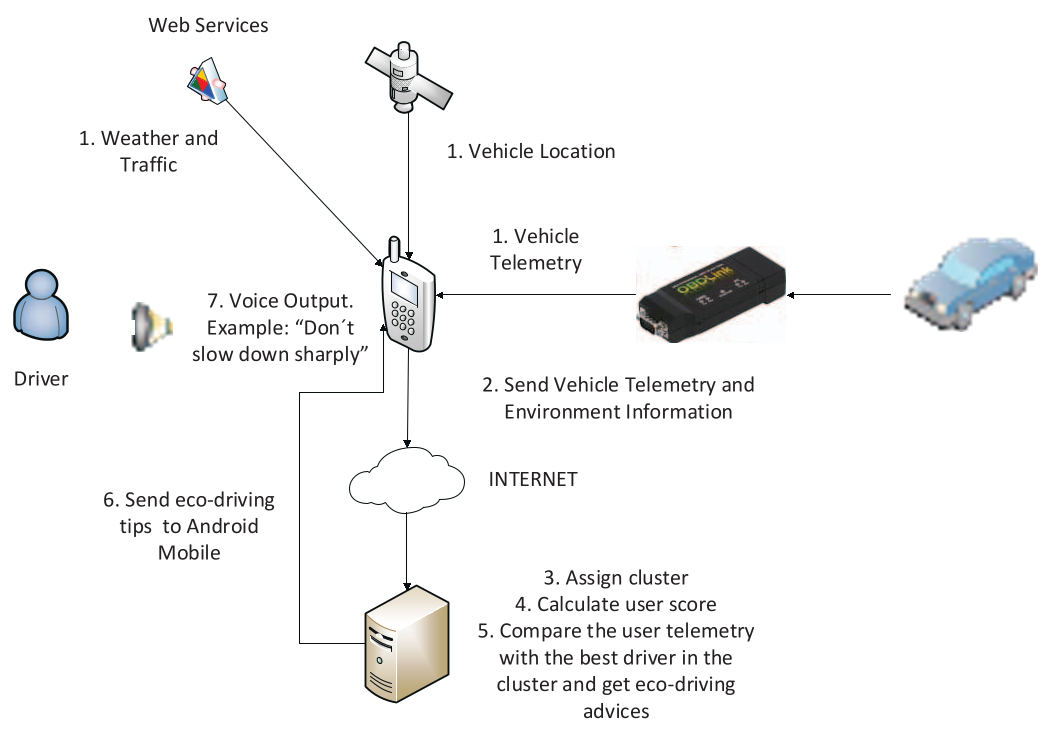 Fig 1: The GAFU Architecture, showing the flow from OBD2 data to the Social Network layer.
The system provides two-tier feedback:
- Real-time: Immediate voice warnings when a rule (e.g., "High RPM") is violated.
- Post-trip: Social rankings and "Eco-tips" generated by comparing your performance to the "Best Driver" in your cluster.
Experimental Results
The authors tested GAFU across five vehicle models in Madrid and Granada. The impact was immediate:
- Urban Drivers (Cluster 1): Saw a 31.20% improvement in efficiency metrics.
- Highway Drivers (Cluster 2): Achieved a 33.32% improvement, notably eliminating hard decelerations entirely.
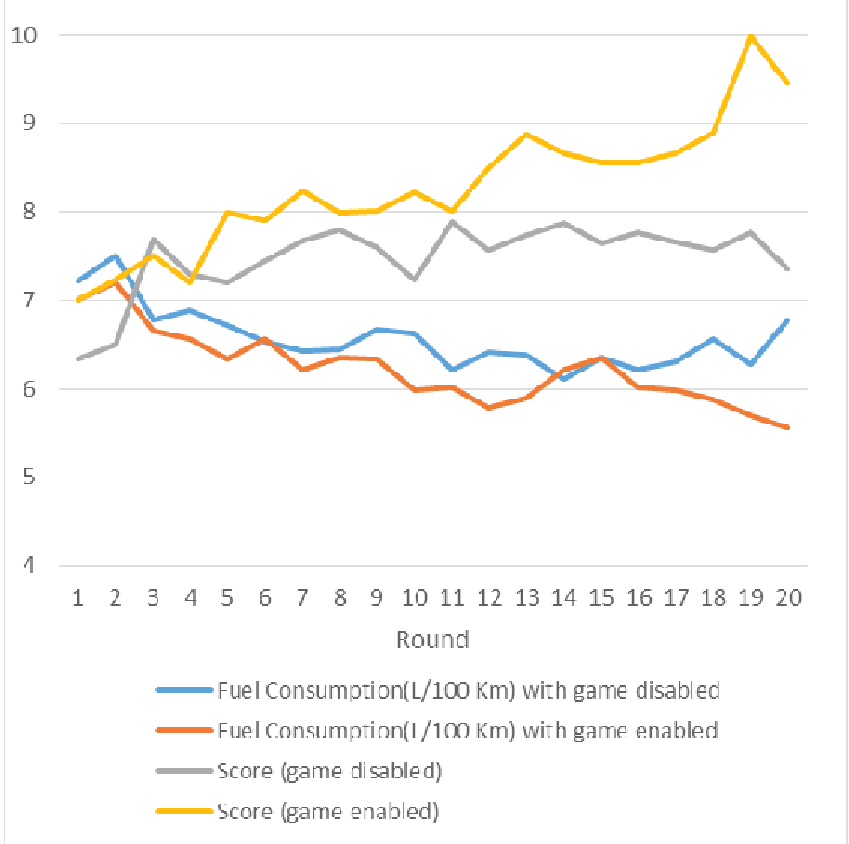 Fig 2: Longitudinal data showing how a driver’s score increases and fuel consumption decreases over 20 rounds of the game.
Critical Perspective: Beyond the Score
While GAFU shows impressive short-term results, the "novelty effect" of gamification is a known challenge. The authors acknowledge that long-term habit formation remains the ultimate goal. Furthermore, as we transition to Electric Vehicles (EVs), the Fuzzy Logic rules will need to shift from monitoring RPM to monitoring regenerative braking efficiency and battery thermal management.
Conclusion
GAFU proves that social pressure and fair competition are powerful motivators. By using Fuzzy Logic to handle the "fuzziness" of human driving behavior and EM clustering to handle environmental variables, it provides a robust framework for the next generation of connected car applications.