
Gaining Insight in Social Networks: Leveraging Bi- and Triclustering for Smart Recommendations
Gaining Insight in Social Networks with Biclustering and Triclustering
The paper introduces a hybrid approach combining biclustering and a novel pseudo-triclustering technique to analyze social network data from Vkontakte. By identifying dense communities of Users, Interests, and Groups, the method enables social tagging and personalized recommendations.
TL;DR
This research addresses the challenge of making sense of massive, multi-dimensional social network data. By moving beyond simple "friend-to-friend" links and employing Formal Concept Analysis (FCA) through biclustering and a novel pseudo-triclustering approach, the authors developed a system that tags social groups with specific user interests. This allows for highly relevant recommendations of groups to join and friends to follow, even when the data is sparse or noisy.
Problem & Motivation: The Complexity of "Closeness"
In modern social networks like Vkontakte, a user isn't just a node in a graph; they are defined by their Interests and the Groups they belong to. Analyzing these 3-mode relationships (User-Group-Interest) is notoriously difficult.
Current methods often rely on finding "cliques" (where everyone is connected to everyone), but in the real world, data is messy. If a user forgets to list one interest, a traditional algorithm fails to recognize them as part of a community. Furthermore, finding all maximal cliques is NP-hard, leading to an "exponential explosion" of patterns that no human or machine can efficiently process.
Methodology: The Core Mechanism
The authors overcome these hurdles by introducing a flexible "density" requirement and a two-stage clustering process.
1. Object-Attribute (OA) Biclustering
Instead of looking for perfect rectangles in a data matrix (Formal Concepts), they look for OA-biclusters. These allow for "white space" or missing links.
- Density (): A threshold that defines how many "dots" must be in the rectangle. If , the cluster is valid even if only half the possible connections exist.
- Scalability: This moves the computation from exponential to polynomial time.
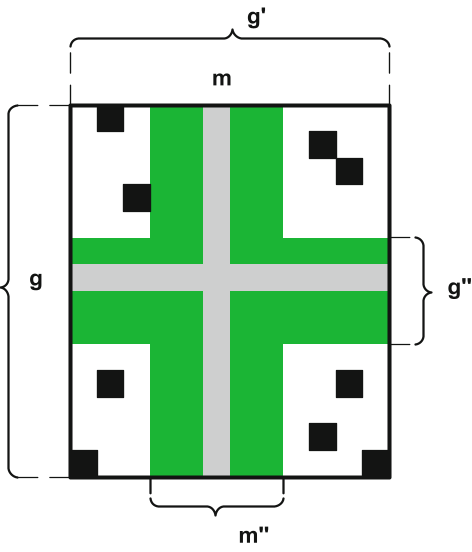 Figure 1: Comparison of a dense bicluster (gray/green areas) vs. sparse real-world data (dots). The bicluster captures the core similarity while tolerating missing pairs.
2. Pseudo-Triclustering
Rather than trying to calculate a 3D "tri-concept" from scratch—which is computationally draining—the authors use a "divide and conquer" strategy:
- Extract User-Interest biclusters.
- Extract User-Group biclusters.
- Intersect the Users from both sets. If the same group of users shares both a set of interests and a set of groups, a Pseudo-Tricluster is born.
Experiments & Results
The team tested their approach on data from four major universities (Bauman, MIPT, RSUH, and RSSU).
Key Findings:
- Data Reduction: By increasing the density threshold () from 0.0 to 0.5, the number of patterns to analyze decreased by nearly 80%, making the results much more "human-readable."
- Efficiency: UI (User-Interest) biclusters were generated in seconds, while the more complex UG (User-Group) contexts took longer but remained within practical limits (e.g., ~1800s for the largest dataset).
- Community Insight: They successfully identified specific niches. For example, a cluster was found consisting of users interested in "monasteries" and "orthodox churches" who also gravitated toward similar music and specific social groups.
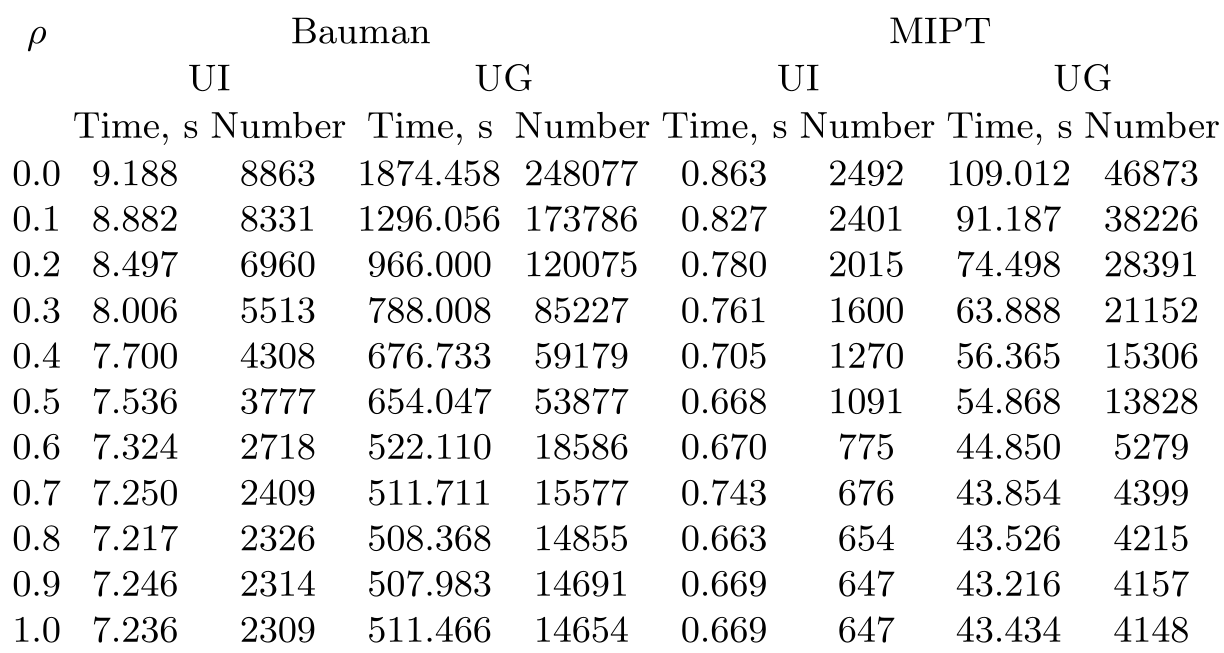 Table 1: Performance metrics showing how increasing the density threshold () drastically reduces the number of generated clusters and computation time.
Critical Analysis & Conclusion
The value of this work lies in its pragmatism. By acknowledging that social data is "noisy," the authors utilized biclustering as a fault-tolerant tool. The pseudo-triclustering method is a clever heuristic that bypasses the "curse of dimensionality" inherent in triadic data.
Limitations:
- The merging process depends heavily on the extent similarity threshold (). If set too high, you find nothing; if too low, the triclusters become meaningless.
- Manual tuning of these thresholds currently requires "expert intuition," which may be hard to scale to all social media platforms without automated optimization.
Future Work: The authors suggest that these triclusters are the perfect engine for recommender systems. If a user is "almost" in a tricluster, the missing "Interest" or "Group" provides a high-confidence recommendation essentially waiting to be made.