
This paper introduces a Gait Foundation Model based on a dual-stream spatiotemporal transformer (Masked Autoencoder paradigm) to extract embeddings from 3D skeletal motion. Trained on 3,414 adults, the model significantly outperforms engineered features in predicting age, BMI, and 1,980 phenotypic targets across 18 body systems, establishing gait as a systemic health biomarker.
TL;DR
Researchers have developed a Gait Foundation Model using self-supervised learning on 3D skeletal data from over 3,400 individuals. Moving beyond simple metrics like "walking speed," this AI model can predict diverse health markers—from liver elasticity and bone density to mental health and medication usage—purely by analyzing how a person moves. The study proves that gait is not just a symptom of leg issues but a systemic vital sign reflecting the state of nearly every organ system in the body.
The Problem: The "Reductionist" Trap in Gait Analysis
For decades, clinicians have called gait the "sixth vital sign." However, we have traditionally treated it as a symptom (e.g., a "Parkinsonian shuffle") or reduced it to simple scalars like cadence and step length.
The authors argue that this approach is like trying to understand a symphony by only measuring its volume. By focusing on a few engineered features, we discard the inter-joint coordination and temporal dynamics that might signal subclinical disease long before a patient "limps."
Methodology: Building a Gait Foundation Model
The core of this work is the GaitMAE, a Dual-Stream Spatio-Temporal Transformer.
- The Inputs: 3D coordinates of 26 anatomical joints captured by a single depth camera (Azure Kinect) during tasks like treadmill walking, Romberg tests (balance), and sit-to-stand.
- The Training: Using a Masked Autoencoder (MAE) objective, the model learns by "guessing" missing parts of a movement sequence. If you hide the movement of the left leg, can the model predict its trajectory based on the torso and right arm?
- The Output: A 1,024-dimensional "Gait Embedding"—a compact numerical signature of a person's unique movement style.
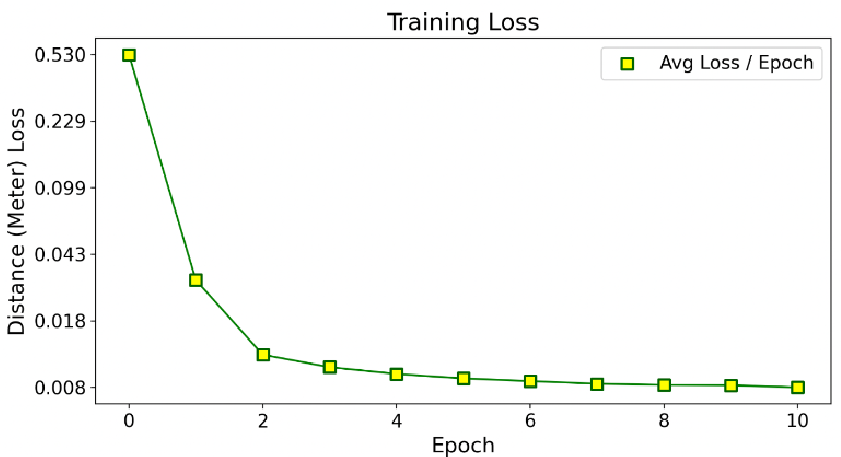 Figure 1: The GaitMAE architecture. The model learns to reconstruct masked joints with ~8mm accuracy, creating a high-fidelity internal representation of human movement.
Key Findings: More Than Just a Pretty Walk
The most striking result is the model's ability to "see" inside the body. While the model predicted age (r=0.69) and BMI (r=0.90) with high accuracy, the real breakthrough was its predictive gain.
Even after accounting for a person's age, weight, and even visceral fat (VAT), the gait embeddings provided independent information across nearly every body system:
- Metabolic Health: Predicted liver elasticity and sound speed, likely capturing the relationship between liver stiffness and musculoskeletal "sarcopenia."
- Mental Health: Successfully predicted clinical depression and the use of antidepressants, which often subtly alter dopaminergic motor control.
- Frailty & Bone Density: Captured markers of "biological age" that standard clinical tests often miss.
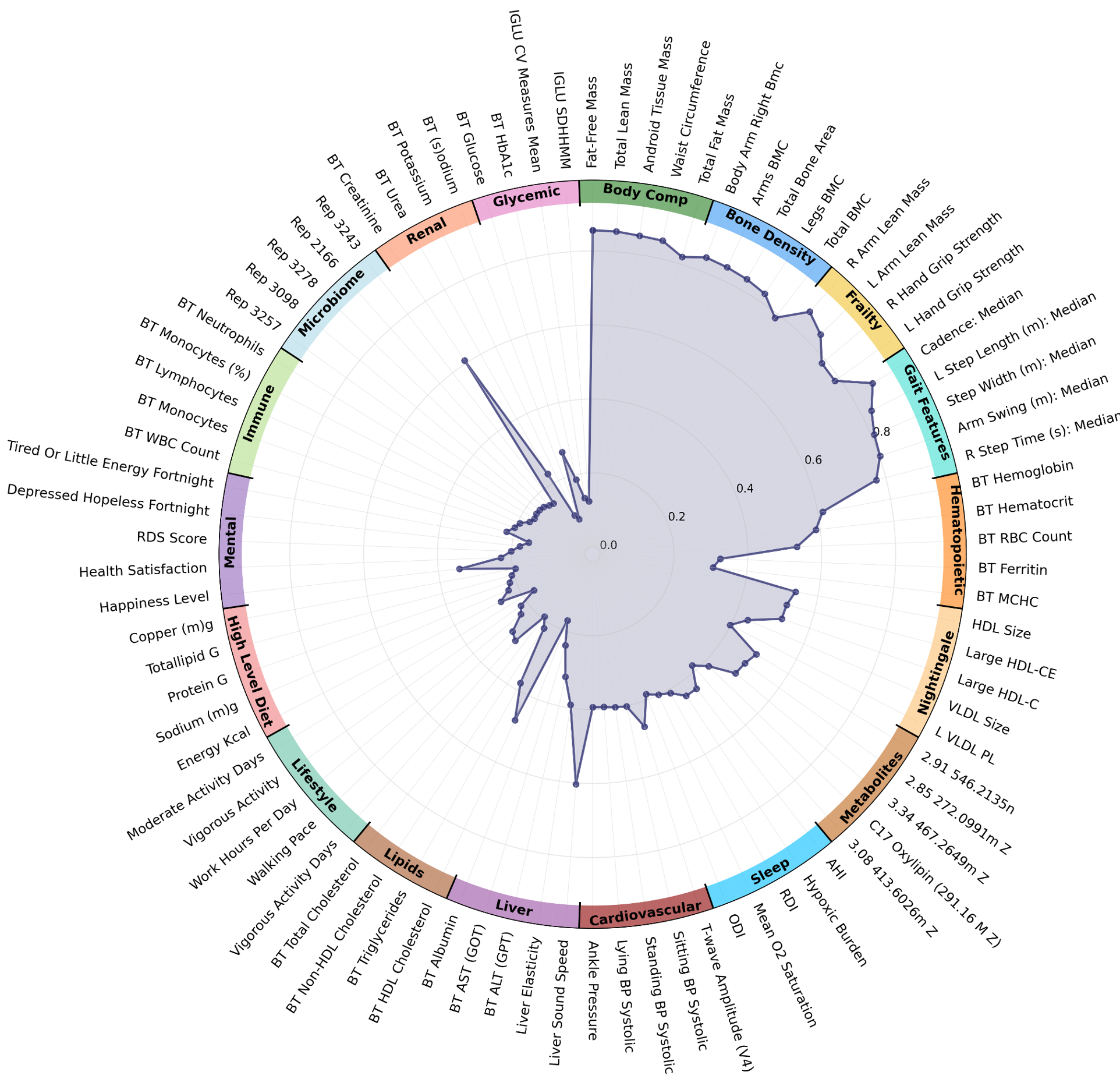 Figure 2: Radar plot showing the top features predicted across 18 body systems. From blood tests to lifestyle habits, movement encodes a wealth of biological data.
Interpretability: Which Part of Your Body Tells Your Story?
The researchers used "ablation studies" to determine which joints were responsible for which predictions:
- The Legs: Dominated predictions for metabolic health, lipids, and frailty (consistent with traditional biomechanics).
- The Torso: Surprisingly, the torso was the best predictor of sleep quality and lifestyle habits. Sleep deprivation impairs core stability, which manifests as subtle changes in trunk sway during walking.
- Sex Differences: Aging was predicted mostly by leg dynamics in men (reflecting faster lower-limb strength decline) but by arm and torso dynamics in women.
Critical Analysis & Future Outlook
This paper represents a paradigm shift. It moves gait analysis from specialized clinics to population-scale screening.
The Pros:
- Accessibility: It uses a single depth camera, not a million-dollar motion capture lab.
- Breadth: It establishes a "Foundation Model" for movement, similar to how Large Language Models are foundation models for text.
The Challenges:
- Diversity: The cohort was primarily Ashkenazi Jewish; validation on globally diverse populations is required.
- Hardware: The model was trained on depth cameras. The next "holy grail" is translating this to standard 2D smartphone video, allowing anyone to check their "movement health" at home.
Conclusion
The way you walk is a reflection of your systemic physiology. By treating gait as a foundation for health prediction, we open the door to passive, continuous health monitoring that could detect the earliest signs of liver disease, neurodegeneration, or cardiovascular decline—just by watching a person walk across a room.