
Dynamic Governance: Solving the Pollution Game via System Dynamics
Game modeling and policy research on the system dynamics-based tripartite evolution for government environmental regulation
This paper presents a tripartite evolutionary game model involving the government, businesses, and society to study environmental regulation. By integrating Evolutionary Game Theory (EGT) with System Dynamics (SD), the authors compare static and dynamic punishment mechanisms to identify optimal policy combinations for sustainable pollution control.
TL;DR
Environmental regulation is not a static command-and-control task but a dynamic game of cat and mouse. This research demonstrates that traditional "Static Punishment" leads to catastrophic social losses. By using System Dynamics (SD) to model a tripartite game between Government, Enterprise, and Society, the authors prove that a Dynamic Punishment mechanism combined with targeted rewards can steer the industry toward a "Zero Pollution, Zero Inspection" ideal state.
The Core Conflict: Why Static Regulation Fails
Most environmental policies are designed as fixed rules. However, in reality, enterprises adapt to regulations. If the punishment is static, the system often enters a "cycling oscillation" where neither the government nor the firms reach a stable, beneficial strategy.
The authors identify two fatal flaws in prior work:
- Interactive Feedback Neglect: Policy makers often ignore that a firm's decision today is a reaction to the government's inspection yesterday.
- Social Interest Vulnerability: While a game might reach a mathematical equilibrium, the "path" to that equilibrium might incur such high social costs (pollution spikes or regulatory debt) that the policy becomes a failure in practice.
Methodology: The "Policy Laboratory"
The researchers constructed two models using Vensim DSS to simulate long-term behaviors (2000-month horizons).
1. The Static Punishment Model
In this setup, the penalty for pollution is a fixed coefficient. The simulation revealed that while the system can reach equilibrium, the "Loss of Integrated Social Benefit" often reaches astronomical, "unacceptable" peaks during the transition.
2. The Dynamic Punishment Model
Here, the "Punishment" is not a constant. It is a function of:
- The current proportion of polluters.
- The current rate of government inspection.
- The cumulative loss to society.
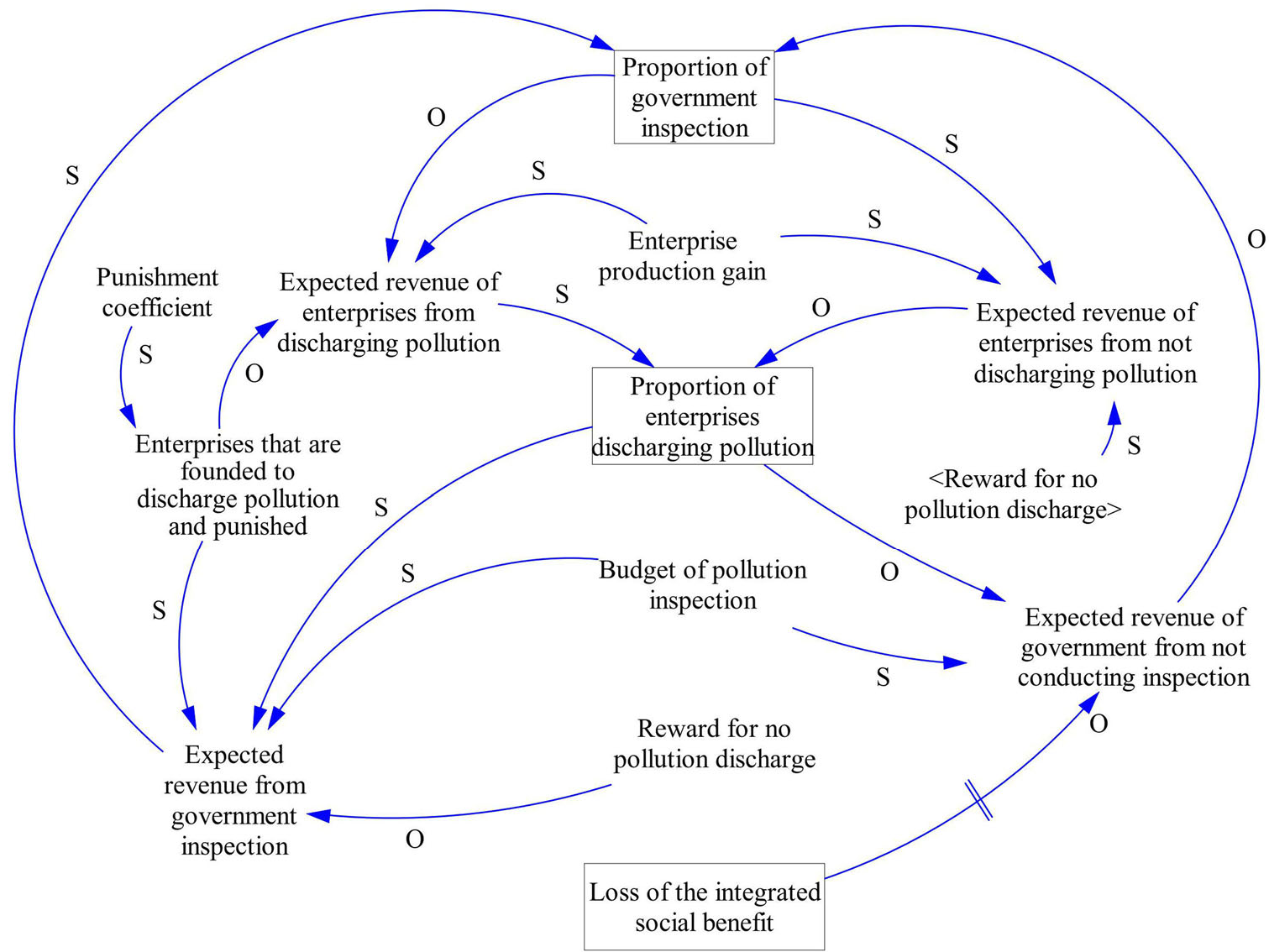 Figure: The Causal Loop Diagram showing the feedback chains between regulation, gain, and social interest.
Experimental Insights: Search for the "Ideal State"
The study defines the Ideal State as a scenario where:
- Enterprises choose "No Pollution" as a pure strategy.
- The Government maintains "No Inspection" (saving administrative costs).
- Social loss is minimized.
Key Findings:
- Single Strategy Failure: Simply increasing the "Inspection Budget" or "Production Gains" was largely invalid in the dynamic model. These levers alone do not change the underlying structure of the game.
- The Power of Combinations: The most effective "nudge" was a combination of increasing the Reward for no pollution discharge and the Punishment Coefficient.
- Dynamic Superiority: Under the Dynamic Punishment Model, the system reached the ideal state much faster (124 vs. 653 simulations) and maintained a social loss decline from the very start.
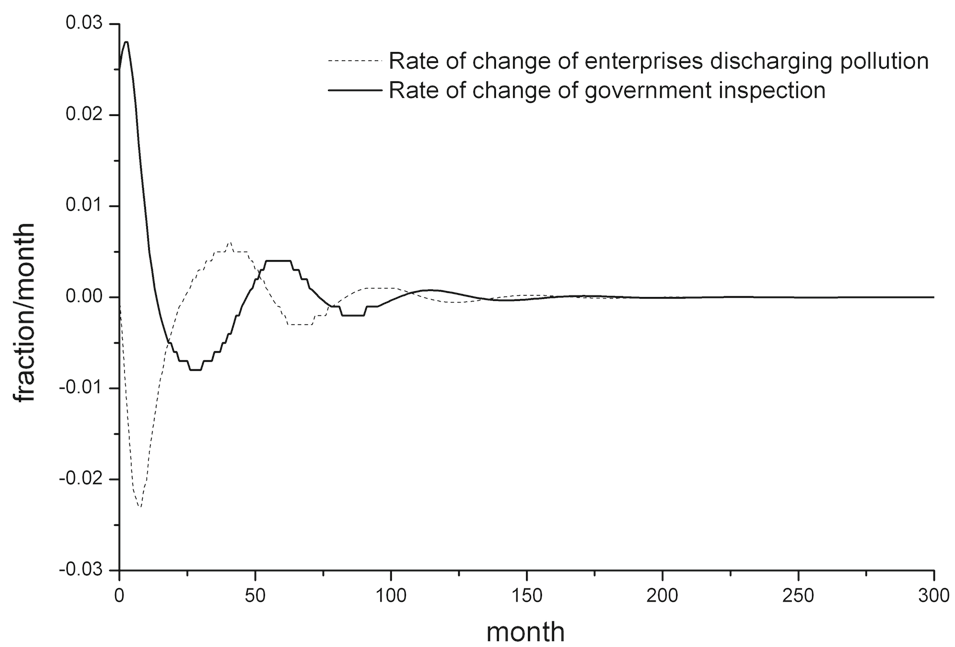 Figure: The convergence of strategies under Dynamic Punishment—notice the stabilization of the 'Rate of Change' variables.
Critical Analysis & Conclusion
This paper shifts the focus from calculating equilibrium to simulating the path towards it. It highlights that the "Loss of Social Interest" is a critical variable that often escapes traditional game theory but is captured vividly by System Dynamics.
Takeaway for Policy Makers: Stop looking for a "Silver Bullet" single policy. The "Ideal State" of environmental protection is only achievable through Adaptive Governance—where penalties scale with the severity of the industry's behavior, and rewards are used to "pull" firms toward compliance while punishments "push" them away from pollution.
Limitations: The model assumes continuous strategy selection and ignores technological progress. Future research should integrate "Technological Innovation" as a variable that could lower the cost of compliance for enterprises, potentially accelerating the transition to the ideal state.