
Strategic Competitive Contagion: Balancing Quality and Seeding in Social Networks
Game theoretic analysis of a strategic model of competitive contagion and product adoption in social networks
This paper presents a strategic model of competitive contagion where two firms vie for market share in a social network using fixed budgets. It combines game-theoretic diffusion (local coordination games) with a resource allocation problem to determine the optimal balance between product quality (payoff) and initial seeding (free offers).
TL;DR
How should a company allocate a limited marketing budget? Should they make the product "better" (higher payoff for users) or give it away to more "seed" influencers? This paper provides a game-theoretic answer: using local coordination games and spectral graph theory, the authors prove that your strategy should depend almost entirely on your budget relative to your competitor, regardless of the network's specific shape.
Background: The Social Coordination Problem
Product adoption is rarely an isolated choice. Whether it's choosing a messaging app like WhatsApp or a social platform like LinkedIn, the value of the service increases as more of your neighbors join. This is a Local Coordination Game.
The authors distinguish their work from previous stochastic models by assuming agents are myopic and rational. They don't switch products because of a random "infection" probability; they switch because they look at their neighbors and calculate which product gives them a higher utility.
Methodology: The Mechanics of Diffusion
The core of the paper rests on the transition between individual logic and global network bounds.
1. The Local Update Rule
An agent switches from product to product if: Here, and are the payoffs. This defines the Risk Dominance (). If the fraction of your friends using exceeds this threshold, you switch.
2. Network Topology and Spectral Bounds
Using the spectral radius and the minimum degree , the authors derive an exponential bound for the expected number of adoptions.
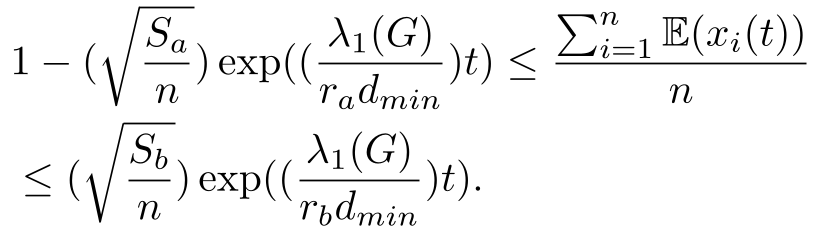
The intuition here is powerful: the "speed" of contagion is governed by the ratio of the network's connectivity () to the product's resistance to change ().
The Strategic Game: Quality vs. Quantity
The most significant contribution is the analysis of the competition between Firm A and Firm B. Each has a budget . They must choose:
- (Cost per unit): Investing in product quality to increase consumer payoff .
- (Initial Seeds): The number of people who get the product for free.
Using a Cobb-Douglas production function (), the researchers solved for the Nash Equilibrium.
The "Budget Paradox" Strategy
The equilibrium yields a surprising insight regarding the ratio of investments:

- If you are the Underdog (Small Budget ): You cannot compete on scale. Your best bet is to invest heavily in the quality () of the product. By making your product's payoff much higher, you lower the "risk dominance" threshold required for a switch to occur.
- If you are the Leader (Large Budget ): You should focus on seeding (). Even if your product quality is slightly lower, your ability to overwhelm the network with initial users creates a coordination effect that "locks in" the market.
Critical Analysis: Is Network Structure Truly Irrelevant?
The paper claims that the ratio of strategies is independent of network structure. This is a bold theoretical result, but it comes with caveats:
- Homogeneous Payoffs: The model assumes the payoff is the same for all users. In reality, different communities in a network value products differently.
- Myopic Behavior: The assumption that agents only look one step ahead (myopic) might not hold for high-stakes technology adoptions where users anticipate future trends.
- Spectral Dependance: While the strategy ratio is independent, the absolute success of the campaign is still heavily dictated by . A fragmented network might still kill both products regardless of strategy.
Conclusion
This work bridges the gap between micro-level game theory and macro-level network science. It provides a rigorous mathematical justification for common marketing intuitions: "niche" players must be "better," while "giants" simply need to be "everywhere." For future researchers, the next step is clearly to move beyond "seeding counts" to "seeding locations"—analyzing how Centrality measures might warp these Nash Equilibria.