
Game Theoretic Attack Analysis: Quantifying the Stealthy Risks of OSN Data Sharing
Game theoretic aack analysis in online social network (OSN) services
This paper presents a novel game-theoretic framework to model and analyze attack-defense dynamics in Online Social Network (OSN) services. By utilizing a zero-sum Markov game model, the authors simulate interactions between legitimate users (agents) and attackers to determine optimal data-sharing policies and quantify system vulnerabilities across various threat scenarios.
Executive Summary
TL;DR: This research transforms the abstract problem of social media privacy into a rigorous Zero-Sum Markov Game. By modeling the struggle between a user attempting to reach an "Optimal" sharing state and an attacker seeking to expose private data, the study quantifies exactly how much advantage an adversary needs to break a system. It reveals a chilling reality: metadata "clusters" allow even low-skilled attackers to compromise nearly all private data with minimal effort.
Positioning: This work serves as a foundational quantitative bridge between social network sociology and cybersecurity, moving beyond qualitative checklists to simulation-driven risk assessment.
Problem & Motivation: The Illusion of Control
In the current OSN landscape, users operate under a binary illusion: data is either "public" or "private." However, the authors argue that the reality is a spectrum of four states: Optimal, Under-shared, Over-shared, and Hybrid.
The core friction lies in the Motivation Gap. Users want rapid utility (sharing), while service providers often implement coarse access controls. This creates "Over-shared" states where unintended data leakage occurs. The authors' insight was to realize that this isn't just a configuration error—it is a dynamic game where the attacker's knowledge of the network structure (metadata) functions as a strategic lever.
Methodology: The Markov Game Framework
The paper formalizes OSN interaction as a two-player game between an Agent (User) and an Opponent (Attacker).
The Strategy Matrix
The game revolves around four primary actions:
- Share (S) / Mask (M): The user's drive toward the "Optimum" (n, 0) state—sharing public items while hiding private ones.
- Conceal (C) / Expose (E): The attacker's drive toward the "Worst" (0, m) state—hiding what the user wants public and exposing what should be private.
Architecture of the Interaction
The transition between states is governed by probabilities ( for the defender and for the attacker). The most innovative aspect is the modeling of the "Battleship Tactic", where once an attacker "hits" a private item, they perform a linear search in that metadata neighborhood, simulating how real-world hackers use folder names or friend lists to find sensitive content.
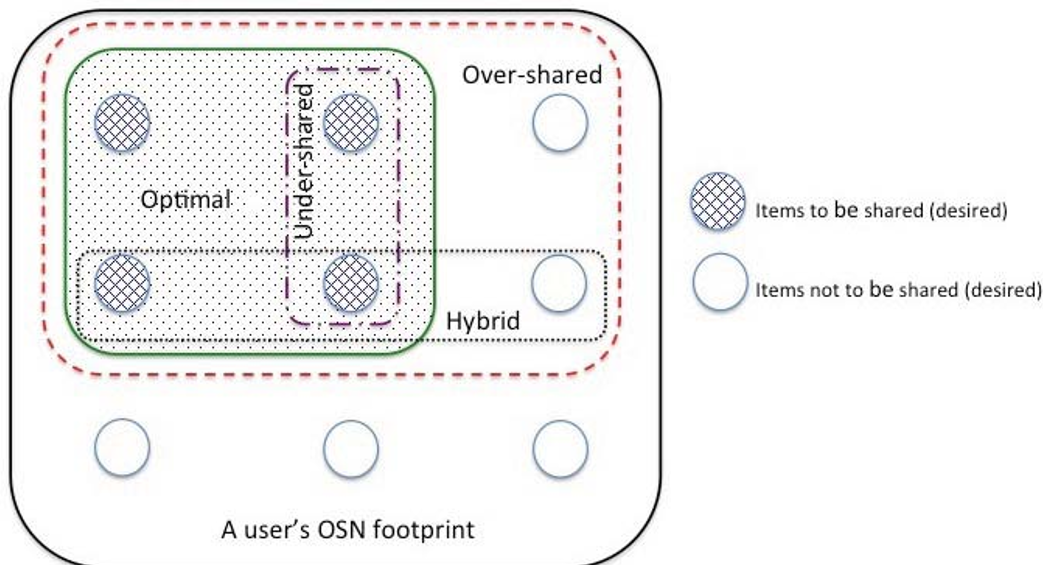 Figure 1: The transition landscape between Optimal, Under-shared, and Over-shared states.
Experiments & Results: The "Advantage" Threshold
Through C++ simulations, the authors tested four distinct threat profiles:
- The Blind Attacker: When attacking randomly without system knowledge, an adversary needs a massive 2.5 to 1 advantage in success probability to cause even marginal damage.
- The Metadata Explorer: This is the most realistic threat. By using limited knowledge to find clusters, the attacker's efficiency skyrockets. Even with a 1:1 probability ratio, 41% of private data was exposed if stored in a single cluster.
- The Insider Threat: If p=q (even odds) and the attacker has full knowledge, the "game" ends in total compromise in roughly 300 rounds, proving that defenses are almost useless against motivated insiders.
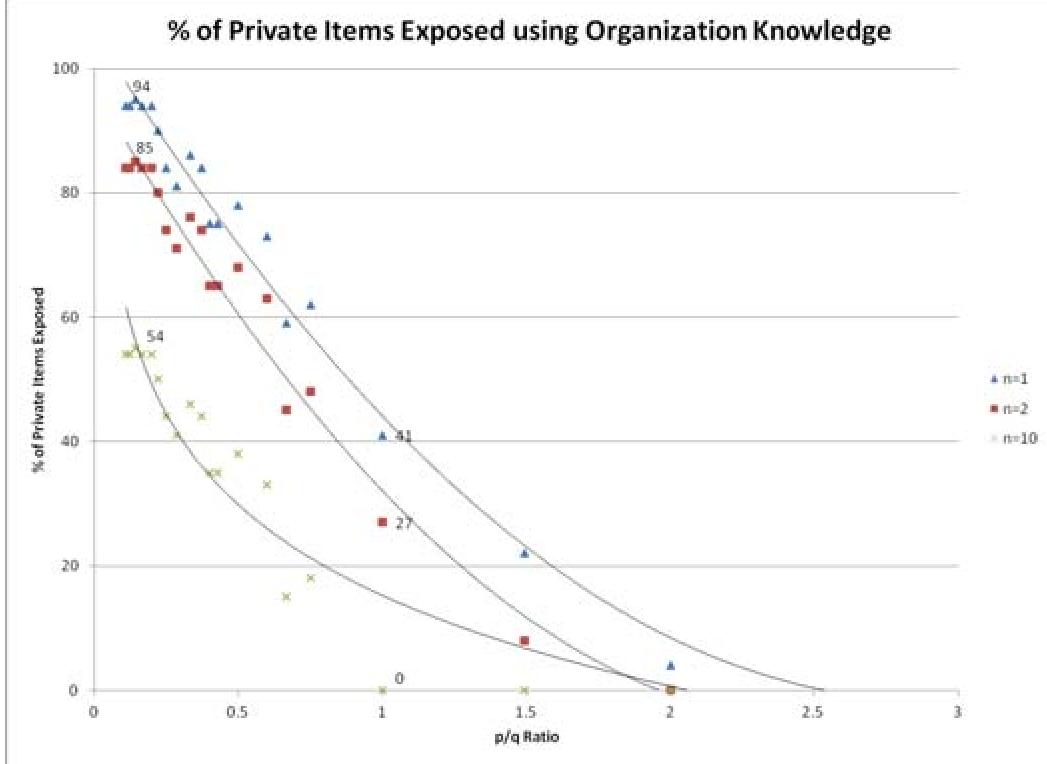 Figure 2: The impact of data clustering. Note how spreading private data across 10 clusters (bottom trace) significantly mitigates the exposure rate compared to a single cluster.
Deep Insight & Conclusion
The Takeaway: The most profound finding is the Danger of Rapid Exposure. Users who prioritize sharing speed over security (never using the "Mask" action) essentially hand victory to the attacker. Even at a 3:1 advantage for the defender, purely "sharing-focused" users still lost 12% of their private data illicitly.
Limitations: The model assumes a zero-sum game, which might not capture scenarios where service providers (as a third player) benefit from "over-sharing" for ad-revenue, creating a three-way conflict of interest.
Future Outlook: As OSNs move toward decentralized architectures, this game-theoretic approach will be vital. Designers must optimize for "Data Dispersion"—breaking the clustering that the "Battleship" tactic relies on—to ensure that a single metadata leak doesn't lead to a total privacy collapse.