
Microgrid Social Networks: Navigating Energy Trading Under Information Uncertainty
A game-theoretic model for energy trading of privacy-preserving Microgrid Social Networks
The paper introduces a Bayesian-Stackelberg game-theoretic model for energy trading within a Microgrid Social Network (MGSN). By integrating physical power buses with cyber-level social networks, it achieves a Decentralized Energy Management (DEM) system where participants navigate imperfect information using a Bayesian approach.
TL;DR
This paper addresses the "honesty gap" in decentralized energy markets. By treating Microgrids as social entities that may hide their true status (Privacy-Preserving), the authors propose a Bayesian-Stackelberg game model. It allows Microgrids to trade energy effectively even when 90% of the participants are providing inaccurate or incomplete data about their power needs.
Background: The Convergence of Power and Social Networks
As we transition toward distributed energy resources, Microgrids (MGs) have emerged as the modular building blocks of the future grid. However, coordination is hard. The authors propose the Microgrid Social Network (MGSN) architecture, where MGs are connected not just by physical wires, but by social layers for information exchange.
The central challenge is Privacy. An MG might not want to reveal it is in an "Abnormal" (emergency) state to avoid being exploited or due to data sensitivity. This "imperfect information" breaks standard game-theoretic models.
Methodology: The Bayesian-Stackelberg Approach
The authors model the market as a hierarchical game:
- Sellers (Leaders): Decide what proportion () of their surplus energy to sell vs. store.
- Buyers (Followers): Based on the sellers' available energy, they decide on bidding prices ().
Overcoming Information Asymmetry
The "secret sauce" is how MGs estimate the state of others. The model uses a Social Link Weight () to characterize trust. If MG has a close social tie to MG , it is more likely to trust 's status update. If the tie is weak, MG uses a Bayesian update to "guess" the true state of by observing its neighbors.
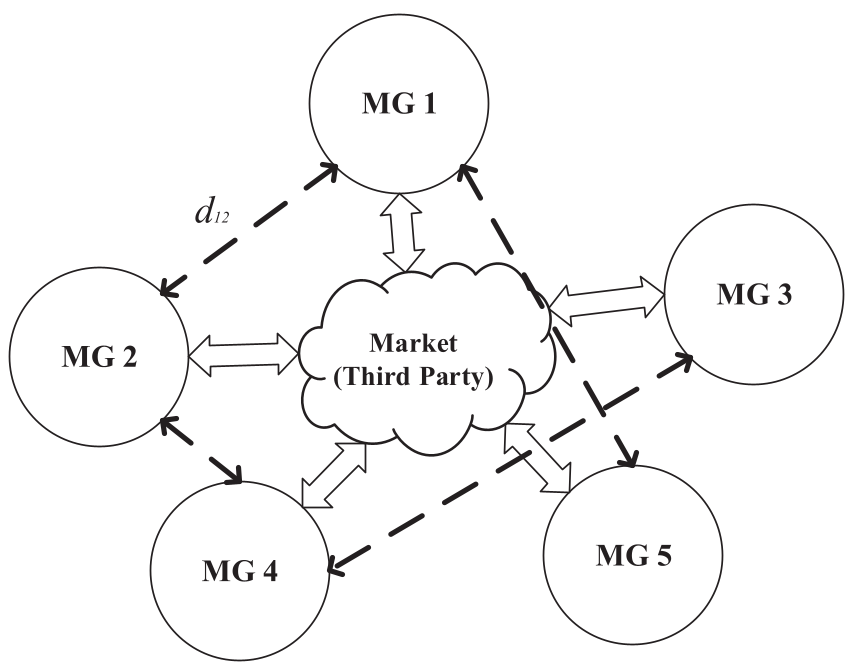 Figure: The dual-layer communication involving the physical market and the social network layer.
Mathematical Intuition: The Payoff Functions
Unlike simple profit maximization, the payoff functions here are nuanced:
- Sellers: Balance the revenue from selling against the "satisfaction" of keeping energy in reserve for their own emergencies.
- Buyers: Balance the need for power against the desire to pay as little as possible.
The model converges to a Bayesian Nash Equilibrium (BNE) using the Nikaido-Isoda function, which iteratively updates strategies until no player can improve their payoff by deviating.
Experimental Validation
The authors tested the model in Case Studies involving 20 Microgrids.
Key Insight: Resilience to Lies
In "Case Study II," the authors simulated environments where participants shared inaccurate information.
- Finding: When 90% of the participants shared false data, the MGs using the proposed Bayesian estimation model achieved significantly higher payoffs/satisfaction than those who either completely trusted or completely ignored social information.
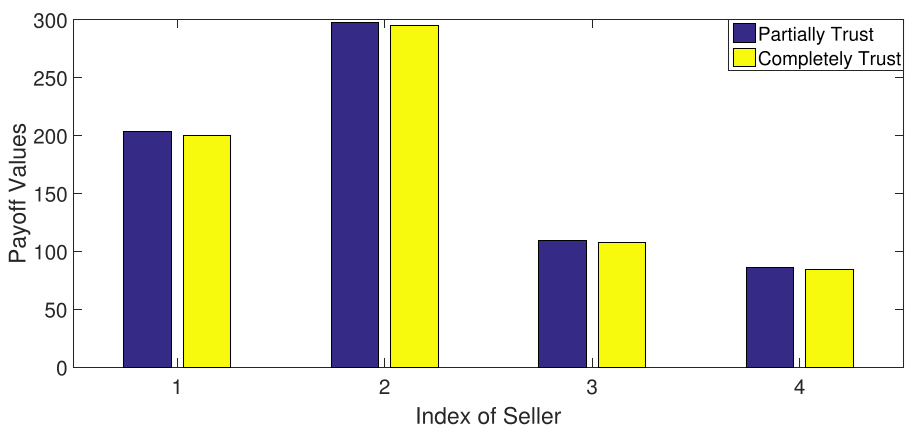 Figure: Sellers and Buyers maintain higher utility even when the market is flooded with inaccurate state data.
Critical Analysis & Conclusion
The strength of this work lies in its realistic assumption of player behavior. In decentralized systems, agents are rarely 100% transparent. By integrating "Social Trust" into the Bayesian framework, the authors bridge the gap between abstract game theory and practical power engineering.
Limitations: The model currently assumes a static social network weight (). In future work, these weights could be dynamic—learning over time which MGs are "liars" and adjusting trust scores accordingly (Reputation Systems).
Takeaway: Effective energy trading in a privacy-conscious world requires looking beyond the meter and into the social fabric of the grid participants.