
To Lie or Not to Lie: A Game-Theoretic Lens on Social Media Deception
Toward a Game Theoretic Model of Information Release in Social Media with Experimental Results
This paper introduces a game-theoretic framework to model user behavior regarding information release (disclosing, withholding, or deceiving) on Online Social Networks (OSNs). By integrating survey data from 200 participants, the authors establish a model where a user's decision-making is heavily influenced by their immediate "inner circle" of friends and the desire for a positive "social image."
TL;DR
Why do we lie on social media? It’s not just about privacy—it’s about math and social status. This paper explores the "Privacy Paradox" by creating a game-theoretic model where users decide whether to release, withhold, or fake information based on their friends' behaviors. The takeaway: your social circle's "average" honesty level and your desire for a "successful image" are the ultimate architects of your online identity.
The Motivation: Beyond the Privacy Paradox
For years, researchers have been puzzled by the Privacy Paradox: users say they care about privacy, yet they continue to post sensitive data. This paper argues that information disclosure isn't a binary choice. It is a strategic triad:
- Truthful Disclosure: Sharing real data for social benefits.
- Withholding: Just not answering the question.
- Deception: Providing fake data to reap social rewards while protecting the "real" self.
The authors' survey of 200 participants revealed a crucial insight: Lying is rarely about privacy; it’s about "Social Image." Users are more likely to lie to appear successful or to fit in with their "inner circle" than to hide from surveillance.
Methodology: The Math of Peer Pressure
The researchers modeled the social network as a graph . Each user seeks to maximize a payoff function that balances:
- Benefit : The gain from social interaction (utility).
- Social Cost : The penalty for deviating from the group's "honesty norm."
- Moral Cost : The internal psychological cost of lying.
The Payoff Structure
A critical part of the model is the "Neighborhood Average." Your behavior is compared against (the average amount and quality of information released by your immediate neighbors).
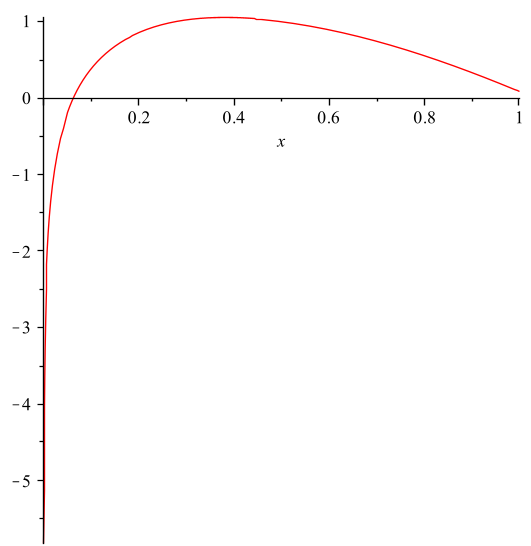 Fig 1: The payoff function showing the "sweet spot" of information disclosure.
The paper proves that if the benefit functions are concave and cost functions are convex, a Nash Equilibrium exists—a state where no user can benefit by unilaterally changing their disclosure strategy.
Experiments and Insights
By simulating a 6-node network with varying sensitivities to privacy (represented by the variable ), the authors found that network topology matters immensely.
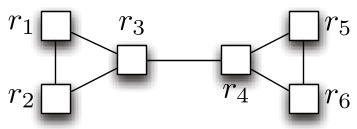 Fig 2: A small-scale social graph used to demonstrate asymmetric disclosure equilibria.
In the experiment:
- Users with high sensitivity to privacy naturally drifted toward disclosing only ~27-28% of their info.
- Users with low sensitivity disclosed ~40%.
- Interestingly, centrality matters: Even if you are insensitive to privacy, if your friends are "secretive," the social pressure will lead you to withhold more information than you otherwise would.
Critical Analysis: The Automorphism Conjecture
One of the most profound "Senior Editor" takeaways here is the author's Conjecture V.1. They suggest a deep link between Graph Theory (Automorphisms) and Game Theory (Equilibria).
Essentially, if two users occupy perfectly symmetrical positions in a social graph and have similar biological/social profiles, they must converge to the same disclosure strategy at equilibrium. If they don't, it implies their hidden "internal" payoff functions (their personal values) are different. This allows researchers to "reverse engineer" a person’s private values just by watching their social media behavior relative to their peers.
Final Thoughts
This work moves identity verification from a simple "database check" to a dynamic "behavioral game."
- Limitation: The model currently assumes a static graph, whereas social circles shift constantly.
- Future Work: Integrating "active" transactions like 'Likes' and 'Shares' into the payoff function would make the model even more robust for modern AI-driven social platform analysis.
Ultimately, this paper reminds us that on social media, we aren't just protecting our data; we are playing a high-stakes game of "Social Image" where the rules are written by our friends.