
The Math of Rivalry: Decoding TopCoder Competitions via Game Theory
A Game Theoretic Model of Software Crowdsourcing
This paper presents a game-theoretic model to analyze competitive behaviors in software crowdsourcing, specifically focusing on the 2-player algorithm challenges on TopCoder. By applying static games of complete information and computing Nash equilibria, the authors identify critical probability thresholds that dictate whether a coder should challenge an opponent's solution.
TL;DR
Why do some coders choose to challenge their rivals while others play it safe? This paper uses Game Theory to model the algorithm challenges on TopCoder. By calculating Nash Equilibria, the authors uncover a specific mathematical "tipping point"—a probability threshold that determines when a rational coder will switch from defense to an aggressive challenge.
Background Positioning
In the landscape of Software Engineering (SE) research, crowdsourcing is often viewed through the lens of project management or basic incentives. This work moves the needle toward Behavioral Modeling, treating developers as rational agents in a high-stakes competitive environment. It is a foundational step in quantifying the "Human-in-the-loop" dynamics of platforms like TopCoder.
Problem & Motivation
On TopCoder, the "Challenge Phase" is a 15-minute window of intense psychological and technical warfare. Players can gain 50 points by finding a bug in another's code but lose 25 if they fail.
Current literature fails to address the Simultaneous Decision Problem:
- If I challenge and fail, I lose my lead.
- If I don't challenge but my rival does, I might lose everything.
- Information is transparent (skill ratings, scores), yet the optimal move remains non-obvious.
The authors argue that players act simultaneously under "complete information," making it a perfect candidate for a Static Game model.
Methodology: The Core Game
The researchers simplified the interaction into a 2-player matrix. Each player has two strategies: Challenge (C) or Not Challenge (NC).
The Payoff Matrix
The utility for each player is calculated based on:
- : Skill levels of players A and B.
- : The probability of a successful challenge.
- : The potential points from the coding phase.
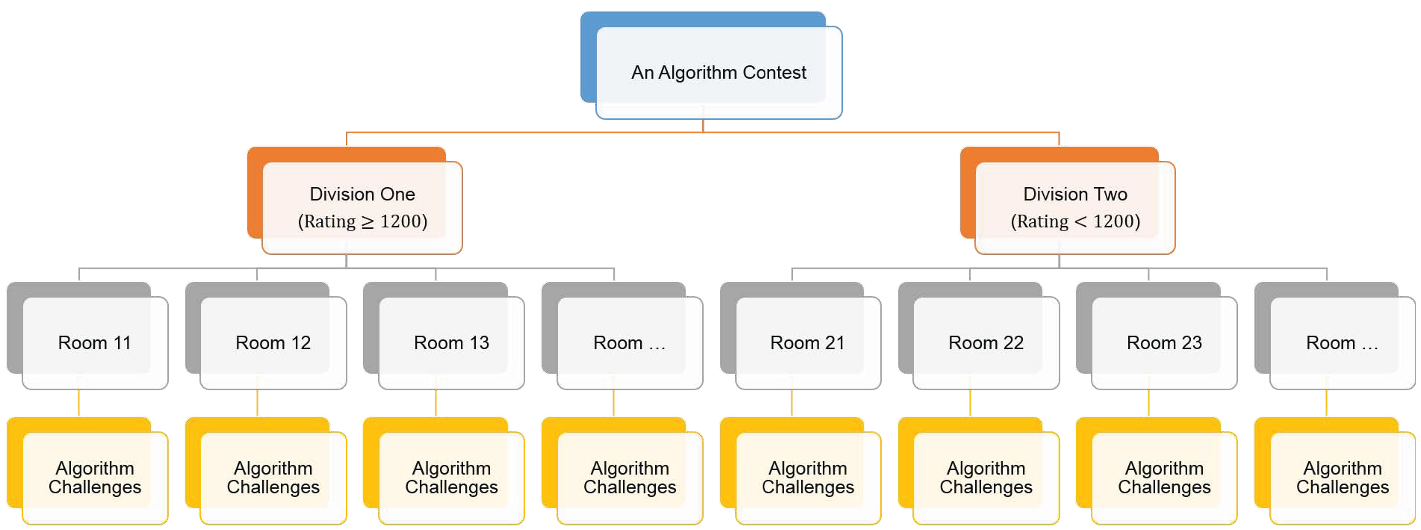 Figure 1: The hierarchical structure of TopCoder contests where these games occur.
The authors dissected the game into 9 distinct conditions based on whether the expected gain from a challenge is positive, zero, or negative. For each, they solved for the Pure-strategy Nash Equilibrium—the state where no player can benefit by changing their strategy if the other remains unchanged.
Experiments & Results: The Tipping Point
The most profound insight from the study is the derivation of the Probability Threshold.
Key Findings:
- The Dominant Strategy: A player will always challenge if: Given TopCoder’s standard values (Reward , Penalty ), the threshold is approximately 0.33. If you are 34% sure you can break the code, you must attack.
- Pure vs. Mixed Strategies: While pure strategies (C, C) or (NC, NC) dominate most scenarios, the authors found that if the payoffs align perfectly at zero, players enter a "randomized" state, though this is rare in practice.
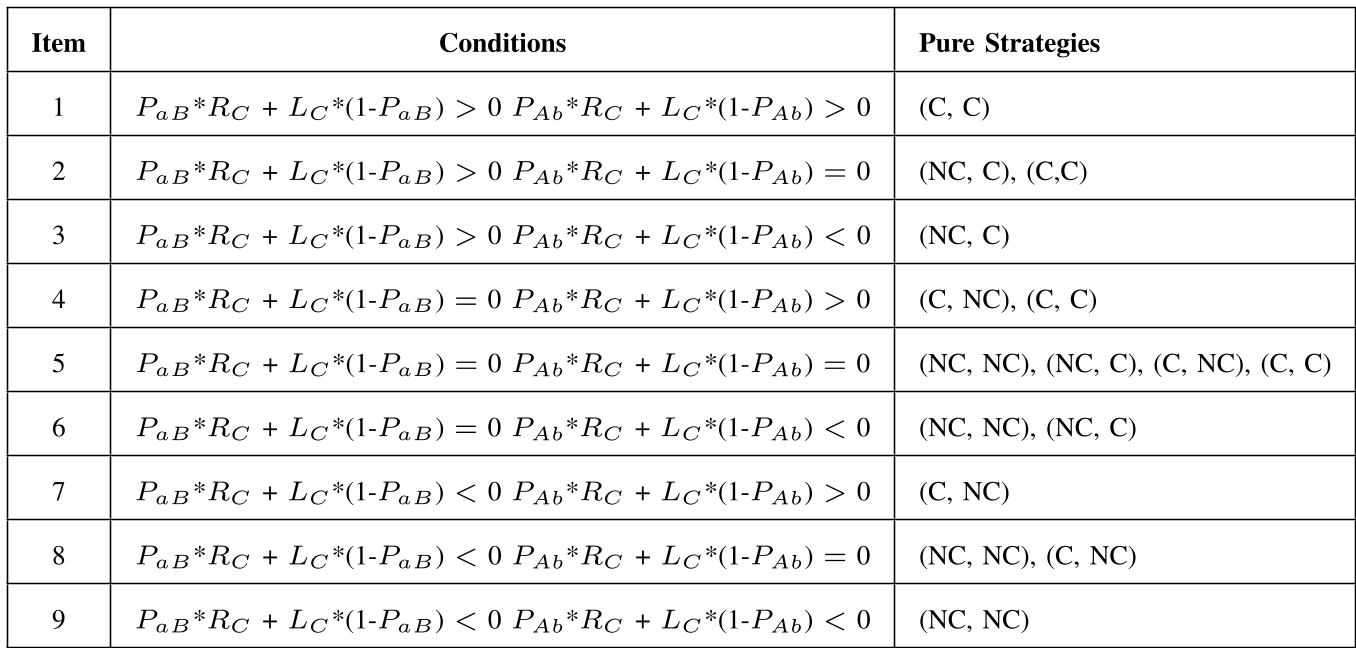 Table XII: Summary of Pure-Strategy Nash Equilibria across the 9 scenarios.
Critical Insight & Conclusion
Takeaway
The value of this model is its predictive power. By knowing a player's historical success rate (), platform organizers can predict the intensity of the challenge phase. For participants, it provides a cold, mathematical framework to replace "gut feelings" during the 15-minute heat of the SRM.
Limitations
- Simplicity: The 2-player model doesn't fully capture the "room" dynamic (20 players), where the risk of being challenged by anyone else shifts the utility.
- Static Nature: It assumes decisions are made once at the start, ignoring the "sniping" behavior often seen at the last second of the challenge phase.
Future Outlook
The authors suggest that by adding a stage for actual participation between the challenge and testing phases, platforms could further leverage these competitive advantages. Future research will likely integrate Time Costs and N-player dynamics to better mirror the chaotic reality of software crowdsourcing.