
Game Theory for OSNs: Balancing Social Sharing and Privacy via Markov Games
A game theoretic approach for modeling optimal data sharing on Online Social Networks
The paper introduces a game-theoretic framework for modeling optimal data sharing and privacy protection in Online Social Networks (OSNs). It presents a two-player zero-sum Markov game where an agent (user) competes against an opponent (attacker) to reach an equilibrium between sharing desired information and hiding private data.
TL;DR
Researchers have developed a mathematical framework using Zero-sum Markov Games to solve the fundamental tension of Online Social Networks (OSNs): the need to share information for social utility versus the need to protect private data. By modeling the user and attacker as competing players, they derive an optimal policy that guides users toward an "Optimal State" where desired content is shared and private content remains hidden.
Background: The Privacy-Utility Dilemma
In the modern social media landscape, users are constantly balancing on a tightrope. On one side, Social Utility requires sharing data with friends and colleagues; on the other, Privacy Protection requires shielding sensitive information from malicious entities.
Current solutions like FaceCloak (data encryption) or FlyByNight (client-side encryption) provide technical barriers, but they don't help a user decide how to act in a dynamic environment where an attacker might be actively trying to expose or conceal information. The authors argue that this is not a one-time setup but a repeated game of strategy.
Problem & Motivation
The paper identifies a critical gap: existing privacy models are often static. However, OSN interactions are stochastic. Transitions between privacy states are influenced by:
- Facilitating Parameters: Automatic sync, social needs, or exposure by others.
- Detracting Parameters: Fear of privacy loss or lack of platform knowledge.
The author's insight is that since the user's gain (hiding a private item) is the attacker's loss (failing to expose it), this environment can be perfectly captured by a Zero-sum Markov Game.
Methodology: The Markov Game Framework
1. The State Space
The game is defined by a matrix of states , where is the number of shared items and is the number of exposed private items.
- Optimal State (n, 0): All desired data is shared; zero private data is leaked.
- Worst State (0, m): No desired data is shared; all private data is leaked.
2. The Players' Moves
- Agent (User): Can Share (S) an extra item or Hide (H) an exposed item.
- Opponent (Attacker): Can Conceal (C) a shared item (DoS) or Expose (E) a private item.
3. Architecture and Dynamics
The core of the methodology lies in the Value Iteration algorithm for Markov Games. Unlike a standard Markov Decision Process (MDP) that uses a simple max operator, this model uses a maxmin operator to account for the opponent's optimal counter-moves.
 The Stage Game Payoff Matrix representing the expected rewards for joint actions (Hide/Share vs Expose/Conceal).
The mathematical engine is the Bellman Equation for Zero-sum Games:
Experiments and Results
The authors simulated a scenario with 9 states (). Using a discount factor (balancing short-term and long-term gains), the model reached convergence in just 5 iterations.
Key Findings:
- Mixed Strategies: In central "Hybrid" states, the optimal policy isn't a single action but a probability distribution (e.g., 50% chance to Hide, 50% chance to Share). This prevents the attacker from predicting and exploiting the user's behavior.
- Advantage and Drift: If the probability of successful protection () is higher than the probability of successful attack (), the system naturally drifts toward the optimal state .
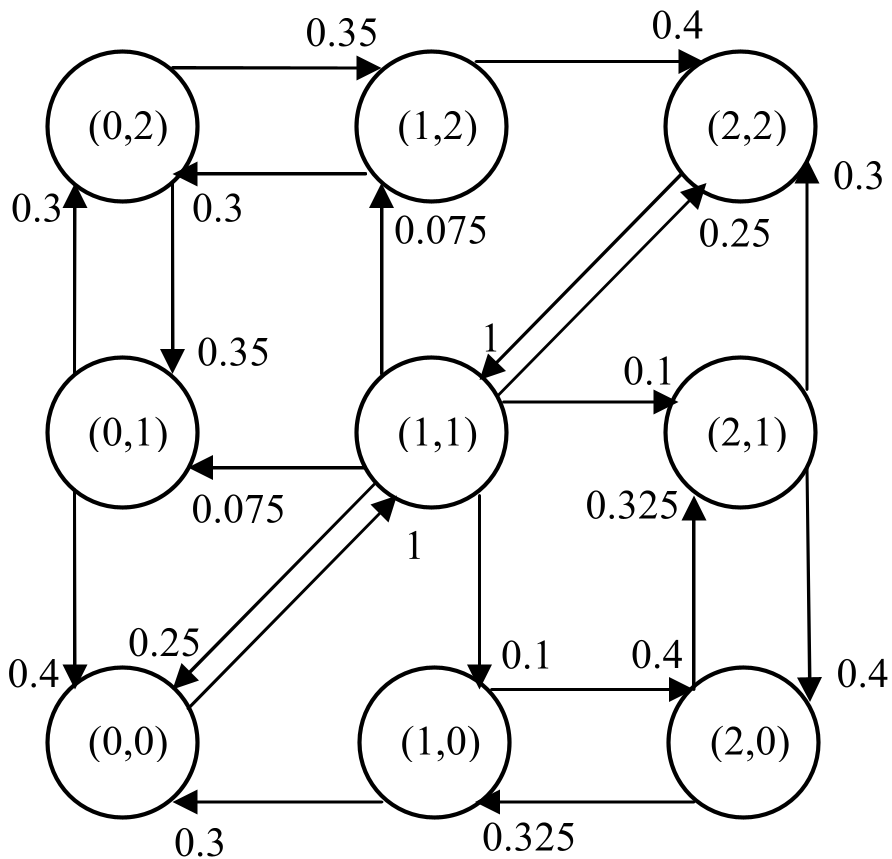 Fig 1: The resulting Markov Chain showing the transition probabilities when both players play optimally.
Critical Analysis & Conclusion
Takeaway
This research moves privacy from a "feature" to a "strategy." By quantifying the rewards of sharing versus the costs of exposure, OSN providers could eventually build AI privacy assistants that dynamically suggest the best settings for a user based on current threats.
Limitations
- Perfect Observation: The model assumes users always know exactly which data has been leaked. In reality, data leaks (like shadow profiles) are often invisible.
- Rational Opponent: The model assumes the attacker is a perfectly rational "minimax" player, which may not always be the case for automated bots.
Future Outlook
The authors plan to extend this to Incomplete Information games, where the user doesn't have a 100% clear view of the attacker's state. This will bring the model closer to the messy, "fog-of-war" reality of the internet.
Keywords: Game Theory, Markov Game, OSN, Privacy Protection, Security.