
Engineering Cooperation: Optimal Two-Sided Rating Protocols in Crowdsourcing
Game-Theoretic Design of Optimal Two-Sided Rating Protocols for Service Exchange Dilemma in Crowdsourcing
This paper proposes the first game-theoretic design of a two-sided rating protocol (P) to resolve the service exchange dilemma in crowdsourcing. It introduces a mechanism involving a recommended strategy and a rating update rule that utilizes differential punishments to stimulate cooperation among self-interested, anonymous users, effectively approaching social optimum in imperfect monitoring environments.
TL;DR
Crowdsourcing platforms are often paralyzed by a "social dilemma" where users want to consume but not contribute. This paper introduces the first two-sided rating protocol that strategically updates reputation for both clients and servers. By applying game-theoretic constraints—specifically the One-Shot Deviation Principle and the Principle of Fairness—the authors provide an algorithmic roadmap to maximize social welfare even when monitoring is imperfect.
Background: The Service Exchange Dilemma
In a typical crowdsourcing exchange (e.g., Yahoo! Answers, Upwork), a user is both a "Client" (requester) and a "Server" (provider). Because providing high-quality service incurs costs (time, energy, bandwidth), a rational agent's myopic equilibrium is to provide zero effort. This results in a "Service Exchange Dilemma" where collective utility collapses to zero.
The authors argue that existing reputation systems are too simplistic. They don't account for:
- Asymmetry: Users have different needs and capabilities.
- Anonymity: The "Whitewashing" problem where bad actors rejoin as new users.
- Noisy Observation: Imperfect monitoring where high effort is occasionally misreported as low effort.
Methodology: The Two-Sided Mechanism
The core innovation is the Two-Sided Rating Protocol (P). Unlike traditional systems that only rate the seller, this protocol treats the exchange as a dual-role interaction.
1. The Social Norm & Recommended Strategy
The protocol defines a set of binary rating labels . 1 represents a "Good" standing. The platform recommends a strategy —essentially telling the server how much effort to exert based on their own rating and the client's rating.
2. The Rating Update Rule (The Engine)
Reputation isn't just a static score; it's a transition probability. If a server follows the recommendation, they are rewarded with a better rating (governed by ); if they deviate, they face differential punishment (governed by ). Crucially, clients are also monitored: if they request too much without serving others, their rating drops (governed by ).
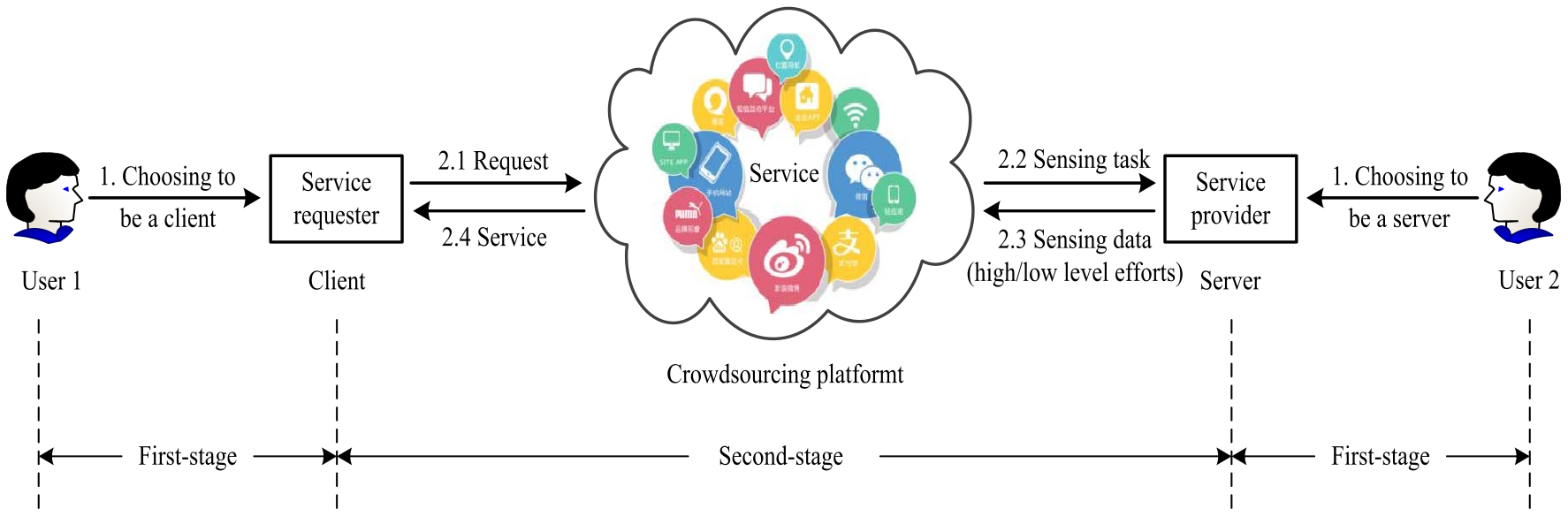 Figure 1: The dual role of users as requesters and providers managed by the platform.
3. Sustainability Constraints
To make this protocol work, it must satisfy two game-theoretic conditions:
- One-Shot Deviation Principle: A user shouldn't be able to gain by cheating just once.
- Principle of Fairness: A user shouldn't be able to gain by only acting as a client and never as a server.
The Optimization Algorithm
The paper formulates the design of these protocols as a non-convex optimization problem. They propose a Two-Stage Two-Step Alternate Algorithm to find the optimal punishment factors ().
The intuition is brilliant: by fixing one punishment factor and optimizing the other, the platform can find the minimal punishment necessary to keep everyone honest. Why minimal? Because excessive punishment reduces social mobility and total welfare.
Experimental Insights
The researchers tested their protocol against various "Intrinsic Parameters" like user patience () and monitoring error ().
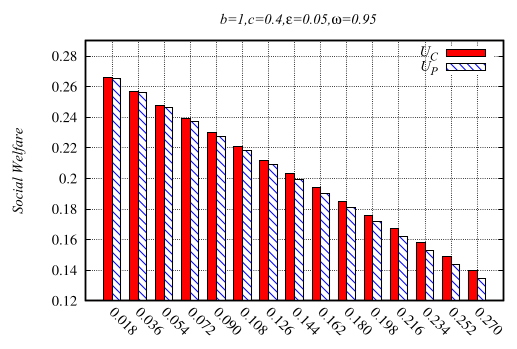 Figure 4: Impact of system costs and monitoring errors on optimal punishment parameters.
Key Findings:
- Patience is Virtue: If users are "patient" (high discount factor ), the protocol requires lower punishment to maintain cooperation.
- The Cost of Noise: As monitoring error () increases, the gap between the protocol's welfare and the social optimum widens, necessitating stricter punishments.
- Fairness Scaling: The protocol successfully forces the client/server ratio () toward 1, preventing "free-riding."
Critical Analysis & Conclusion
Strength
This work moves beyond "monetary incentives" which are often impractical for small-scale knowledge exchanges (like answering a quick question). It provides a mathematical proof that reputation alone, if structured two-sidedly, can sustain a healthy ecosystem.
Limitations
- Binary Simplicity: The model uses binary labels (0 or 1). In the real world, reputation is often a continuous spectrum (e.g., 1-5 stars).
- Rationality Assumption: The model assumes users are perfectly rational agents calculating long-term discounted utilities. Human behavior is often more erratic.
Future Work
The authors suggest extending this to multi-level ratings and continuous action spaces. The next frontier is likely "Bargaining Implementation"—using trial-and-error (Reinforcement Learning) to adjust these parameters in real-time as user behavior evolves.
For platform designers, the message is clear: Rate the requester as much as the provider. Only by balancing the scales can we solve the dilemma of the digital crowd.