
Game Theory on Instagram: The Hidden Cost of "Instafame"
Prediction of online social networks users' behaviors with a game theoretic approach
This paper introduces a game-theoretic framework to model and predict user behavior on Instagram, specifically balancing follower outreach with community health. By defining explicit cost and payoff functions based on real-world data from 50 profiles, it identifies the Nash Equilibrium for optimal community management.
TL;DR
Is it possible to become famous on social media while keeping your community perfectly clean? This paper applies Game Theory to Instagram behavior, modeling users as strategic players who must balance "Outreach" (Payoff) against "Negativity" (Cost). Through data collected from real profiles, the authors quantify a sobering reality: popularity and toxicity are inextricably linked.
The Social Media Dilemma: Growth vs. Sanity
We often view social media success through a single lens: growth. However, every new follower brings potential engagement but also a higher probability of spam and hate speech. This paper identifies a critical gap in social network analysis—the lack of a mathematical framework to predict how users manage this trade-off.
The authors’ core insight is that social media interaction is essentially a two-player game where the goal is to reach an "optimal community"—defined as maximum outreach with minimum negativity.
Methodology: Mapping the Rules of the Game
The researchers defined five key variables (Followers, Likes, Posts, Comments, and Negativity Percentage) to construct two primary functions:
- Payoff Function: Represents a user's outreach and influence.
- Cost Function: Represents the "negativity" (hate/spam) within the community.
Users have two primary strategic actions: Posting (which increases both payoff and cost) and Blocking (which decreases both).
The Model Architecture
The state of an account at time is predicted based on current stats and the moves chosen by the players. The mathematical goal is to find the control policy that satisfies the condition where neither player can improve their community state by unilaterally changing their move—the Nash Equilibrium.
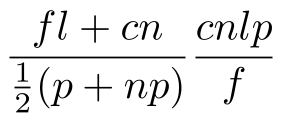 The Payoff and Cost relationship used to determine the utility of account actions.
Key Experimental Findings
By analyzing 50 Instagram profiles, the authors uncovered several patterns that challenge or confirm our intuition about social dynamics:
- The "Tax" on Popularity: There is a strong, linear correlation between the Cost and Payoff functions. This suggests that as your influence grows, the "cost" of managing negativity scales up right along with it.
- Comments Toxicity: Interestingly, the study found no correlation between the total number of comments and the percentage of negative comments. High engagement does not automatically mean a "toxic" community, though the absolute volume of hate increases with scale.
- Follower Power: Follower count remains the strongest predictor for both likes and comment volume, reinforcing the "rich-get-richer" dynamics of social algorithms.
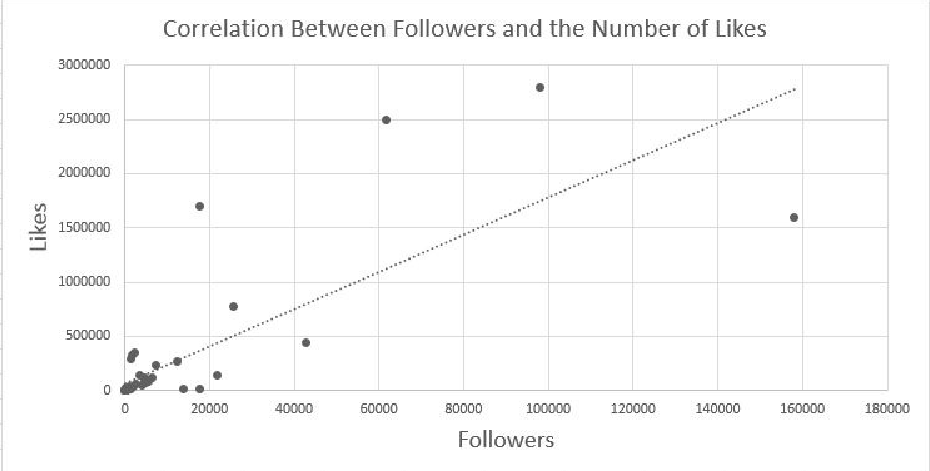 Data shows that engagement (Likes) scales predictably with follower count, providing a solid baseline for the Payoff function.
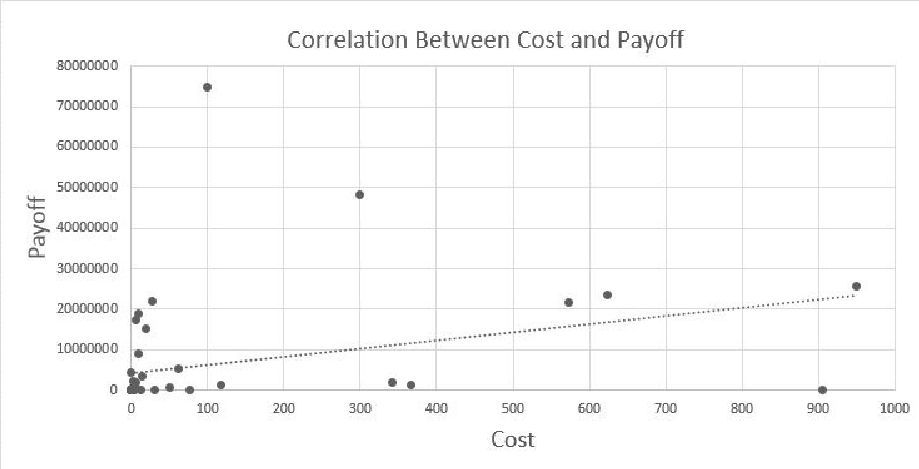 The pivotal finding: Greater outreach (Payoff) is almost always accompanied by greater negativity (Cost).
Critical Analysis & Future Outlook
While the sample size (50 profiles) is relatively small, this work provides a rigorous mathematical foundation for what many influencers feel intuitively.
Limitations:
- The model assumes a "cooperative" environment between users; however, social media is often adversarial (e.g., rivalries or "troll" accounts).
- The "blocking" action is treated as a simple decrease in cost/payoff, but in reality, it may have secondary effects like "shadow-banning" or changing algorithm visibility.
The Takeaway: For platforms like Instagram and X (formerly Twitter), this research highlights that negativity isn't just a bug—it’s a mathematical byproduct of scale. Future research should look into how AI-driven moderation can "cheat" the cost function, allowing payoff to rise without a corresponding spike in community toxicity.