
Game-Theoretic Media Cloud Allocation: Navigating Social Dynamics in Resource Management
Game Theoretic Resource Allocation in Media Cloud With Mobile Social Users
This paper proposes a hierarchical resource allocation scheme for Media Clouds using a four-stage Stackelberg game. It coordinates interactions between the media cloud (resource provider), distributed brokers (middlemen), and mobile social users (consumers) to optimize Quality of Experience (QoE) and economic utility.
Executive Summary
TL;DR: This work introduces a multi-tier resource allocation framework that bridges the gap between Media Clouds and Mobile Social Networks (MSNs). By modeling the system as a four-stage Stackelberg game and integrating evolutionary game theory for user behavior, the authors provide a stable, iterative solution that optimizes profit for providers and Quality of Experience (QoE) for social users.
Background: As multimedia traffic explodes, the "Media Cloud" has emerged as a vital solution. However, we often treat users as isolated entities. This paper argues that social features—like community commonalities and peer-influenced decision-making—are the "missing link" in efficient resource distribution.
The Core Problem: Why Conventional Allocation Fails
Resource allocation in high-traffic scenarios typically ignores two critical factors:
- The Broker Layer: Large media clouds don't interact with millions of users directly; they use distributed brokers. The competition between these brokers adds a layer of complexity.
- Social Contagion: Mobile users in a community aren't independent. They observe each other. If a friend gets better streaming quality on Broker A than you get on Broker B, you switch. Conventional models treat these as fixed or random variables rather than dynamic social behaviors.
Methodology: The Four-Stage Stackelberg Game
The authors decompose the ecosystem into four distinct stages of decision-making, solved via backward induction:
- Stage I (Media Cloud): The "Ultimate Leader" determines the wholesale price () for resources.
- Stage II (Broker Leasing): Brokers decide how much resource () to buy based on the wholesale price.
- Stage III (Broker Pricing): Brokers set a retail price () for their users to maximize profit.
- Stage IV (Mobile Social Users): Users select a broker. This is modeled as an Evolutionary Game. Users use a "Replicator Dynamic"—a biological model of strategy evolution—where they switch to brokers providing higher utility than the community average.
System Architecture
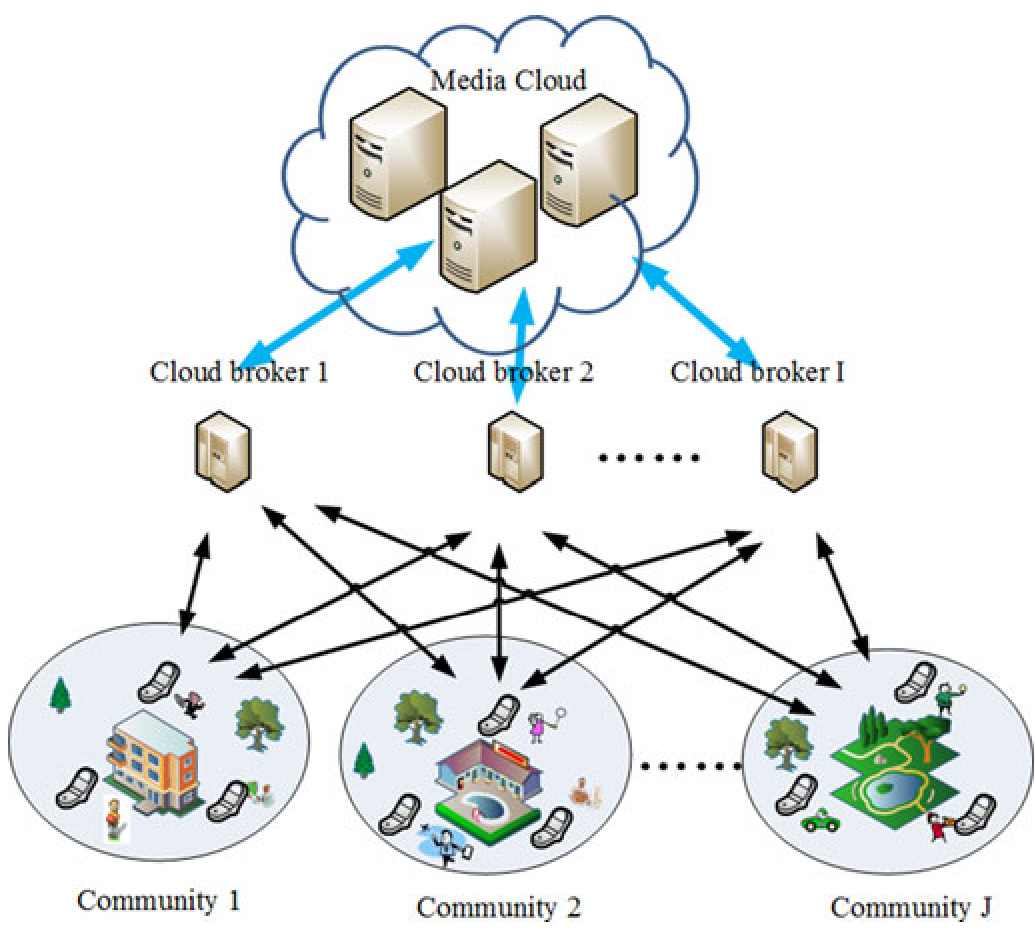 Figure 1: The hierarchical framework involving Media Cloud, Brokers, and Community-based Users.
The mathematical core relies on a QoE model that follows the logarithmic law of human perception: This ensures that the "utility" is not just a technical metric, but a reflection of actual human satisfaction.
Experiments and Results: Stability and Superiority
The paper demonstrates that the proposed iterative algorithm reaches a Stackelberg Equilibrium—a state where no player (Cloud, Broker, or User) can improve their utility by changing strategies alone.
Performance vs. Benchmarks
The authors compared their game-theoretic approach against Uniform Resource Allocation (URA) and Random Resource Allocation (RRA).
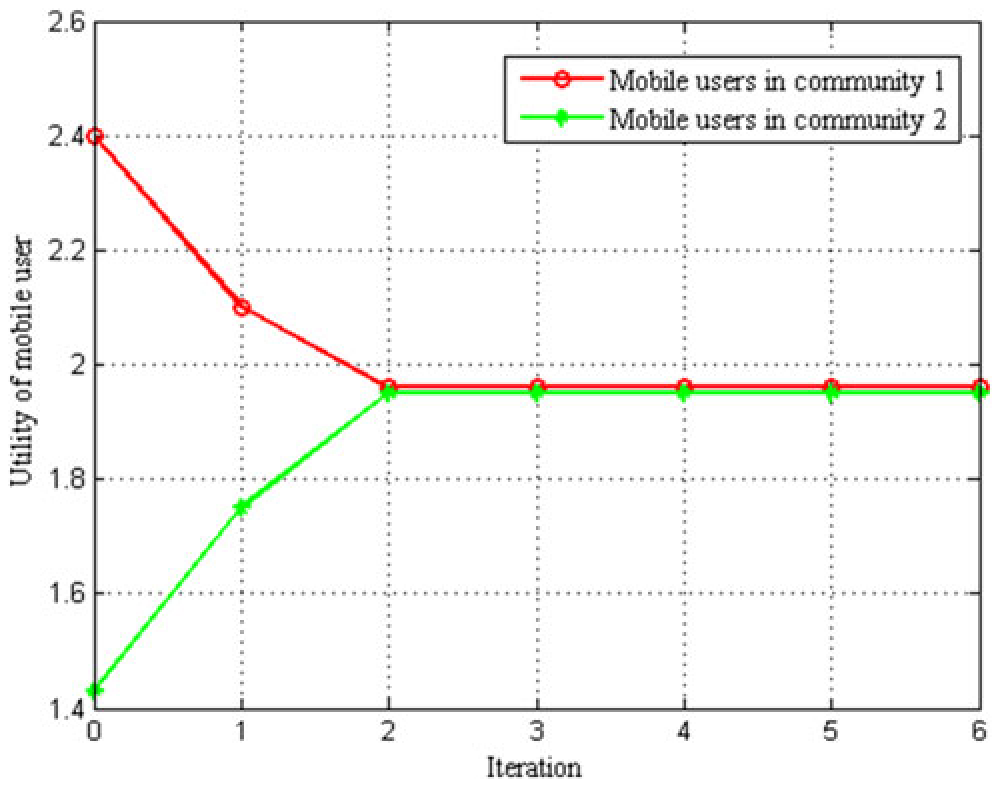 Figure 2: Convergence of the evolution among mobile social users toward the equilibrium.
Key Takeaway from Results:
- User Utility: The proposed method consistently delivers higher utility than RRA or URA because it accounts for specific demand sensitivities within communities.
- Media Response Ratio (MRR): By optimizing the task processing time, the proposed scheme achieved the highest MRR, meaning smoother video playback and fewer "stuttering" events for the end-user.
Critical Analysis & Future Outlook
Insight: The Power of Social Information
The most striking contribution is the use of Evolutionary Replicator Dynamics. By assuming users in a community share information, the model achieves a self-organizing balance. If one broker becomes congested, its utility drops, and the social "pressure" naturally pushes users toward underutilized brokers.
Limitations
- Communication Overhead: The algorithm assumes users in a community can seamlessly exchange utility information. In high-latency or privacy-sensitive scenarios, this might be difficult to implement.
- Homogeneity: The model assumes users in a community have "similar interests." Real-world social networks are often more heterogeneous.
Future Work
The authors plan to investigate information spreading models, specifically how the diffusion of information about resource availability affects the speed at which the equilibrium is reached. In the era of 6G and Edge Computing, this social-aware orchestration will be a cornerstone of network design.
Takeaway for the Industry: To build the next generation of content delivery networks, don't just optimize the hardware; model the social behavior of the people holding the devices.