
GAME: Bridging Geo-Social Optimization with Pairwise Stability
Game-Theoretic Solutions for Constrained Geo-Social Event Organization
The paper introduces a game-theoretic framework for Constrained Geo-Social Event Organization (GSEO), aimed at assigning users to events while minimizing total distance and social costs. It proposes a hybrid approach using "Combined Dynamics" that integrates unilateral deviations and bilateral swaps to reach a stable state, outperforming existing greedy methods in both solution quality and computational efficiency.
TL;DR
The problem of organizing events for millions of social network users is a logistical nightmare involving two conflicting goals: keeping events close to users (spatial) and keeping friends together (social). This paper presents GAME, a game-theoretic framework that treats users as strategic players. By moving beyond simple individual choices to "bilateral swaps" (Pairwise Stability), the authors achieved a 15% better solution quality and a 10x speedup over previous state-of-the-art methods.
Background & Motivation: The Capacity Trap
In Geo-Social Event Organization (GSEO), the goal is to minimize a joint cost function:
- Distance Cost: How far a user travels to an event.
- Social Cost: The penalty for being separated from friends.
Existing solutions typically use greedy algorithms or Nash Equilibrium dynamics. However, capacity constraints (minimum and maximum attendees) act as "walls." If an event is full, a user cannot move there even if it would drastically lower their cost. This creates a sub-optimal equilibrium. The authors realized that while a unilateral move might be blocked, a bilateral swap between two users could bypass these constraints while benefiting everyone involved.
Methodology: The Power of Combined Dynamics
The authors propose a dual-layered iterative process called Combined Dynamics.
1. The Equilibrium Concept
Instead of relying solely on Nash Equilibrium (where no single player wants to move), they introduce Pairwise Stability. In this state, no two players can find a scenario where swapping their assigned events would result in a lower cost for both.
2. The GAME Algorithm
The execution follows three main stages:
- INIT (Sampling-based Initialization): A fast, randomized approach to create a feasible starting point that respects all capacity limits.
- UNI (Unilateral Deviations): Players move individually to better events until no further moves are possible without breaking capacity rules.
- BI (Bilateral Deviations): The algorithm identifies pairs of users who can trade places to mutually reduce their costs.
 The objective function balances distance and social edge weights via a parameter .
To make this efficient for millions of users, the authors developed Event Pair Heaps. Instead of checking every pair of users (which is ), they check pairs of events and maintain heaps of the best potential "candidate" users for swaps, significantly reducing the search space.
Experiments: Speed and Quality
The framework was tested on real-world data from Foursquare (2.1M users) and Gowalla.
Key Performance Insights:
- Efficiency: In a large instance with 128 events, the previous best method (SEOG) took 3.5 hours. GAME finished in just 16 minutes.
- Quality: As the number of events increases, social groups are naturally split, causing costs to rise. However, GAME consistently maintained the lowest cost curve compared to benchmarks.
- Scalability: By utilizing localized heaps and sampling, the complexity remains manageable even as the social graph grows into the millions of edges.
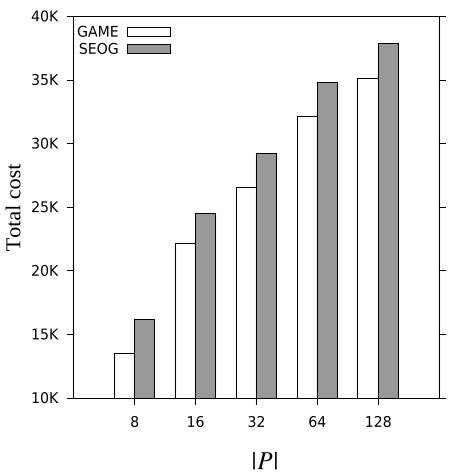 Experimental results on the Gowalla dataset showing GAME (blue) consistently outperforming the competition in cost reduction.
Critical Insight & Conclusion
The true brilliance of this work lies in recognizing that constraints change the game's topology. In an unconstrained world, Nash Equilibrium is sufficient. In a world with physical limits (like venue sizes), "cooperation" via swaps becomes necessary to find the global optimum.
While the paper focuses on social events, this logic is directly applicable to any constrained resource allocation problem—from assigning students to school districts to optimizing cloud server loads where latency (distance) and data dependency (social ties) must be balanced.
Takeaway: If your optimization problem is stuck due to hard constraints, stop looking at individual moves and start looking for "swaps."