
Game Theory in the Shadows: How Colluders Bargain in Multimedia Social Networks
Game-theoretic strategies and equilibriums in multimedia fingerprinting social networks
This paper explores the strategic interactions in multimedia fingerprinting social networks using game theory. It proposes a bargaining model to analyze how colluders reach agreements on risk and reward distribution and identifies the Nash equilibria in the competitive game between colluders and fingerprint detectors.
TL;DR
This research provides a rigorous game-theoretic framework to understand the "honor among thieves" in digital piracy. By modeling colluders in a multimedia social network as rational agents bargaining over risk and reward, the authors identify stable equilibria for attacks. They prove that these bargaining solutions are not just internal agreements but optimal strategies that account for the detector’s best-response actions.
The "Fairness" Problem in Piracy
Digital fingerprinting protects intellectual property by embedding unique labels into media. However, users can collude by averaging their copies to "wash out" the fingerprint. Traditionally, researchers assumed these attackers were a monolith.
The reality is more complex:
- Heterogeneous Resources: Some users have high-resolution (base + enhancement) layers; others have only the base layer.
- Conflicting Interests: A strategy that minimizes risk for User A might expose User B.
- Time Sensitivity: Pirated content loses value exponentially; an agreement reached too late is worth nothing.
Methodology: The Bargaining Arena
The authors define the utility of a colluder as the difference between the Expected Reward (profit from redistributing the copy) and the Expected Risk (loss if caught).
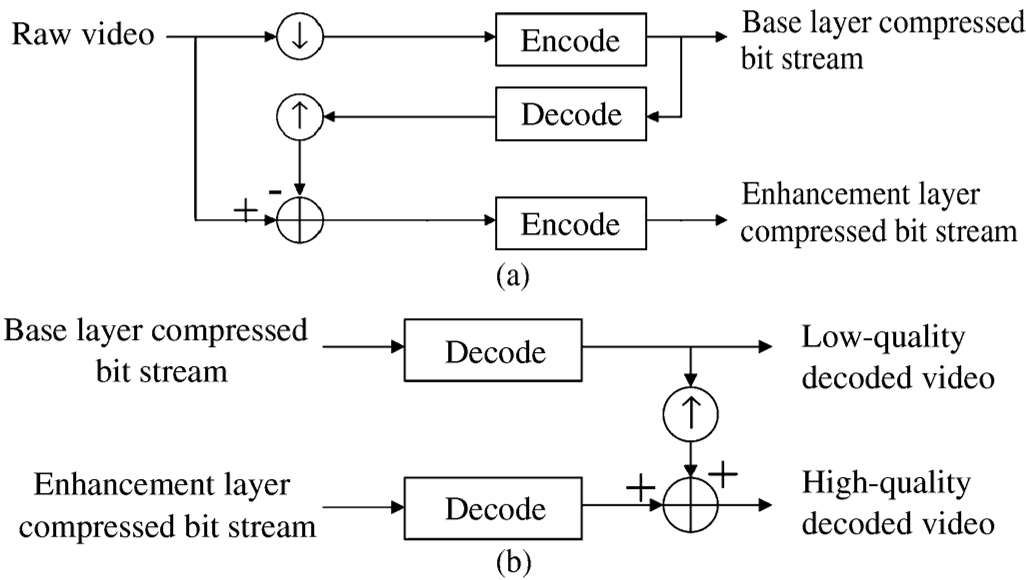 Figure 1: The architecture of a scalable collusion attack across different video layers.
The Four Fairness Criteria
How do colluders decide on the collusion parameter ? The paper evaluates:
- Absolute Fairness: Everyone gets the same utility (mathematically difficult to maintain).
- Max-Min: Maximize the utility of the "weakest" player to ensure participation.
- Max-Sum: Maximize the collective profit (utilitarian approach).
- Nash-Bargaining Solution: A proportional fairness model that accounts for the relative "bargaining power" of different subgroups.
Identifying the Equilibrium
One of the paper's most salient insights is the Time-Sensitive Bargaining Equilibrium. Since the market value of a movie drops after its DVD release, colluders must reach an agreement immediately. It is shown that the "first-mover" (usually the group with higher-resolution copies) has the advantage, and a rational agreement is reached in the very first round to avoid the "decay" of reward.
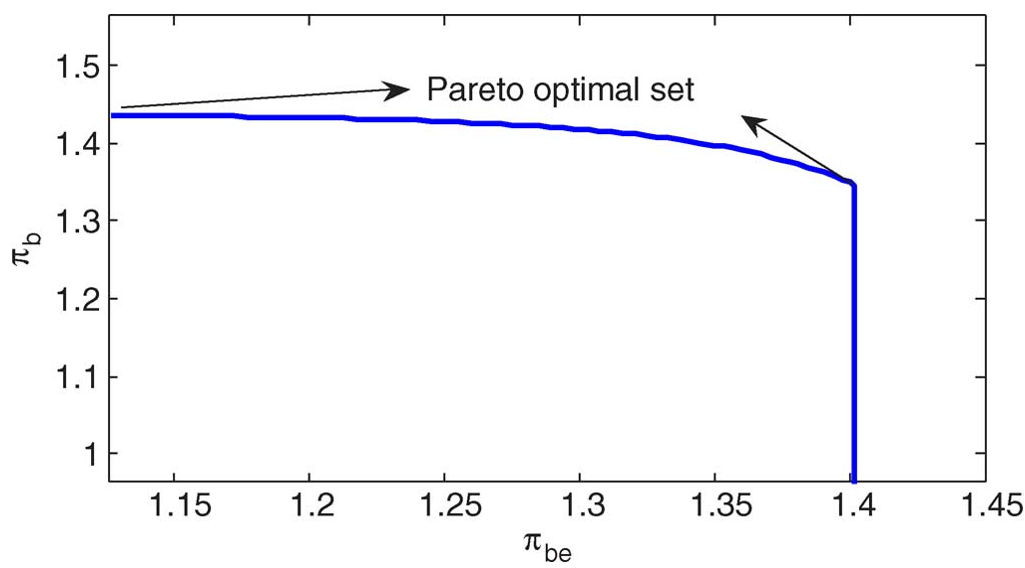 Figure 2: The Pareto-optimal set showing the trade-off between the utilities of different colluder groups.
The Detector-Colluder Game
The interaction isn't just among colluders; it's a Stackelberg Game against the digital rights enforcer.
- The Colluders (Leader): Choose an attack strategy () that satisfies their internal bargaining.
- The Detector (Follower): Employs a "self-probing" detector to observe the attack and choose the statistics that maximize the probability of capture.
The authors prove a critical point: The internal bargaining solutions found by colluders are actually Nash Equilibria in the wider game against the detector. This means that a rational attacker has no incentive to deviate from these "fair" agreements.
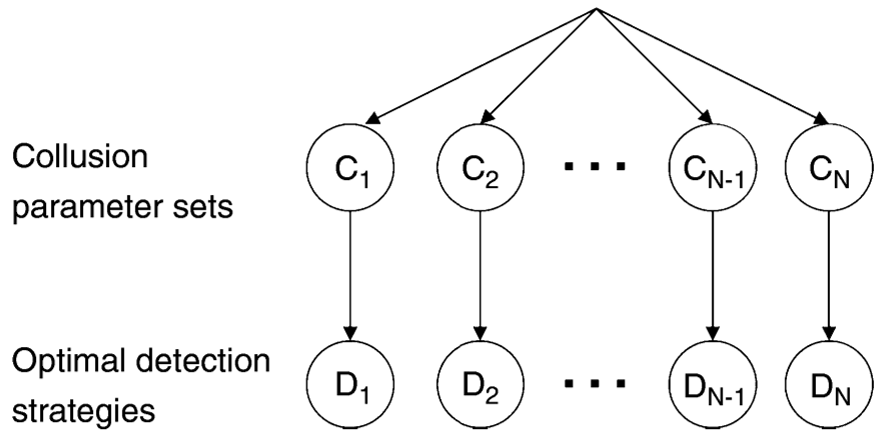 Figure 3: The strategic game tree between colluders and the fingerprint detector.
Critical Insight: The "Cheat-Proof" Nature of Nash
The analysis reveals an interesting behavioral trait: in Absolute Fairness, Max-Min, and Max-Sum models, colluders are incentivized to lie about their perceived risk (loss term ) to gain more reward. However, the Nash-Bargaining solution is cheat-proof—the outcome remains stable even if players attempt to manipulate their private information.
Conclusion
This paper transforms multimedia forensics from a cat-and-mouse game of signal processing into a predictable study of human behavior. By understanding how social structures and economic incentives drive collusion, enforcers can narrow their detection focus to a small, finite set of "rational" attacks, making the protection of digital assets significantly more efficient.